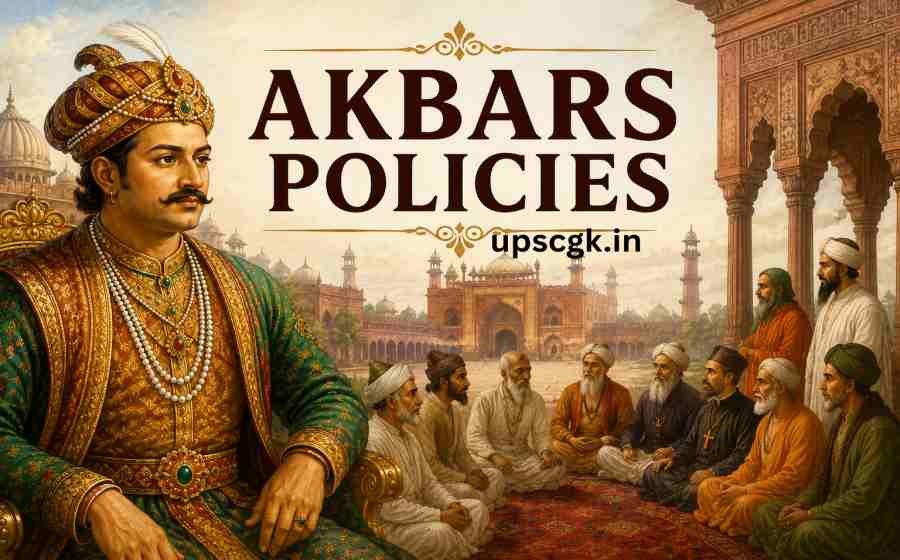
Explore Akbars policies of religious tolerance and governance, including Sulh-i-Kul, administrative reforms and their impact on the Mughal Empire.
Akbars Policies
Akbar is considered one of the greatest rulers in Indian history because of his administrative abilities, inclusive policies, and efforts to create unity among diverse communities. He ruled the Mughal Empire from 1556 to 1605 and transformed it into one of the most powerful and stable empires in India. Unlike many rulers of his time, Akbar understood that maintaining a vast empire required more than military strength. He believed that respect for different cultures, religions, and communities was essential for long-term peace and development.
His policies of religious tolerance and governance played a significant role in strengthening the Mughal Empire. These policies not only increased political stability but also promoted social harmony and economic growth. Akbar’s approach toward administration and religion made him stand out among other medieval rulers.
Table of Contents
Akbar’s Religious Tolerance Policy
India during Akbar’s period was a land of multiple religions, languages, and traditions. Hindus formed the majority population, while Muslims, Jains, Christians, Parsis, and followers of other religions also lived in different parts of the country. Akbar realized that governing such a diverse society required an inclusive approach.
One of Akbar’s most important policies was Sulh-i-Kul, meaning “Universal Peace.” This principle emphasized tolerance and peaceful coexistence among all religions. Under this policy, the emperor attempted to treat all religious groups fairly and reduce discrimination.
Pilgrimage Tax
Akbar abolished several practices that created dissatisfaction among non-Muslims. One of his major steps was the abolition of the pilgrimage tax, which had been imposed on Hindus visiting sacred places. He also removed the Jizya tax, a tax traditionally collected from non-Muslims under Islamic rule. This decision helped improve relations between different communities and increased public support for his administration.
Akbar also invited scholars and religious leaders from various backgrounds for discussions. He established the Ibadat Khana or House of Worship at Fatehpur Sikri. Religious scholars from Islam, Hinduism, Jainism, Christianity, and Zoroastrianism participated in debates and discussions there. Akbar listened to different viewpoints and developed a broader understanding of religious ideas.
His interest in religious harmony eventually led him to introduce Din-i-Ilahi, a spiritual order that attempted to combine positive principles from various religions. However, Din-i-Ilahi did not become widely accepted and remained limited in influence.
Despite this, Akbar’s efforts reflected his desire to create unity among people and reduce religious conflicts within the empire.
Akbar’s Relationship with Rajputs
Akbar understood the importance of political alliances. Rather than relying solely on military conquest, he established friendly relations with powerful Rajput rulers.
He formed alliances through diplomacy and marriage relations with several Rajput kingdoms. Many Rajput leaders were given important positions in the Mughal administration and army. This approach helped reduce rebellions and strengthened the empire.
Rajput nobles remained loyal supporters of Akbar and played a significant role in expanding Mughal power. Their inclusion demonstrated Akbar’s belief that talent and loyalty were more important than religious identity.
Akbar’s Administrative and Governance Policies
Akbar introduced major administrative reforms that made the Mughal Empire efficient and organized. His governance policies created a strong central administration and improved revenue collection.
Central Administration
Akbar divided the administration into different departments to ensure smooth functioning. Important officials assisted him in managing various responsibilities.
Key positions included:
- Wazir – Responsible for financial matters
- Mir Bakshi – Managed military affairs
- Qazi – Handled judicial matters
- Sadr – Supervised religious and charitable activities
This structured system reduced confusion and improved administrative efficiency.
Mansabdari System
One of Akbar’s most important administrative reforms was the Mansabdari System. Under this system, government officials and military officers received ranks called Mansabs.
The rank determined:
- Position in administration
- Salary and privileges
- Number of soldiers to be maintained
This system ensured better control over officials and strengthened the military structure of the empire.
Revenue System
Akbar’s finance minister Raja Todar Mal introduced important land revenue reforms.
Land measurement and classification were conducted to assess agricultural productivity. Revenue was fixed based on average crop production over several years. This system reduced arbitrary taxation and created a more organized method of tax collection.
Farmers benefited because tax rates became more predictable, while the government received stable revenue.
Impact of Akbar’s Policies
Akbar’s policies had long-term effects on Indian society and the Mughal Empire.
Political Stability:
Religious tolerance and inclusion of different communities reduced internal conflicts and strengthened loyalty toward the empire.
Economic Growth:
Improved administration and efficient tax systems increased agricultural and commercial development.
Social Harmony:
His policies encouraged cooperation among different religious and cultural groups.
Administrative Efficiency:
The structured governance system helped manage a large empire effectively.
Summary
Akbar’s policies of religious tolerance and governance played a major role in making the Mughal Empire powerful and stable. His principle of Sulh-i-Kul promoted peace and acceptance among different religious communities, while his administrative reforms strengthened government functioning. Through diplomacy, inclusion, and efficient administration, Akbar created a model of governance that remains significant in Indian history.
His rule demonstrates that successful leadership is not based only on power but also on understanding diversity, promoting unity, and ensuring fair governance for all citizens.
Also Check: History