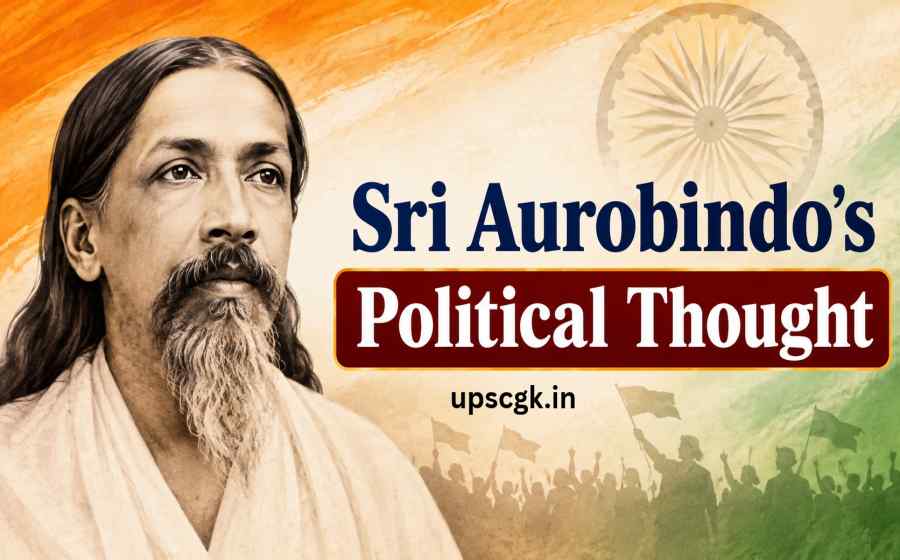
Explore Sri Aurobindos political thought, including nationalism, complete independence, spiritual nationalism and his vision of human unity.
Sri Aurobindos Political Thought
Sri Aurobindo (1872–1950) was an influential Indian philosopher, nationalist, poet and spiritual thinker who made significant contributions to India’s freedom movement and political philosophy. His political ideas combined nationalism, individual liberty, cultural identity and spirituality. Unlike thinkers who viewed nationalism only as a political movement, Sri Aurobindo considered it a deeper force connected with the spiritual and cultural development of a nation.
He believed that India’s struggle for independence was not simply a demand for political freedom but also a movement for national awakening and the revival of its spiritual heritage. His ideas influenced Indian nationalism and continue to hold importance in discussions about freedom, national identity and human development.
Table of Contents
Early Political Influences
Sri Aurobindo received his early education in England and returned to India in 1893. Initially, he worked in Baroda, where he studied Indian history, culture and philosophy while developing his political ideas.
He became increasingly critical of British colonial rule and the moderate approach of early Indian nationalists. He believed that constitutional petitions and appeals to British authorities were insufficient to achieve genuine freedom.
Through newspapers such as Bande Mataram, he promoted assertive nationalism and encouraged Indians to demand complete independence. He became one of the prominent voices advocating Swaraj during the early twentieth century.
Nationalism as a Spiritual Force
One of the central features of Sri Aurobindo’s political thought was his concept of spiritual nationalism. He believed that a nation was more than a geographical territory or a collection of people. It possessed a collective identity, cultural heritage and a deeper spiritual existence.
For him, India was not merely a piece of land but a living manifestation of a collective national consciousness. He regarded the nation as a sacred entity and believed that serving the motherland was a form of service to the Divine.
His nationalism was therefore rooted in love for the country, cultural awareness and spiritual responsibility. He wanted Indians to develop a strong national consciousness rather than remain divided by regional, social and religious differences.
Complete Independence and Swaraj
Sri Aurobindo was among the early Indian political leaders who openly advocated complete independence from British rule.
At a time when many moderate leaders demanded administrative reforms and greater participation in government, he argued that India had the right to govern itself.
He believed that Swaraj meant more than limited political representation. It involved freedom from foreign domination and the ability of Indians to determine their own political, economic and cultural future.
He supported methods such as Swadeshi, national education and passive resistance as instruments of the freedom struggle. These approaches aimed to strengthen Indian society and reduce dependence on British institutions and products.
Criticism of British Colonialism
Sri Aurobindo strongly criticised British imperialism because it denied Indians political freedom and weakened their confidence in their own civilisation.
He believed colonial rule created economic dependence, political subordination and cultural inferiority. He opposed the idea that India needed British guidance to become a developed nation.
According to him, Indians had to recover their self-respect, cultural confidence and national unity to achieve genuine independence.
However, his opposition to colonialism was not based on hatred towards British people. His broader philosophy emphasised human unity and the spiritual progress of humanity.
Swadeshi and National Education
Sri Aurobindo supported the Swadeshi movement, which encouraged Indians to use indigenous goods and strengthen domestic industries.
He viewed economic self-reliance as an important part of political independence. A country that remained economically dependent on a foreign power could not enjoy complete freedom.
He also emphasised national education. He believed that education should develop intellectual ability, moral character, physical strength and spiritual awareness.
Rather than simply producing individuals suitable for colonial administration, education should create responsible citizens with a strong understanding of India’s history, culture and national responsibilities.
Passive Resistance and Political Action
Sri Aurobindo supported passive resistance as a method of opposing colonial authority. It involved refusing cooperation with unjust government institutions and policies.
He advocated the use of boycotts, Swadeshi, national education and organised public action to challenge British rule.
His approach aimed to build national strength through collective participation and self-reliance. He believed that political freedom required courage, discipline and public awareness.
His ideas contributed to the development of more assertive methods within the Indian nationalist movement.
Spirituality and Human Development
Spirituality occupied a central position in Sri Aurobindo’s philosophy. He believed that political and social progress should be connected with the inner development of individuals.
For him, true freedom was not limited to the removal of external restrictions. It also required freedom from ignorance, selfishness and narrow-mindedness.
He developed the philosophy of Integral Yoga, which aimed at the transformation of human consciousness through spiritual development.
He believed that individuals could contribute to society more effectively when they developed higher moral and spiritual values. Thus, his political philosophy connected national progress with personal transformation.
From Nationalism to Human Unity
Although Sri Aurobindo strongly supported Indian nationalism during the freedom struggle, his later philosophy developed towards a broader vision of humanity.
After withdrawing from active politics in 1910 and settling in Pondicherry, he increasingly focused on spiritual practice and philosophical writing.
He argued that nationalism should not become an instrument of hatred, domination or conflict between nations. Instead, national development should contribute to the larger progress of humanity.
In his work The Ideal of Human Unity, he explored the possibilities of international cooperation and the development of a more united human society.
His vision suggested that nations could preserve their identities while working together towards global harmony.
Relevance of Sri Aurobindo’s Political Thought Today
Sri Aurobindo’s political ideas remain relevant in contemporary discussions about nationalism, education, cultural identity and human development.
His emphasis on national self-confidence highlights the importance of preserving cultural heritage while engaging with the modern world.
His understanding of freedom also reminds us that political independence must be accompanied by social responsibility, economic strength and intellectual development.
Furthermore, his vision of human unity offers an important perspective on international cooperation, peace and global challenges.
His philosophy encourages a balance between national interests and universal human values.
Summary
Sri Aurobindo’s political thought represents a distinctive combination of nationalism, freedom and spirituality. He believed that India’s independence was essential for its national regeneration and that true progress required more than political change.
His ideas of spiritual nationalism, Swaraj, Swadeshi, national education and human unity made him an important figure in Indian political thought. By connecting individual transformation with national development and global harmony, Sri Aurobindo presented a vision of freedom that extended beyond colonial independence.
Also Check: Political Science