Explore Nalanda and Takshashila Universities, the greatest centers of ancient Indian education known for knowledge, culture, science and global learning.
Nalanda and Takshashila Universities
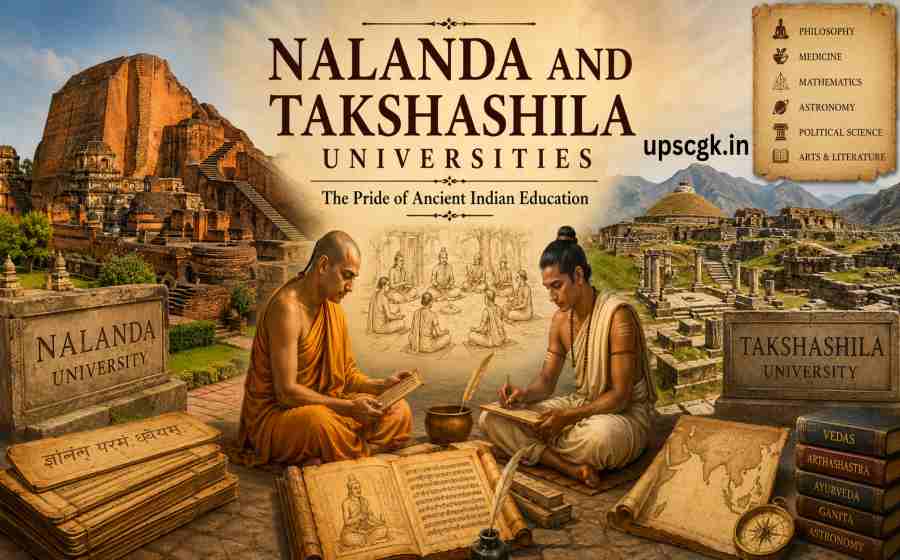
Ancient India was one of the world’s greatest centers of learning and knowledge. Long before modern universities were established in Europe, India had developed highly advanced educational institutions that attracted students from different parts of Asia. Among these institutions, Nalanda and Takshashila Universities were the most famous. These universities became symbols of wisdom, culture, philosophy, science, and intellectual growth. They played an important role in shaping the educational traditions of ancient India and influenced learning systems across the world.
The ancient Indian education system focused not only on bookish knowledge but also on character development, discipline, morality, and practical learning. Students studied under skilled teachers called gurus in an atmosphere of dedication and respect. Education was considered sacred and was closely connected with spiritual and social values.
Table of Contents
Takshashila University – The First Great Center of Learning
Takshashila was one of the earliest universities in the world. It is believed to have existed around the 6th century BCE in the ancient region of Gandhara, which is now located in present-day Pakistan. Takshashila became a major center of higher education and attracted students from India, China, Persia, Greece, and Central Asia.
Unlike modern universities with a fixed campus structure, Takshashila functioned as a collection of schools and teachers. Students chose their subjects and studied under expert scholars. Admission to the university was considered difficult because students needed strong intellectual abilities and discipline.
Subjects Taught at Takshashila
A wide variety of subjects were taught at Takshashila, including:
- Vedas and Sanskrit grammar
- Philosophy and religion
- Mathematics and astronomy
- Medicine and surgery
- Political science and administration
- Warfare and military training
- Commerce and economics
One of the most famous teachers associated with Takshashila was Chanakya, also known as Kautilya. He was the author of the famous political text Arthashastra and the mentor of Chandragupta Maurya. Another famous scholar linked with Takshashila was Panini, who made major contributions to Sanskrit grammar.
Takshashila became popular because it encouraged open discussions, debates, and practical education. Students were trained to think independently and solve problems logically.
Nalanda University – The Jewel of Ancient Indian Education
Nalanda University was another world-famous center of education in ancient India. It was established during the Gupta period in the 5th century CE, most likely under the rule of Kumaragupta I. Nalanda reached its peak between the 5th and 12th centuries CE and became one of the greatest educational institutions in history.
Nalanda was located in present-day Bihar and attracted thousands of students and teachers from countries such as China, Korea, Japan, Tibet, Sri Lanka, and Southeast Asia. It was not just a university but also a great center for Buddhist studies and cultural exchange.
Features of Nalanda University
Nalanda had a well-organized campus with:
- Large classrooms and lecture halls
- Monasteries for students and teachers
- Beautiful gardens and temples
- A massive library with thousands of manuscripts
- Separate hostels for students
Historical records mention that Nalanda had around 10,000 students and 2,000 teachers at its peak. The university followed strict rules and high academic standards. Students had to pass difficult entrance examinations before gaining admission.
Subjects Studied at Nalanda
Students at Nalanda studied various subjects such as:
- Buddhist philosophy
- Logic and reasoning
- Grammar and literature
- Mathematics and astronomy
- Medicine
- Art and architecture
- Politics and law
One of the most famous visitors to Nalanda was the Chinese traveler Xuanzang, who studied there for several years. He wrote detailed accounts about the university’s excellent education system, discipline, and intellectual environment. Another Chinese scholar, Yijing, also praised Nalanda in his writings.
Teaching Methods in Ancient Indian Universities
The teaching methods at Nalanda and Takshashila were highly advanced for their time. Education focused on both theoretical and practical knowledge. Teachers used lectures, debates, discussions, storytelling, and question-answer sessions to help students understand concepts deeply.
Students lived close to their teachers, creating a strong bond between guru and disciple. Discipline, respect, and dedication were considered essential qualities for learning. Education was mostly free, and many kings and wealthy people donated money to support these institutions.
The ancient education system aimed to develop intellectual ability, moral values, and spiritual understanding together. Students were encouraged to live simple lives and focus completely on gaining knowledge.
Importance of Nalanda and Takshashila
Nalanda and Takshashila were not only educational institutions but also centers of cultural and scientific development. They helped spread Indian knowledge, philosophy, mathematics, medicine, and Buddhism across Asia.
These universities proved that ancient India had a highly organized and advanced system of higher education. They encouraged international learning and welcomed students from different countries, religions, and cultures. Their libraries preserved valuable manuscripts and contributed greatly to world knowledge.
The influence of these universities can still be seen in modern educational systems that value research, discussion, residential learning, and international exchange.
Decline of the Ancient Universities
Despite their greatness, both universities eventually declined due to political instability and foreign invasions. Takshashila suffered repeated invasions and gradually lost its importance.
Nalanda University was severely damaged during the invasion of Bakhtiyar Khilji in the 12th century CE. Its famous library was destroyed, and countless manuscripts were burned. This marked a major loss for Indian and world heritage.
However, the legacy of Nalanda and Takshashila continues to inspire scholars and historians even today.
Summary
Nalanda and Takshashila Universities were shining examples of India’s rich educational heritage. They demonstrated the importance of knowledge, discipline, research, and cultural exchange in society. These ancient universities attracted students from across the world and made India a global center of learning.
Their contribution to education, philosophy, science, and culture remains unforgettable. Even in the modern age, Nalanda and Takshashila remind us that India has a deep tradition of intellectual excellence and world-class education.
Also Check: History