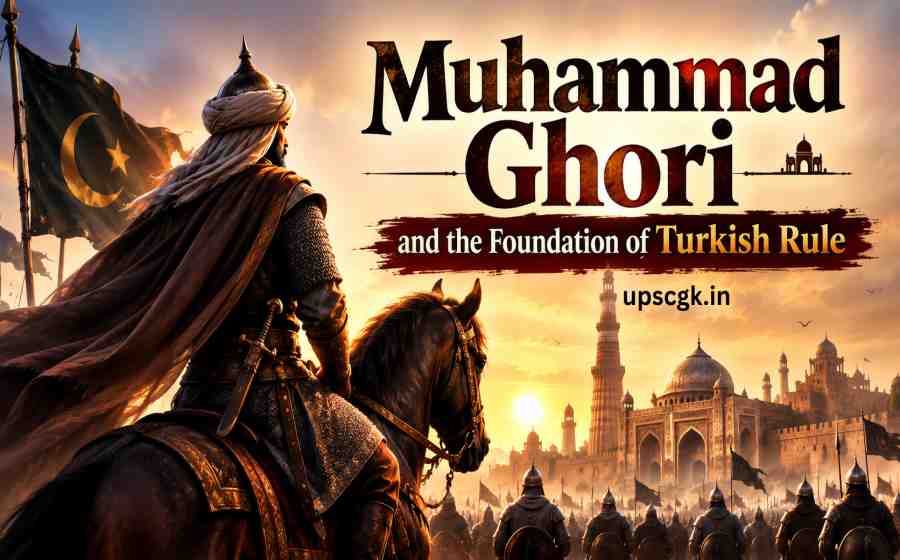
Discover how Muhammad Ghori established the foundation of Turkish rule in India through battles, strategic administration and the rise of the Delhi Sultanate.
Muhammad Ghori
Muhammad Ghori occupies a significant place in Indian history as the ruler who laid the foundation of lasting Turkish rule in northern India. Unlike earlier invaders such as Mahmud of Ghazni, whose campaigns were largely motivated by wealth and military prestige, Muhammad Ghori focused on establishing political control over conquered territories. His military victories, administrative vision, and capable generals paved the way for the emergence of the Delhi Sultanate, which would dominate much of the Indian subcontinent for over three centuries.
Although Muhammad Ghori himself did not establish the Delhi Sultanate, his conquests created the conditions that allowed his trusted slave-general Qutb-ud-din Aibak to found it after Ghori’s death. His campaigns marked a turning point in medieval Indian history by ending the dominance of several Rajput kingdoms in northern India and introducing a new phase of centralized Turkish administration.
Table of Contents
Early Life of Muhammad Ghori
Muhammad Ghori, also known as Mu’izz al-Din Muhammad bin Sam, belonged to the Ghurid dynasty, which ruled the mountainous region of Ghor in present-day Afghanistan. The Ghurids emerged as a powerful force during the 12th century after weakening the influence of the Ghaznavids.
Unlike Mahmud of Ghazni, Ghori inherited a kingdom that sought territorial expansion rather than temporary raids. After consolidating power in Afghanistan, he turned his attention toward northwestern India, recognizing its political fragmentation and strategic importance.
Reasons for the Indian Campaigns
Several factors encouraged Muhammad Ghori to invade India:
- The decline of the Ghaznavid Empire created opportunities for expansion.
- The Rajput kingdoms were politically divided and frequently engaged in internal conflicts.
- India possessed immense agricultural wealth and prosperous trade routes.
- Establishing permanent rule would strengthen the Ghurid Empire against rival Central Asian powers.
Rather than launching isolated raids, Muhammad Ghori aimed to incorporate Indian territories into his expanding empire.
Initial Campaigns in India
Muhammad Ghori’s first major expedition into India began in 1175 CE, when he captured Multan, which was under the control of the Ismaili rulers. He soon occupied Uch and gradually secured parts of Sindh.
In 1178 CE, he attempted to invade Gujarat but suffered a major defeat at the Battle of Kayadara against the Solanki ruler Mularaja II. This setback convinced him to avoid the difficult desert route into western India.
Instead, Muhammad Ghori shifted his focus toward Punjab. He successfully captured Lahore in 1186 CE, defeating the last Ghaznavid ruler, Khusrau Malik. This victory eliminated the Ghaznavids and established a secure base for further expansion into northern India.
The First Battle of Tarain (1191 CE)
The most significant challenge before Muhammad Ghori was the powerful Rajput ruler Prithviraj Chauhan III, who controlled Ajmer and Delhi.
In 1191 CE, the two armies met at the First Battle of Tarain near present-day Haryana.
During the battle:
- Rajput cavalry and war elephants launched strong attacks.
- Muhammad Ghori was wounded.
- The Ghurid army suffered defeat and retreated.
Prithviraj Chauhan achieved a remarkable victory, but he failed to pursue the retreating Ghurid forces decisively. This allowed Muhammad Ghori to reorganize and prepare for another invasion.
The Second Battle of Tarain (1192 CE)
One year later, Muhammad Ghori returned with a larger and better-organized army.
The Second Battle of Tarain (1192 CE) became one of the most decisive battles in Indian history.
Muhammad Ghori introduced several tactical improvements:
- Highly mobile cavalry units.
- Mounted archers employing hit-and-run tactics.
- Better battlefield coordination.
- Strategic exhaustion of Rajput forces before launching the final assault.
The Rajput army was decisively defeated, and Prithviraj Chauhan was captured. The victory at Tarain transformed the political landscape of northern India. Delhi and Ajmer soon came under Ghurid control, opening the way for further expansion.
Expansion After Tarain
Following the victory, Muhammad Ghori entrusted the administration of conquered territories to his loyal generals, especially Qutb-ud-din Aibak.
Over the next few years:
- Delhi became the administrative center.
- Ajmer was secured.
- Rajput resistance was gradually suppressed.
- Turkish authority expanded across the Ganga-Yamuna Doab.
Muhammad Ghori did not remain permanently in India but relied on trusted military commanders to govern the conquered regions.
The Battle of Chandawar (1194 CE)
Another major obstacle to Turkish expansion was Jayachandra, the ruler of the Gahadavala dynasty of Kannauj.
In 1194 CE, Muhammad Ghori defeated Jayachandra at the Battle of Chandawar.
This victory had far-reaching consequences:
- Kannauj came under Turkish influence.
- Varanasi was captured.
- Large parts of the fertile Gangetic Plain were incorporated into Ghurid territories.
- Rajput political dominance weakened further.
The conquest significantly strengthened Turkish authority in northern India.
Role of Qutb-ud-din Aibak
One of Muhammad Ghori’s greatest strengths was his ability to select capable military commanders.
Among them, Qutb-ud-din Aibak played the most important role.
He:
- Administered newly conquered territories.
- Suppressed rebellions.
- Expanded Turkish influence into Rajasthan and central India.
- Established effective military administration.
After Muhammad Ghori’s death in 1206 CE, Aibak declared independence and founded the Delhi Sultanate, becoming its first ruler.
Administrative Policies
Muhammad Ghori understood that military victories alone could not sustain an empire.
His administrative measures included:
- Appointment of loyal Turkish governors.
- Construction of military garrisons in strategic locations.
- Revenue collection through local officials.
- Delegation of authority to trusted slave-generals (Mamluks).
This decentralized yet disciplined system ensured that the conquered territories remained under effective control.
Death of Muhammad Ghori
In 1206 CE, Muhammad Ghori was assassinated while returning from Lahore to Ghazni. The exact identity of his assassins remains uncertain, with historical accounts attributing the attack to different groups.
Since he left no direct heir, his vast empire fragmented. However, his Indian territories remained under the control of Qutb-ud-din Aibak, who transformed them into an independent kingdom.
Foundation of Turkish Rule in India
Muhammad Ghori’s greatest contribution was not merely his military victories but the political system he established.
His achievements include:
- Ending the dominance of major Rajput powers in northern India.
- Introducing stable Turkish administration.
- Making Delhi the center of political authority.
- Creating conditions for the establishment of the Delhi Sultanate.
- Promoting the Mamluk system of governance through trusted slave-generals.
Unlike earlier conquerors who focused on plunder, Muhammad Ghori sought to establish a permanent state that continued long after his death.
Historical Significance
Historians regard Muhammad Ghori as one of the architects of medieval India’s political transformation. His victories at Tarain and Chandawar reshaped the balance of power in northern India and enabled the rise of a centralized Turkish state.
The institutions developed under his rule influenced successive dynasties, including the Mamluks, Khaljis, Tughlaqs, Sayyids, and Lodis. These dynasties collectively governed large parts of India for more than three centuries, leaving a lasting impact on administration, military organization, architecture, and culture.
Summary
Muhammad Ghori occupies a unique place in Indian history because he transformed military conquest into enduring political control. His campaigns were not temporary raids but carefully planned efforts to establish lasting authority over northern India. Through decisive victories, capable generals, and effective administration, he laid the foundation of Turkish rule that ultimately evolved into the Delhi Sultanate.
Although he did not personally rule India for long, his vision and policies changed the course of medieval Indian history. The political institutions created under his leadership continued to shape the subcontinent for generations, making Muhammad Ghori one of the most influential figures in the establishment of Turkish rule in India.
Also Check: History