Learn about Mahmud of Ghazni’s campaigns, invasions of India, military achievements, administration and lasting legacy in medieval Indian history.
Mahmud of Ghazni
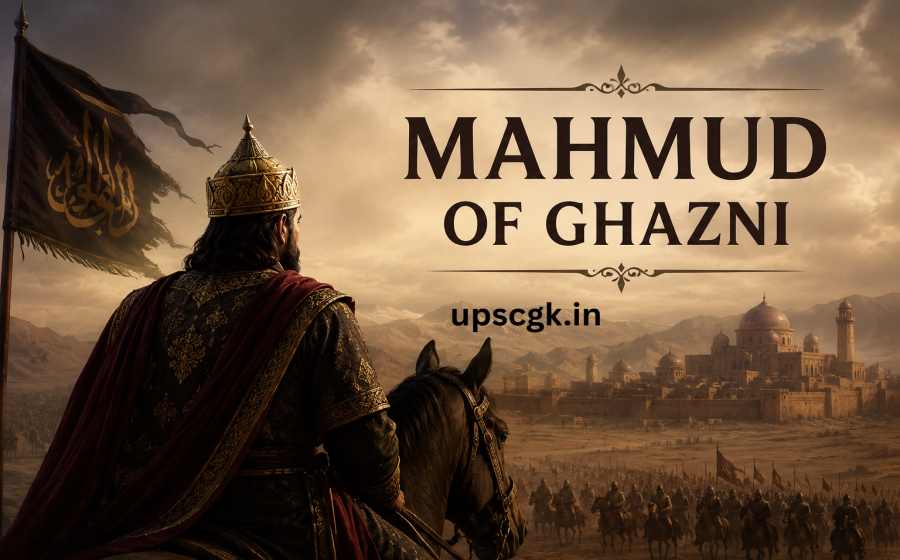
Mahmud of Ghazni remains one of the most influential and controversial rulers in medieval Asian history. As the ruler of the Ghaznavid Empire from 998 CE to 1030 CE, he transformed Ghazni into a powerful political and cultural center while launching numerous military expeditions into the Indian subcontinent. His campaigns brought immense wealth to his empire, expanded his influence across Central Asia, and significantly impacted the political landscape of northern India.
Although Mahmud never established a permanent empire in India, his repeated invasions weakened several regional kingdoms and laid the foundation for later Turkish conquests that eventually resulted in the establishment of the Delhi Sultanate.
Table of Contents
Early Life and Rise to Power
Mahmud was born in 971 CE to Sabuktigin, the founder of the Ghaznavid dynasty. Sabuktigin had established control over Ghazni (present-day Afghanistan) after serving under the Samanid rulers.
After Sabuktigin’s death in 997 CE, a succession struggle broke out between Mahmud and his brother Ismail. Mahmud defeated Ismail in 998 CE and became the ruler of the Ghaznavid Empire.
A capable military commander and administrator, Mahmud rapidly expanded his kingdom across parts of Afghanistan, Iran, Central Asia, and present-day Pakistan.
Expansion of the Ghaznavid Empire
Mahmud’s primary objective was to strengthen and enlarge his empire. Before concentrating on India, he defeated several rivals in Central Asia and Persia.
His empire eventually stretched from:
- Khorasan
- Afghanistan
- Khwarezm
- Parts of Iran
- Punjab
This vast territory made the Ghaznavid Empire one of the strongest Islamic kingdoms of its time.
Mahmud’s Campaigns in India
Mahmud is best remembered for his repeated invasions of India. Historical records mention seventeen campaigns between 1000 CE and 1027 CE.
His objectives included:
- Acquiring enormous wealth
- Expanding political influence
- Strengthening the Ghaznavid treasury
- Demonstrating military supremacy
- Controlling strategic frontier regions
Unlike later rulers, Mahmud generally did not seek to establish permanent rule over most of northern India, except for Punjab, which became an important Ghaznavid province.
Major Campaigns
1. Battle of Peshawar (1001 CE)
Mahmud defeated Hindu Shahi ruler Jayapala near Peshawar.
This victory marked the beginning of Turkish military dominance in northwestern India. Following the defeat, Jayapala is said to have abdicated and later committed self-immolation according to historical accounts.
2. Campaign Against Anandapala (1008 CE)
Jayapala’s successor, Anandapala, formed a confederacy of Rajput rulers to resist Mahmud.
Despite fierce resistance, Mahmud emerged victorious near Waihind. This battle significantly weakened the Hindu Shahi kingdom and expanded Ghaznavid influence in Punjab.
3. Conquest of Multan
Mahmud launched campaigns against Multan to suppress rulers whom he considered politically unreliable.
The conquest strengthened his control over the northwestern frontier and secured important trade routes.
4. Raid on Thanesar (1014 CE)
Thanesar was an important religious center.
Mahmud captured the city and carried away considerable wealth, further enhancing the financial strength of his empire.
5. Expedition to Mathura and Kannauj (1018 CE)
Mahmud invaded the prosperous cities of Mathura and Kannauj, both renowned for their temples and wealth.
Contemporary chroniclers describe the immense riches acquired during these expeditions, although the exact figures remain debated by historians.
6. Attack on the Somnath Temple (1025 CE)
The most famous of Mahmud’s campaigns was his expedition against the Somnath Temple in present-day Gujarat.
The temple was an important pilgrimage center and possessed considerable wealth accumulated through donations.
After a difficult march across the Thar Desert, Mahmud captured the temple, seized its treasures, and returned to Ghazni.
This campaign became one of the defining events of his reign and remains widely discussed in historical and political debates.
Military Strategy
Mahmud was regarded as one of the finest military commanders of his era.
His success was based on:
- Highly mobile cavalry
- Skilled horse archers
- Well-trained professional army
- Effective intelligence network
- Careful logistical planning
- Surprise attacks and rapid movement
His disciplined forces often outmaneuvered larger but less coordinated armies.
Administration and Governance
Mahmud was not only a conqueror but also an efficient administrator.
His administration featured:
- Centralized authority
- Efficient tax collection
- Provincial governors
- Strong military organization
- Promotion of trade
The wealth obtained from military campaigns helped finance governance, public works, and the army.
Patron of Art and Learning
One of Mahmud’s lasting achievements was his patronage of scholarship and culture.
The city of Ghazni became an important intellectual center.
His court attracted distinguished scholars including:
- Al-Biruni, who wrote extensively about India’s geography, science, religion, and society.
- Firdausi, the celebrated Persian poet and author of the Shahnameh, though his relationship with Mahmud became strained over issues of patronage.
Mahmud also commissioned mosques, libraries, palaces, and educational institutions, enhancing Ghazni’s reputation across the Islamic world.
Impact of His Indian Campaigns
Mahmud’s invasions had far-reaching consequences.
Political Impact
- Weakened several regional kingdoms.
- Reduced the power of the Hindu Shahis.
- Facilitated later Turkish expansion into northern India.
- Strengthened Ghaznavid control over Punjab.
Economic Impact
- Large quantities of wealth were transferred from Indian kingdoms to Ghazni.
- Ghazni developed into a prosperous imperial capital.
- Many Indian rulers invested more resources in military defense.
Cultural Impact
Mahmud’s campaigns increased contact between Central Asia and the Indian subcontinent.
Although his invasions caused destruction in some regions, they also contributed to greater interaction in trade, scholarship, architecture, and administration between the two regions over time.
Legacy of Mahmud of Ghazni
Mahmud’s legacy is interpreted differently by historians.
Supporters view him as:
- A brilliant military strategist.
- Builder of a powerful empire.
- Patron of Persian literature and Islamic scholarship.
- Administrator who strengthened state institutions.
Critics emphasize:
- The destruction associated with some of his raids.
- Temple plundering during several campaigns.
- Heavy reliance on military expeditions for wealth.
Modern historians generally examine Mahmud within the broader political, economic, and military context of the 11th century rather than through a single perspective.
Historical Importance
Mahmud of Ghazni occupies an important place in medieval history because he:
- Expanded the Ghaznavid Empire into one of the leading powers of Central Asia.
- Conducted repeated campaigns into the Indian subcontinent between 1000 and 1027 CE.
- Weakened several north Indian kingdoms, particularly the Hindu Shahis.
- Transformed Ghazni into a renowned center of culture, learning, and architecture.
- Patronized eminent scholars such as Al-Biruni and Firdausi.
- Created conditions that influenced subsequent Turkish expansion and, indirectly, the emergence of the Delhi Sultanate.
Summary
Mahmud of Ghazni was one of the most significant rulers of the 11th century. His military campaigns reshaped political dynamics across Central Asia and northwestern India, while his administrative reforms and patronage of art and scholarship elevated Ghazni into a flourishing imperial capital. Although his legacy continues to generate debate due to the nature of his Indian expeditions, his influence on medieval history is undeniable. Understanding Mahmud’s campaigns and legacy provides valuable insight into the political transformations that preceded the establishment of Turkish rule in northern India and the eventual rise of the Delhi Sultanate.
Also Check: History