Discover MN Roy’s Radical Humanism, political ideas and journey from Marxism to individual freedom, rationalism, ethical values and radical democracy today.
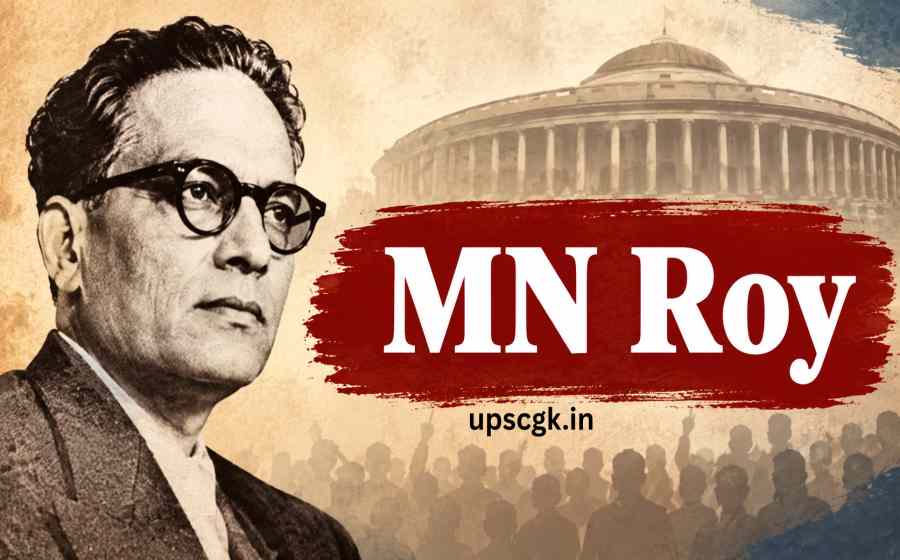
MN Roy
Manabendra Nath Roy (M. N. Roy) was an influential Indian revolutionary, political philosopher and social thinker who made a significant contribution to modern Indian political thought. Initially associated with revolutionary nationalism and Marxism, he later developed an independent political philosophy known as Radical Humanism or New Humanism.
His political ideas focused on individual freedom, rational thinking, scientific outlook, democracy and ethical values. Roy believed that the ultimate purpose of politics should be the development and liberation of human beings rather than the concentration of power in the hands of the state or any political organisation.
Table of Contents
Early Life and Political Journey
M. N. Roy was born on 21 March 1887 in Bengal. His original name was Narendra Nath Bhattacharya. During his early years, he became involved in revolutionary activities against British colonial rule in India.
During the First World War, he travelled abroad and eventually reached Mexico, where he became actively involved in socialist and communist movements. He played an important role in establishing the Mexican Communist Party in 1919.
Later, Roy became associated with the international communist movement and participated in the Communist International. He also contributed to the development of communist ideas in India.
After returning to India in 1930, he was arrested by the British colonial government and imprisoned. Following his release in 1936, he joined the Indian National Congress but later developed serious differences with its leadership.
In 1940, he established the Radical Democratic Party. However, his political thinking gradually moved away from conventional communism towards a philosophy based on individual freedom and human values.
In 1948, he dissolved the Radical Democratic Party and began developing the Radical Humanist Movement. His ideas were mainly presented in New Humanism: A Manifesto (1947) and his Twenty-Two Theses on Radical Democracy.
Transition from Marxism to Radical Humanism
One of the most important aspects of M. N. Roy’s political thought was his intellectual transition from Marxism to Radical Humanism.
Initially, Roy strongly supported Marxism because he believed that capitalism created economic inequality and exploitation. He considered revolutionary movements necessary for establishing a more equal society.
However, with time, he became critical of certain aspects of Marxist philosophy and communist political practices.
He disagreed with the excessive emphasis on economic factors in explaining historical development. According to Roy, human history was influenced not only by economic conditions but also by intellectual, cultural and ethical factors.
He also criticised the dictatorship of the proletariat and the concentration of political power in a single party or state.
Roy believed that a revolution could not be considered successful if it destroyed individual liberty in the name of collective welfare.
Consequently, he developed Radical Humanism, which placed human beings, reason and freedom at the centre of political and social development.
Radical Humanism: Meaning and Philosophy
Radical Humanism, also known as New Humanism, was the central philosophy of M. N. Roy’s later political thought.
It was based on the belief that human beings possess the ability to think rationally, make independent decisions and improve society through scientific knowledge and ethical behaviour.
Roy argued that individuals should not remain dependent on religious authorities, political leaders or unquestionable ideologies.
The main objective of Radical Humanism was to create a society where every individual could enjoy freedom, dignity and opportunities for intellectual and social development.
Its important principles included:
1. Individual Freedom
Roy considered individual freedom the foundation of a progressive society. He believed that society and political institutions should exist to protect and promote individual liberty.
For him, the freedom of individuals was more important than the unrestricted power of the state.
2. Reason and Scientific Outlook
Roy strongly supported rational thinking and scientific investigation. He opposed blind faith, superstition and dogmatic beliefs.
According to him, human beings should use reason and scientific knowledge to understand social problems and find practical solutions.
3. Humanism and Moral Values
Roy believed that politics should be guided by ethical principles and concern for human welfare.
He argued that social progress required individuals with moral responsibility, independent thinking and respect for human dignity.
4. Opposition to Authoritarianism
Roy opposed authoritarian political systems, including communist dictatorships. He believed that no political party, leader or government should exercise unlimited authority over individuals.
5. Universal Humanism
Roy’s philosophy extended beyond nationalism and narrow political identities. He supported a universal humanist outlook based on cooperation, equality and respect for humanity.
MN Roy’s Concept of Radical Democracy
Another major contribution of Roy was his concept of Radical Democracy, also known as Organised Democracy.
He believed that conventional parliamentary democracy had several limitations. In his opinion, democracy should not be restricted to voting during elections or choosing representatives every few years.
He argued that ordinary citizens should participate continuously and directly in political decision-making.
Roy proposed a decentralised democratic system based on local organisations and people’s participation.
The major features of his concept of Radical Democracy were:
- Decentralisation of Power: Political authority should be distributed among local democratic institutions rather than concentrated in a central government.
- Active Citizen Participation: People should participate regularly in public affairs and decision-making.
- Organised Local Communities: Local democratic organisations should form the foundation of the political system.
- Political Accountability: Representatives and public authorities should remain answerable to citizens.
- Partyless Democracy: Roy gradually came to believe that political parties encouraged competition for power and weakened genuine democratic participation.
His idea of partyless democracy aimed to encourage independent political participation rather than making citizens dependent on political parties.
Criticism of M. N. Roy’s Political Thought
Although Roy made important contributions to political philosophy, his ideas also faced criticism.
Some Marxist thinkers disagreed with his rejection of Marxism and argued that he underestimated the importance of economic structures and class struggles.
His concept of partyless democracy was also criticised as difficult to implement in large and politically diverse societies.
Furthermore, critics questioned whether decentralised democratic institutions could effectively manage complex national issues without strong political coordination.
Despite these limitations, Roy’s ideas remain important for understanding individual liberty, democratic participation and the relationship between individuals and the state.
Contribution to Indian Political Thought
M. N. Roy occupies a distinctive position in modern Indian political thought because of his independent approach to political philosophy.
His journey from revolutionary nationalism to communism and finally to Radical Humanism demonstrates his willingness to reconsider established ideologies.
His emphasis on individual freedom, scientific thinking, secular values and democratic participation contributed to discussions on the nature of democracy and social progress.
His political philosophy also encouraged people to question authoritarianism and develop independent political judgement.
Although Radical Humanism did not become a dominant political movement in India, its ideas continue to offer an alternative perspective on democracy, freedom and human development.
Summary
M. N. Roy was a revolutionary thinker whose political philosophy evolved significantly throughout his life. His transition from Marxism to Radical Humanism reflected his growing belief that economic equality alone could not guarantee human freedom.
Through Radical Humanism, he placed individual liberty, reason, scientific outlook and ethical responsibility at the centre of political development.
His concept of Radical Democracy further emphasised decentralisation and active public participation in governance.
Ultimately, M. N. Roy believed that the real measure of a progressive society was the freedom and dignity enjoyed by its individuals. His political thought remains a valuable contribution to modern Indian political philosophy.
Also Check: Political Science