Explore BR Ambedkars political thought on equality, democracy, liberty and social justice and his vision of an inclusive Indian society.
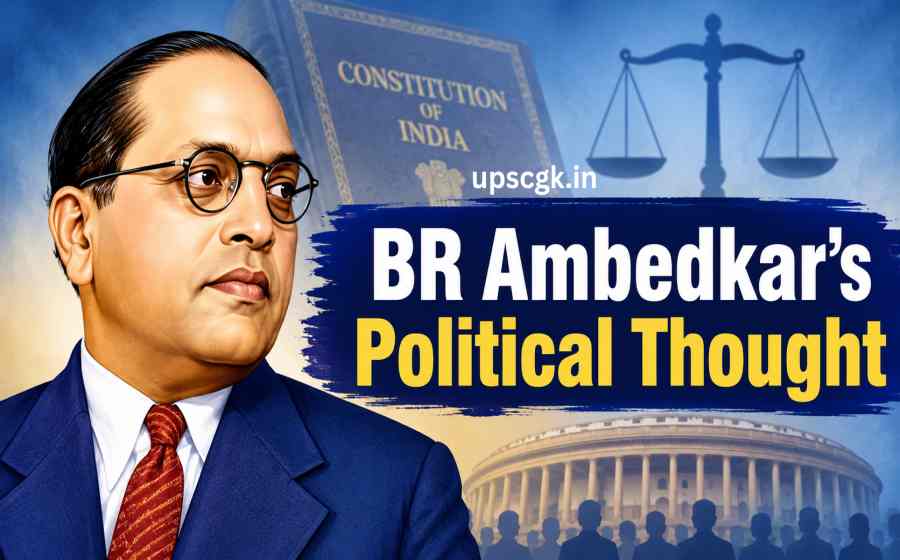
BR Ambedkars Political Thought
Dr. Bhimrao Ramji Ambedkar was one of the most influential thinkers, social reformers and political leaders in modern Indian history. Popularly known as Babasaheb Ambedkar, he played a central role in drafting the Indian Constitution and worked throughout his life to establish a society based on equality, liberty, justice and human dignity. His political philosophy focused on eliminating caste discrimination, protecting individual rights and creating equal opportunities for all citizens.
Ambedkar believed that political freedom alone was not enough to build a truly democratic nation. Social and economic equality were equally important. His ideas continue to influence Indian democracy, constitutional governance and social justice movements.
Table of Contents
Concept of Equality
Equality was one of the central principles of Ambedkar’s political thought. He strongly opposed the caste system, untouchability and social discrimination, which denied millions of people equal rights and opportunities.
He argued that every individual should enjoy equal status regardless of caste, religion, gender or social background. According to him, a society divided by caste could never become a genuinely democratic society.
Ambedkar demanded:
- Equal rights and opportunities for all citizens.
- Abolition of untouchability and caste-based discrimination.
- Equal access to education, employment and public facilities.
- Protection of historically disadvantaged communities.
He believed that legal equality must be supported by social equality. Without removing social barriers, constitutional rights would remain incomplete in practice.
Democracy and Its Meaning
Ambedkar viewed democracy as much more than a system of elections or majority rule. For him, democracy was a way of life based on mutual respect, equality and peaceful cooperation.
He believed that political democracy could not survive without social democracy. A country might have elections and constitutional institutions, but deep social inequalities could weaken its democratic foundations.
Ambedkar identified three essential principles of social democracy:
- Liberty: Every individual should have freedom of thought, expression, belief and action.
- Equality: All individuals should enjoy equal status and opportunities.
- Fraternity: Citizens should develop a sense of brotherhood and mutual respect.
He considered these principles interconnected and necessary for the successful functioning of democracy.
Social Justice and the Annihilation of Caste
Social justice was at the heart of Ambedkar’s political philosophy. He believed that the caste system was a major obstacle to India’s social progress and national unity.
In his famous work Annihilation of Caste (1936), Ambedkar criticised the traditional caste structure and argued that meaningful social reform required the destruction of caste-based inequalities.
He supported measures that could improve the position of oppressed and disadvantaged communities, including:
- Access to quality education.
- Equal employment opportunities.
- Political representation for marginalised groups.
- Legal safeguards against discrimination.
- Economic and social empowerment.
Ambedkar believed that social justice was not simply about providing assistance to disadvantaged people; it was about ensuring dignity, equal rights and meaningful participation in society.
Role in the Making of the Indian Constitution
Ambedkar played a significant role in shaping the Constitution of India. On 29 August 1947, he was appointed Chairman of the Drafting Committee of the Constituent Assembly.
He believed that the Constitution should protect individual freedoms, establish equality before the law and provide safeguards for weaker sections of society.
Several constitutional provisions reflect his commitment to social justice:
- Article 14: Guarantees equality before the law and equal protection of the laws.
- Article 15: Prohibits discrimination on specified grounds.
- Article 16: Provides equality of opportunity in public employment.
- Article 17: Abolishes untouchability.
- Article 32: Guarantees the right to constitutional remedies for enforcing Fundamental Rights.
Ambedkar also supported constitutional safeguards and affirmative action to improve the representation and opportunities of historically disadvantaged communities.
Political and Economic Democracy
Ambedkar believed that democracy should extend beyond political institutions and elections. It should also address economic inequalities and provide citizens with opportunities to improve their living conditions.
He warned that India would enter a period of contradictions after independence: political equality would exist through universal voting rights, while social and economic inequalities would continue.
He supported:
- Equal opportunities in education and employment.
- Economic empowerment of disadvantaged communities.
- Protection of workers’ rights.
- Fair distribution of opportunities and resources.
- Government policies aimed at reducing social and economic inequalities.
For Ambedkar, democracy could not become meaningful if a large section of society remained economically dependent and socially disadvantaged.
Constitutional Morality and Rule of Law
Ambedkar strongly supported constitutional methods for achieving political and social change. He believed that democratic institutions must function according to constitutional principles rather than personal authority or political pressure.
He emphasised constitutional morality, respect for democratic procedures, accountability and the rule of law.
In his final speech to the Constituent Assembly on 25 November 1949, he warned against the dangers of hero-worship in politics and stressed the importance of constitutional methods.
He believed that citizens and political leaders must respect democratic institutions and avoid unconstitutional methods when seeking political change.
Ambedkar’s Vision of an Inclusive Society
Ambedkar wanted India to become a society where every individual could live with dignity and enjoy equal rights. He believed education, social reform and political participation were essential tools for achieving this vision.
His famous message, “Educate, Agitate, Organize,” reflected his emphasis on awareness, collective action and organised efforts to challenge injustice.
In 1956, he embraced Buddhism along with many followers, reflecting his continued search for a social and ethical framework based on equality, compassion and human dignity.
His vision was not limited to any particular community. He wanted a democratic India in which social discrimination, untouchability and inequality had no place.
Summary
Dr. B. R. Ambedkar’s political thought was built around equality, liberty, fraternity, democracy and social justice. He understood that political independence alone could not create a fair society without eliminating caste discrimination and economic inequality.
His contribution to the Indian Constitution provided a strong foundation for democratic governance and the protection of individual rights. Even today, his ideas remain relevant in discussions about social equality, constitutional values, human rights and inclusive development.
Also Check: Political Science