Explore the BRICS Jaipur Declaration 2026, its key tourism priorities, AI initiatives, sustainable travel, skilling and seamless cooperation.
BRICS Jaipur Declaration 2026
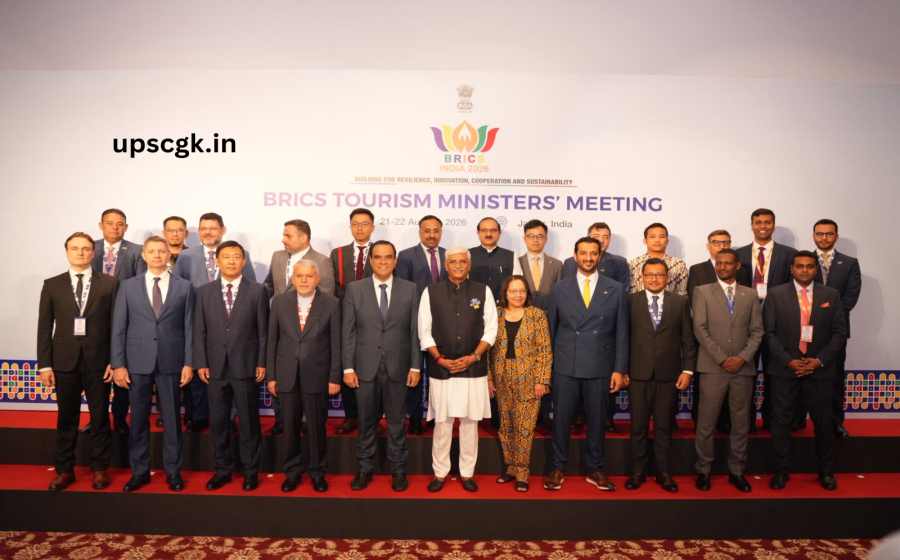
BRICS Tourism Ministers adopted the BRICS Tourism Ministers’ Communiqué 2026, popularly referred to as the Jaipur Declaration, by consensus at Jaipur, Rajasthan, on 21 August 2026. The declaration marked an important step in strengthening cooperation among BRICS countries in the rapidly evolving tourism sector.
The ministerial meeting was organised under India’s 2026 Chairship of BRICS and was chaired by Gajendra Singh Shekhawat, Union Minister for Culture and Tourism. The meeting brought together representatives of BRICS member countries to discuss common challenges, emerging opportunities and future priorities for tourism cooperation.
The Jaipur Declaration places particular emphasis on technology, sustainability, skill development and easier travel. Its broader objective is to make tourism more resilient, inclusive, innovative and responsible in an increasingly interconnected world.
Table of Contents
BRICS Tourism Track 2026
The BRICS Tourism Track during 2026 was guided by the theme:
“Building for Resilience, Innovation, Cooperation and Sustainability.”
The theme reflects the changing nature of global tourism. The sector has become increasingly dependent on digital technology, international connectivity, skilled human resources and sustainable development. At the same time, tourism destinations face challenges related to environmental pressure, climate change, infrastructure and changing visitor expectations.
Representatives from nine BRICS member states participated in the ministerial meeting, including countries such as Brazil, Iran, South Africa and the United Arab Emirates.
The Tourism Track serves as a platform for BRICS members to exchange experiences, identify areas of common interest and promote cooperation in the tourism and hospitality sectors. Such cooperation can support economic activity while also encouraging cultural understanding and people-to-people connections.
Jaipur Declaration and Its Four Key Priorities
The Jaipur Declaration identified four major areas of cooperation among BRICS members.
These are:
1. Artificial Intelligence and Tourism
The first major priority is the growing role of Artificial Intelligence (AI) in the tourism sector.
AI has the potential to transform the way tourists plan journeys and interact with destinations. It can support digital booking platforms, automated customer services, personalised travel recommendations, route planning and multilingual communication.
The BRICS Tourism Ministers’ Communiqué highlighted the importance of using safe, responsible and human-centred AI. This approach recognises that technology should improve visitor experiences while also ensuring that human interests, accessibility and responsible governance remain central.
AI can also assist tourism authorities in destination management. By analysing visitor data, authorities may better understand travel patterns, manage overcrowding and improve the delivery of tourism-related services.
For countries with diverse languages and large numbers of international visitors, AI-powered translation and communication tools can further reduce barriers to travel.
2. Sustainability and Responsible Tourism
The second major priority of the Jaipur Declaration is Sustainability and Responsible Tourism.
Tourism generates employment, supports local businesses and contributes to economic growth. However, uncontrolled tourism can also create pressure on natural resources, heritage sites and local communities.
Responsible tourism seeks to balance economic development with environmental protection and social well-being. It encourages practices that reduce negative impacts while ensuring that local communities benefit from tourism activities.
The focus on sustainability is especially significant for BRICS countries, many of which possess major natural landscapes, biodiversity hotspots, historical monuments and cultural traditions.
Tourism policies based on sustainability can promote resource conservation, support local livelihoods and protect cultural heritage for future generations.
3. Tourism Skilling and Capacity Building
The third priority focuses on Tourism Skilling and Capacity Building.
Tourism is a service-intensive sector that depends heavily on trained human resources. Professionals working in hospitality, travel services, heritage management, guiding and tourism administration require appropriate skills to meet changing industry needs.
The growing use of digital technology has also increased the importance of new capabilities. Tourism workers increasingly need knowledge of digital platforms, online services, communication tools and emerging technologies.
Through cooperation in skilling and capacity building, BRICS countries can exchange best practices and strengthen institutional capabilities. Such efforts can improve service quality and create better employment opportunities in tourism-related industries.
This priority also highlights the connection between tourism development and human capital. Strong infrastructure alone cannot ensure a successful tourism sector without trained and capable professionals.
4. Tourism Exchanges and Seamless Travel Facilitation
The fourth priority identified in the Jaipur Declaration is Tourism Exchanges and Seamless Travel Facilitation.
International tourism depends on efficient connectivity and smooth travel processes. Cooperation among countries can help improve the visitor experience through better information sharing and coordinated approaches.
Tourism exchanges can also strengthen people-to-people relations. When citizens travel across countries, they gain opportunities to experience different cultures, traditions, languages and historical heritage.
For BRICS members, increased tourism cooperation can contribute to stronger economic and cultural links. Easier travel and improved exchanges may also encourage greater collaboration between tourism businesses and institutions.
Preparatory Discussions Before the Ministerial Meeting
The adoption of the Jaipur Declaration followed preparatory discussions held in Jaipur on 19 and 20 August 2026 under the BRICS Tourism Working Group.
These discussions helped develop the agenda and establish areas where participating countries could build consensus. The preparatory process demonstrates the role of working-level consultations in shaping ministerial decisions within multilateral forums.
The host delegation included Bhuvnesh Kumar, Secretary in the Ministry of Tourism, and Harikishore S., Joint Secretary.
The final adoption of the communiqué by consensus reflected a shared approach towards strengthening cooperation in tourism among the participating BRICS members.
Significance for India
The Jaipur meeting was significant for India because it formed part of the country’s broader agenda during its 2026 BRICS Chairship.
India has consistently emphasised the importance of technology, cultural heritage, sustainable development and people-centric growth. The four priorities identified in the Jaipur Declaration closely connect with these broader policy themes.
The choice of Jaipur as the venue also carried symbolic importance. Jaipur is widely known for its historical architecture, cultural traditions and tourism significance. As a UNESCO World Heritage City, it represents the relationship between heritage conservation and tourism development.
By hosting the BRICS Tourism Ministers’ Meeting, India provided a platform for dialogue on the future of tourism cooperation among major emerging economies.
Why the Jaipur Declaration Matters
The tourism sector is closely connected with several areas of the economy, including transport, hospitality, culture, trade and employment. As international travel continues to evolve, cooperation between countries can help address shared challenges and create new opportunities.
The Jaipur Declaration is important because it brings together four interconnected dimensions of modern tourism: technology, sustainability, skills and connectivity.
The emphasis on responsible AI recognises the increasing influence of digital transformation. The focus on sustainability addresses environmental and social concerns. Skilling and capacity building underline the importance of human resources, while seamless travel facilitation supports stronger international exchanges.
Together, these priorities provide a broad framework for future cooperation among BRICS members.
Important Facts
- BRICS is an intergovernmental grouping of major emerging economies.
- The BRICS Tourism Ministers’ Communiqué 2026 is also referred to as the Jaipur Declaration.
- The declaration was adopted by consensus in Jaipur, Rajasthan, on 21 August 2026.
- The meeting was held under India’s 2026 BRICS Chairship.
- Gajendra Singh Shekhawat chaired the ministerial meeting.
- The 2026 BRICS Tourism Track was guided by the theme “Building for Resilience, Innovation, Cooperation and Sustainability.”
- The declaration identified four priority areas: AI and Tourism, Sustainability and Responsible Tourism, Tourism Skilling and Capacity Building, and Tourism Exchanges and Seamless Travel Facilitation.
- Jaipur is the capital of Rajasthan and a UNESCO World Heritage City.
- Responsible tourism focuses on balancing economic, environmental and social sustainability.
Summary
The adoption of the Jaipur Declaration 2026 represents an important development in BRICS cooperation in the tourism sector. By focusing on artificial intelligence, responsible tourism, skill development and seamless travel, the declaration responds to major changes affecting global tourism.
For India, the meeting highlighted the role of its 2026 BRICS Chairship in promoting sectoral cooperation and dialogue among emerging economies. For BRICS as a whole, the declaration provides a shared framework for building a tourism sector that is more resilient, innovative, sustainable and connected.
The Jaipur Declaration is therefore significant not only as a ministerial outcome but also as an example of how international cooperation can address the economic, technological and environmental challenges shaping the future of tourism.
Also Check: Current Affairs