
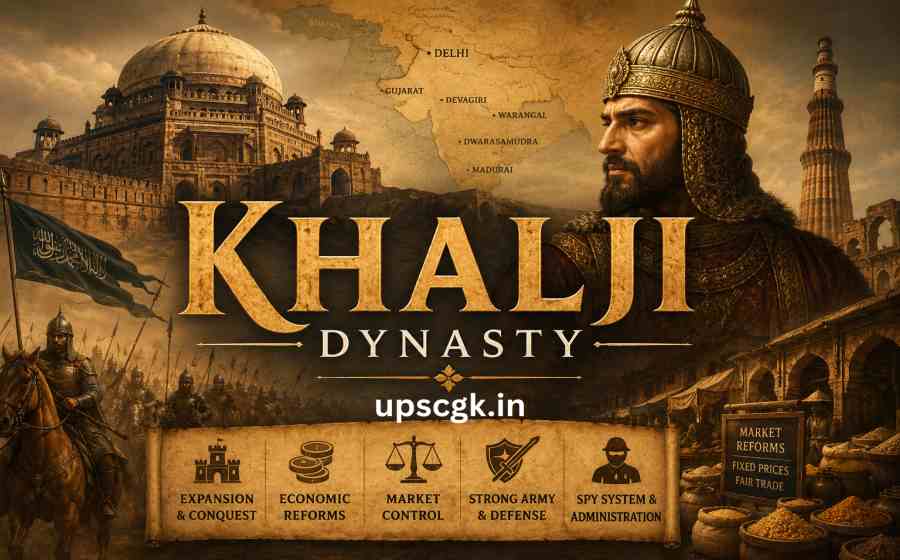
Explore the Khalji Dynasty and Alauddin Khalji’s military expansion, administrative policies and economic reforms that transformed medieval India.
Khalji Dynasty
The Khalji Dynasty was one of the most influential ruling dynasties of the medieval period in India. It ruled the Delhi Sultanate from 1290 to 1320 and played a major role in strengthening the political and military structure of northern India. The dynasty is remembered particularly for the rule of Alauddin Khalji, who introduced important military and economic reforms and expanded the Delhi Sultanate significantly. His administration focused on increasing state control, maintaining a powerful army, and securing political stability.
The Khalji rulers succeeded the Slave Dynasty and brought major changes in governance and administration. Among all the rulers of this dynasty, Alauddin Khalji became the most powerful and capable ruler because of his successful military campaigns and innovative economic policies.
Table of Contents
Rise of the Khalji Dynasty
The Khalji Dynasty was founded by Jalaluddin Khalji in 1290 after the decline of the Slave Dynasty. He became the first ruler of the Khalji family and established his authority over Delhi. His rule was relatively moderate and peaceful. However, his nephew and son-in-law Alauddin Khalji later assassinated him and took control of the throne in 1296.
Alauddin Khalji had ambitious goals. He wanted to create a strong empire and ensure that no internal rebellions or external invasions threatened his kingdom. His rule marked the golden phase of the Khalji Dynasty.
Expansion under Alauddin Khalji
Alauddin Khalji greatly expanded the territory of the Delhi Sultanate through successful military campaigns. He believed that a larger empire would provide greater resources and strengthen the position of the Sultanate.
Conquest of Gujarat
One of his earliest military campaigns was against Gujarat. The region was rich in trade and resources. His forces successfully conquered Gujarat and brought immense wealth to the Sultanate treasury. Valuable goods, wealth, and skilled people became part of the empire.
Rajput Campaigns
Alauddin Khalji also launched military expeditions against various Rajput kingdoms. He captured important forts and territories that strengthened his control over northern India. Several powerful Rajput rulers were defeated during these campaigns. The capture of strategic regions helped him secure important trade routes and strengthen the Sultanate’s authority.
Southern Expeditions
A major achievement of Alauddin Khalji was extending the influence of Delhi into southern India. His trusted general Malik Kafur led campaigns into the Deccan region and southern kingdoms.
Military expeditions were conducted against kingdoms such as:
- Devagiri
- Warangal
- Dwarasamudra
- Madurai
These victories brought enormous wealth, tribute, and political influence to Delhi. Southern rulers accepted the authority of the Sultan and paid tribute to avoid further military conflict.
As a result, the Delhi Sultanate reached one of its largest territorial expansions during Alauddin Khalji’s reign.
Protection against Mongol Invasions
During Alauddin Khalji’s period, repeated Mongol invasions posed a serious challenge to northern India. The Mongols had already caused destruction in many parts of Asia, and protecting India from their attacks became a major concern.
To strengthen defense, Alauddin:
- Built strong forts and military bases
- Increased the size of the army
- Improved border security
- Maintained a permanent standing army
These measures helped in successfully resisting Mongol attacks and protecting the empire.
Economic Reforms of Alauddin Khalji
Alauddin Khalji is especially remembered for his remarkable economic reforms. His policies were designed to support a large army and maintain control over the administration.
Market Control System
One of the most significant reforms introduced by Alauddin Khalji was strict market regulation.
He established separate markets for:
- Food grains
- Cloth
- Horses
- Cattle
- Daily-use goods
Government officials closely monitored these markets to ensure fair prices and prevent cheating.
The objectives behind these reforms were:
- Prevent inflation
- Ensure availability of goods
- Support soldiers with affordable prices
- Reduce corruption and black marketing
Merchants were required to follow fixed prices, and violations led to strict punishment.
Price Control Measures
Alauddin Khalji introduced a systematic price control policy. Essential goods such as wheat, rice, sugar, and cloth had fixed rates.
This policy had several benefits:
- Soldiers could survive on lower salaries
- Cost of living remained stable
- Common people gained easier access to essential goods
Officials regularly inspected markets and maintained records to ensure that traders followed the rules.
Revenue Reforms
The Sultan also introduced land revenue reforms to increase state income.
Key changes included:
- Measurement of agricultural land
- Direct collection of taxes
- Reduction of corruption among local officials
The government collected approximately half of agricultural production as land revenue in many areas.
These reforms strengthened the financial condition of the state and provided resources for administration and military activities.
Spy System and Administration
Alauddin Khalji also developed an effective intelligence network. Spies were appointed throughout the empire to monitor officials, traders, and nobles.
The purpose of the spy system was to:
- Detect conspiracies
- Control corruption
- Prevent rebellions
- Maintain discipline
This administrative structure helped him maintain centralized control over the empire.
Importance of Alauddin Khalji’s Reforms
The reforms introduced by Alauddin Khalji had long-term significance in Indian history. His policies demonstrated how a ruler could combine military strength with economic planning.
His achievements include:
- Expansion of the Delhi Sultanate
- Strong defense against invasions
- Stable administration
- Effective market regulation
- Improved revenue collection system
Although some policies were strict and sometimes harsh, they helped create a powerful and stable state.
Summary
The Khalji Dynasty occupies an important place in Indian medieval history, and Alauddin Khalji stands out as one of its most powerful rulers. His military conquests expanded the empire across large parts of India, while his economic reforms created a structured administrative system. The market regulations, price control policies, and military organization introduced by him became notable examples of governance in medieval India.
His reign reflects a period where administrative innovation and military power worked together to shape the future of the Delhi Sultanate.
Also Check: History