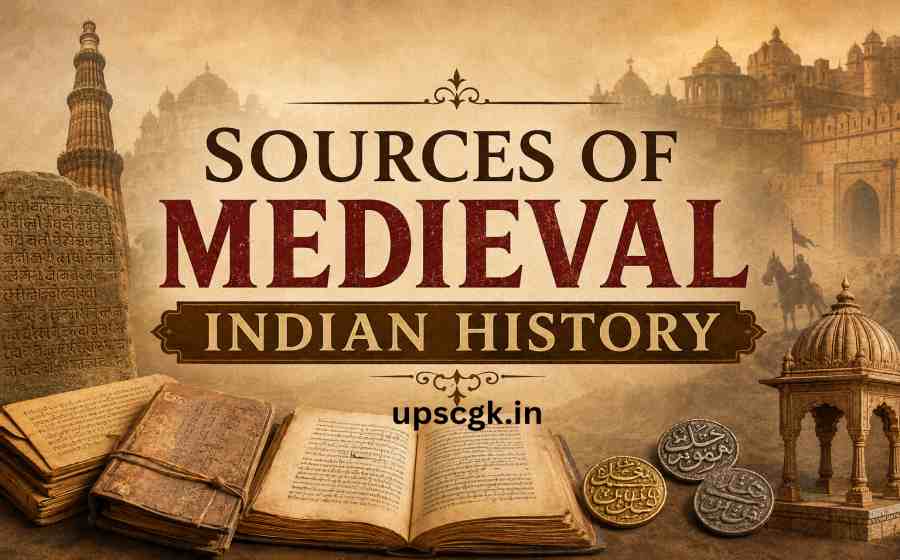
Explore the major sources of Medieval Indian History, including literary works, inscriptions, coins, monuments and foreign travellers’ accounts.
Sources of Medieval Indian History
The study of Medieval Indian History depends on a wide range of historical sources that help historians reconstruct the political, social, economic, cultural, and religious developments of the period. The medieval period in India is generally considered to span from the 8th century CE to the 18th century CE, covering the rise of regional kingdoms, the Delhi Sultanate, the Vijayanagara Empire, the Mughal Empire, and several regional powers.
Unlike ancient history, the medieval period offers a larger variety of written records, official documents, inscriptions, coins, architectural remains, and accounts of foreign travellers. However, historians also face challenges because many medieval writers were closely associated with rulers and often wrote with political or religious bias. Therefore, different types of sources are carefully compared before drawing historical conclusions.
Table of Contents
Importance of Historical Sources
Historical sources help us understand:
- Political administration and governance
- Military campaigns and conquests
- Economic conditions and trade
- Religious movements and cultural developments
- Social structure and daily life
- Art, architecture, and literature
The sources of Medieval Indian History are broadly classified into literary sources, archaeological sources, and foreign accounts.
1. Literary Sources
Literary works form one of the most valuable sources for understanding medieval India. These writings include chronicles, biographies, court histories, religious texts, and regional literature.
A. Persian and Arabic Literature
With the establishment of the Delhi Sultanate, Persian became the official language of administration. Many historians and scholars recorded important political events.
Chach Nama
- Describes the Arab conquest of Sindh by Muhammad bin Qasim.
- One of the earliest Persian historical texts relating to medieval India.
- Provides information about administration and society in Sindh.
Tarikh-i-Firuz Shahi
This title was used by two historians.
Ziauddin Barani
- Describes the reigns of several Delhi Sultans.
- Discusses administration, taxation, nobility, and political theory.
- Considered an important source for Sultanate history.
Shams-i-Siraj Afif
- Focuses mainly on the reign of Firoz Shah Tughlaq.
- Provides detailed information about irrigation, public works, and governance.
Tabaqat-i-Nasiri
Written by Minhaj-us-Siraj, this work records the history of early Delhi Sultans and the Ghurid rulers. It is an important source for understanding the political history of North India.
Baburnama
- Autobiography of Babur.
- Written in Turkish and later translated into Persian.
- Provides first-hand information about India before the establishment of the Mughal Empire.
- Describes geography, agriculture, people, and political conditions.
Akbarnama and Ain-i-Akbari
Written by Abul Fazl, these works are among the finest historical records of medieval India.
Akbarnama
- Describes Akbar’s life, military campaigns, and achievements.
Ain-i-Akbari
- Gives detailed information on administration, revenue, army, trade, agriculture, provinces, and social customs.
- Considered one of the richest sources for Mughal administration.
Badshahnama
Written by Abdul Hamid Lahori, it records the reign of Shah Jahan and provides valuable details about Mughal court life and architectural projects like the Taj Mahal.
B. Sanskrit Literature
Even during medieval times, Sanskrit remained an important language.
Important works include:
- Rajatarangini by Kalhana, which presents the history of Kashmir and is regarded as one of India’s earliest historical chronicles.
- Religious commentaries and philosophical works that provide information about education, society, and religious practices.
C. Regional Literature
Regional languages flourished during the medieval period.
Examples include:
- Tamil devotional literature
- Kannada literary works
- Telugu court poetry
- Marathi Bhakti literature
- Bengali Vaishnava texts
These works help historians understand regional politics, language development, social customs, and religious movements.
2. Archaeological Sources
Material remains provide reliable evidence because they are less influenced by personal opinions.
A. Inscriptions
Inscriptions were engraved on:
- Stone pillars
- Temple walls
- Copper plates
- Forts
- Mosques
They record:
- Land grants
- Tax exemptions
- Royal orders
- Administrative policies
- Military victories
Many inscriptions also mention dates, making them valuable for establishing chronology.
B. Coins (Numismatics)
Coins reveal important information about:
- Names and titles of rulers
- Religious beliefs
- Economic conditions
- Trade relations
- Metallurgy
- Currency system
Coins of the Delhi Sultanate introduced Arabic inscriptions, while Mughal coins reflected high artistic quality and uniform monetary standards.
C. Monuments and Architecture
Buildings are among the most visible sources of medieval history.
Important monuments include:
- Qutub Minar
- Alai Darwaza
- Humayun’s Tomb
- Fatehpur Sikri
- Red Fort
- Taj Mahal
- Gol Gumbaz
- Vijayanagara ruins
- Hampi temples
These monuments reveal:
- Architectural styles
- Religious influences
- Urban planning
- Engineering skills
- Patronage of rulers
D. Paintings and Sculptures
Miniature paintings developed under the Mughals, Rajputs, and Deccan kingdoms.
They provide evidence regarding:
- Court ceremonies
- Costumes
- Weapons
- Music
- Festivals
- Lifestyle of nobles
Temple sculptures also help historians understand religious beliefs and artistic traditions.
3. Foreign Travellers’ Accounts
Foreign visitors left detailed observations about India, many of which complement indigenous records.
Al-Biruni (11th Century)
- Visited India with Mahmud of Ghazni.
- Wrote Kitab-ul-Hind.
- Studied Indian religion, science, mathematics, geography, and society.
- His work is regarded as objective and scholarly.
Marco Polo
- Visited South India during the rule of the Pandya Kingdom.
- Described trade, ports, customs, and economic prosperity.
Ibn Battuta
- Moroccan traveller who visited India during Muhammad bin Tughlaq’s reign.
- Served as the Sultan’s judge (Qazi).
- His work Rihla provides detailed information on administration, roads, markets, cities, and everyday life.
Nicolo Conti
- Italian traveller.
- Visited Vijayanagara.
- Described its wealth, military strength, and commercial prosperity.
Abdur Razzaq
- Persian ambassador to the Vijayanagara Empire.
- Gave vivid descriptions of the capital city, royal court, and economy.
François Bernier
- French physician during Aurangzeb’s reign.
- Compared Mughal administration with European political systems.
- Described land revenue, agriculture, and social inequalities.
Jean-Baptiste Tavernier
- French merchant.
- Famous for describing India’s diamond trade, commerce, and luxury goods.
4. Administrative Records
The medieval period witnessed systematic record-keeping.
Important records include:
- Revenue registers
- Farmans (royal decrees)
- Sanads (official grants)
- Court documents
- Judicial records
These sources help historians understand governance, taxation, land ownership, and administrative organization.
Limitations of Medieval Sources
Despite their importance, medieval sources have certain limitations.
- Many court historians praised rulers excessively.
- Religious bias influenced several writings.
- Some events were deliberately omitted.
- Regional histories are unevenly preserved.
- Foreign travellers often misunderstood local customs.
- Architectural evidence cannot explain every aspect of society.
Therefore, historians compare literary, archaeological, and foreign sources to produce a balanced interpretation.
Summary
The sources of Medieval Indian History provide a comprehensive understanding of one of the most dynamic periods in India’s past. Literary works preserve political and cultural narratives, archaeological evidence offers tangible proof of historical developments, and foreign travellers present valuable external perspectives. Together, inscriptions, coins, monuments, paintings, administrative records, and historical chronicles enable scholars to reconstruct the complex history of medieval India with greater accuracy. A critical and comparative study of these diverse sources remains essential for understanding the political transformations, economic progress, religious movements, and cultural achievements that shaped medieval Indian civilization.
Also Check: History