
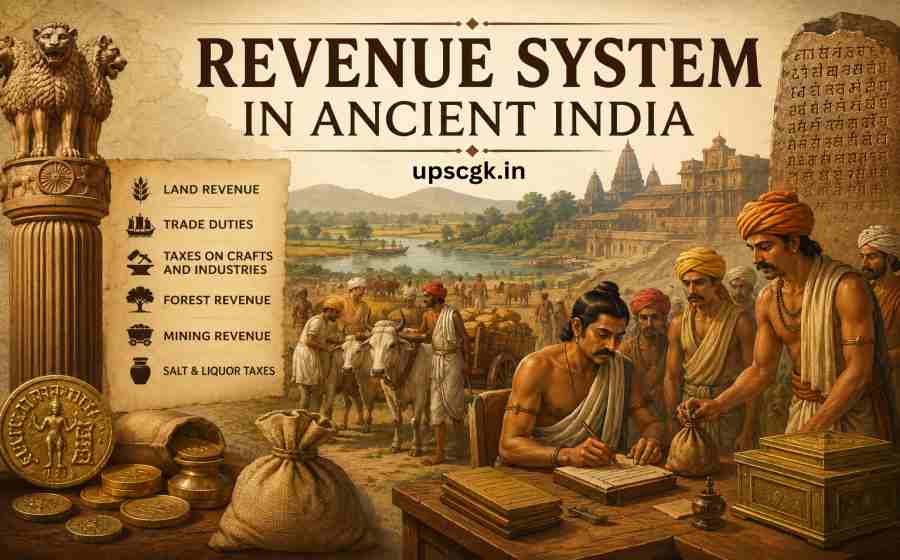
Explore the Revenue System in Ancient India, including land tax, trade duties, royal treasury and economic administration during the Maurya and Gupta periods.
Revenue System in Ancient India
The Revenue System in Ancient India formed the backbone of governance and administration. Every kingdom required a stable source of income to maintain law and order, support the army, build infrastructure, and promote public welfare. Ancient Indian rulers developed an organized taxation system based on agriculture, trade, industries, forests, mines, and other economic activities. The revenue collected was carefully managed by government officials and deposited into the royal treasury.
The evolution of the revenue system can be traced through ancient texts such as the Arthashastra by Kautilya, the Dharmashastras, inscriptions, and foreign accounts of travelers like Megasthenes. While the system changed across different dynasties, its primary objective remained the same, ensuring financial stability for the state without placing an unbearable burden on the people.
Table of Contents
Importance of Revenue in Ancient India
Revenue was considered essential for the functioning of the kingdom. It enabled the ruler to:
- Maintain a well-equipped army.
- Pay salaries to government officials.
- Construct roads, irrigation canals, and public buildings.
- Promote trade and commerce.
- Provide relief during natural disasters.
- Support education, religion, and cultural institutions.
Ancient Indian political thinkers believed that a prosperous treasury was one of the key elements of a strong state.
Agriculture as the Primary Source of Revenue
Agriculture was the main occupation of the people, making land revenue the largest source of state income. Farmers cultivated crops such as rice, wheat, barley, pulses, cotton, and sugarcane.
The tax collected from agricultural land was generally known as Bhaga, meaning the king’s share of the produce. The amount varied according to the fertility of the land, irrigation facilities, and the nature of cultivation.
Generally, the state collected:
- One-sixth of the agricultural produce under normal conditions.
- In some cases, the share could increase during emergencies or decrease during periods of hardship.
This flexible approach helped maintain a balance between state needs and farmers’ welfare.
Revenue Administration under the Mauryan Empire
The Mauryan Empire (321–185 BCE) developed one of the most systematic revenue administrations in ancient India. Kautilya’s Arthashastra provides detailed information about tax collection and financial management.
Several important officials were responsible for revenue administration:
- Samaharta – Chief Revenue Collector responsible for assessing and collecting taxes.
- Sannidhata – Treasurer who maintained the royal treasury.
- Local officers supervised agricultural production and ensured timely tax collection.
The Mauryan administration maintained detailed records of land ownership, crop production, and tax liabilities, reflecting an advanced financial system.
Types of Taxes in Ancient India
The revenue system included various forms of taxation beyond agriculture.
1. Land Tax
Land tax remained the principal source of income. It depended on:
- Fertility of the soil.
- Type of crop cultivated.
- Availability of irrigation.
- Seasonal conditions.
2. Trade and Customs Duties
Merchants engaged in domestic and international trade paid customs duties at ports, city gates, and trade routes.
Taxes were imposed on:
- Imported goods.
- Exported goods.
- Goods transported through markets.
- Commercial transactions.
These duties contributed significantly to state revenue, especially during periods of flourishing trade.
3. Taxes on Crafts and Industries
Artisans, craftsmen, weavers, potters, metalworkers, and other professionals paid taxes on their production or earnings.
Guilds (Shrenis) often played an important role in organizing production and facilitating tax collection.
4. Forest Revenue
Forests were valuable state assets. Revenue was generated from:
- Timber.
- Honey.
- Bamboo.
- Medicinal herbs.
- Elephant capture.
- Wildlife products.
The government often regulated forest resources to ensure sustainable use.
5. Mining Revenue
Ancient India possessed rich deposits of:
- Gold.
- Silver.
- Copper.
- Iron.
- Precious stones.
The state either directly controlled mines or collected taxes from mining activities.
6. Salt and Liquor Taxes
Certain commodities such as salt and liquor were either taxed heavily or controlled by the state. These provided steady income to the treasury.
Role of Trade in Revenue Collection
Trade expanded considerably during ancient times due to improved roads, ports, and maritime connections.
Major trade centres contributed through:
- Market taxes.
- Transit duties.
- Port taxes.
- Licensing fees.
Indian merchants traded with regions including Central Asia, Southeast Asia, Rome, and China. Increased commercial activity directly strengthened the state’s financial resources.
Revenue System during the Gupta Period
During the Gupta Empire (4th–6th century CE), agriculture remained the principal source of income. However, some notable changes appeared.
Land grants to:
- Brahmins.
- Temples.
- Religious institutions.
- Officials.
became increasingly common. Such lands were often exempt from certain taxes, reducing direct state revenue but encouraging religious and educational activities.
The Gupta administration also collected taxes from:
- Agriculture.
- Trade.
- Crafts.
- Mines.
- Forest products.
Although less centralized than the Mauryan system, revenue administration remained efficient.
Tax Collection Methods
Revenue was collected through a structured administrative hierarchy.
Officials conducted:
- Land surveys.
- Crop assessments.
- Maintenance of revenue records.
- Collection of taxes.
- Inspection of local officials.
Taxes could be paid:
- In kind (grain, crops, livestock).
- In cash where monetary transactions were common.
The method depended upon regional economic conditions.
Principles of Fair Taxation
Ancient Indian political philosophy emphasized moderation in taxation.
Kautilya advised that the king should collect taxes like:
“A bee gathers honey from flowers without harming them.”
This famous principle suggested that taxation should generate adequate revenue without exploiting the people.
Relief measures were often provided during:
- Floods.
- Droughts.
- Famines.
- Crop failures.
Such policies helped preserve agricultural productivity and public trust.
Royal Treasury (Kosha)
The Kosha, or royal treasury, occupied a central place in state administration.
Revenue stored in the treasury financed:
- Defence and military campaigns.
- Administrative expenses.
- Public infrastructure.
- Irrigation works.
- Religious ceremonies.
- Welfare measures.
A strong treasury was regarded as essential for political stability and economic growth.
Economic Significance of the Revenue System
The revenue system contributed significantly to the prosperity of ancient Indian kingdoms.
Its major contributions included:
- Supporting efficient governance.
- Encouraging agricultural expansion.
- Promoting domestic and foreign trade.
- Financing infrastructure projects.
- Strengthening military capabilities.
- Maintaining administrative stability.
Well-managed finances enabled several dynasties, including the Mauryas and Guptas, to establish powerful and prosperous empires.
Summary
The Revenue System in Ancient India was a sophisticated and well-organized mechanism that ensured the smooth functioning of the state. Agriculture formed the foundation of taxation, while trade, forests, mines, industries, and customs duties provided additional sources of income. The Mauryan administration established one of the earliest systematic revenue models, while later dynasties refined it according to changing political and economic conditions. Ancient thinkers emphasized fairness, moderation, and efficient administration, making the revenue system not merely a tool for taxation but an essential instrument for governance, economic development, and public welfare. Its principles continue to provide valuable insights into the evolution of fiscal administration in Indian history.
Also Check: History