Explore the historical importance of Ashoka Inscriptions and Edicts, their messages on Dhamma, governance and how they shaped the history of ancient India.
Ashoka Inscriptions and Edicts
The inscriptions and edicts of Emperor Ashoka are among the most valuable historical sources for understanding ancient India. Carved on rocks, pillars, caves, and stone surfaces across the Indian subcontinent, these inscriptions provide direct evidence of the policies, beliefs, and administration of one of India’s greatest rulers. Unlike many ancient rulers whose achievements are known mainly through literary accounts, Ashoka left behind his own words engraved in stone, making his inscriptions a unique and authentic historical record.
Issued during the 3rd century BCE after the Kalinga War, these edicts reflect Ashoka’s transformation from a conqueror to a compassionate ruler dedicated to peace, morality, and public welfare. They also offer valuable insights into the political, social, religious, and administrative life of the Mauryan Empire.
Table of Contents
What are Ashoka’s Inscriptions and Edicts?
Ashoka’s inscriptions are official proclamations engraved on stone surfaces to communicate his policies and ideals to the people. These messages were written in simple language so that ordinary citizens could understand them.
The inscriptions can be broadly classified into four categories:
- Major Rock Edicts
- Minor Rock Edicts
- Major Pillar Edicts
- Minor Pillar Edicts
More than 30 major inscriptions have been discovered across present-day India, Nepal, Pakistan, Bangladesh, and Afghanistan, demonstrating the vast territorial extent of the Mauryan Empire.
Languages and Scripts Used
Ashoka ensured that his messages reached different regions by using local languages and scripts.
The major languages included:
- Prakrit
- Greek
- Aramaic
The inscriptions were written in various scripts such as:
- Brahmi
- Kharosthi
- Greek script
- Aramaic script
The Brahmi script, later deciphered by James Prinsep in 1837, played a crucial role in unlocking the history of ancient India and identifying Ashoka as the ruler behind these inscriptions.
Reason Behind Issuing the Edicts
The Kalinga War proved to be a turning point in Ashoka’s life. Witnessing widespread death and destruction deeply affected him. He abandoned aggressive warfare and adopted the principles of Dhamma, emphasizing compassion, non-violence, justice, and ethical governance.
The inscriptions became an effective medium for spreading these ideals throughout his empire. Rather than glorifying military victories, Ashoka focused on promoting moral values and responsible administration.
Major Themes Found in the Edicts
Promotion of Dhamma
Ashoka’s concept of Dhamma was not confined to any single religion. Instead, it represented a universal moral code encouraging:
- Respect for parents and elders
- Kindness toward servants
- Compassion for animals
- Honesty and truthfulness
- Charity and generosity
- Religious tolerance
- Peaceful coexistence
The edicts repeatedly urge citizens to lead ethical lives based on these principles.
Religious Tolerance
One of the most remarkable aspects of Ashoka’s inscriptions is their emphasis on religious harmony.
Although Ashoka embraced Buddhism, he never forced his subjects to follow it. Instead, he encouraged respect for all religious traditions and discouraged criticism of other faiths. This reflects one of the earliest examples of state-supported religious tolerance in world history.
Welfare of the People
Ashoka considered the welfare of his subjects to be the primary responsibility of a ruler. His edicts describe several public welfare measures, including:
- Construction of roads
- Planting shade trees
- Digging wells
- Building rest houses
- Establishing hospitals for humans and animals
- Providing medicinal herbs
These initiatives demonstrate an advanced understanding of public administration and social welfare.
Administrative Reforms
The inscriptions reveal that Ashoka appointed special officials known as Dhamma Mahamatras to oversee the implementation of moral policies and address public grievances.
He instructed officials to remain accessible to the people and encouraged efficient governance based on fairness and justice rather than fear.
Different Types of Edicts
Major Rock Edicts
These fourteen principal edicts discuss Ashoka’s administrative policies, moral teachings, treatment of subjects, and international relations. They are among the most comprehensive sources on Mauryan governance.
Minor Rock Edicts
These inscriptions focus more directly on Ashoka’s personal faith in Buddhism and his appeal to the people to follow moral conduct.
Some of the earliest references to Ashoka by name are found in these minor edicts.
Major Pillar Edicts
Engraved on beautifully polished sandstone pillars, these inscriptions emphasize justice, non-violence, religious tolerance, and ethical administration. Many of these pillars remain architectural masterpieces of ancient India.
Minor Pillar Edicts
These shorter inscriptions generally relate to Buddhist institutions, monastic discipline, and local administrative matters.
Historical Importance of Ashoka’s Inscriptions
Reliable Primary Historical Source
The inscriptions are considered primary historical evidence because they contain the direct words of Ashoka himself. Unlike later literary texts, they are contemporary records that provide authentic information about the Mauryan Empire.
Understanding Mauryan Administration
The edicts offer detailed knowledge about:
- Administrative organization
- Provincial governance
- Duties of officials
- Judicial practices
- Public welfare policies
Historians rely heavily on these inscriptions to reconstruct the political structure of ancient India.
Evidence of the Mauryan Empire’s Extent
The geographical distribution of Ashoka’s inscriptions across South Asia helps historians map the territorial boundaries of the Mauryan Empire.
The presence of Greek and Aramaic inscriptions in Afghanistan also indicates Ashoka’s interaction with diverse populations beyond the Indian heartland.
Insight into Ancient Society
The inscriptions shed light on everyday social values, ethical conduct, family responsibilities, treatment of servants, animal protection, and religious practices. They provide valuable evidence regarding the social life of ancient Indians during the Mauryan period.
Development of Writing and Scripts
The decipherment of the Brahmi script through Ashoka’s inscriptions revolutionized the study of Indian history. It enabled historians to read numerous ancient inscriptions and significantly expanded knowledge of India’s early civilizations.
Spread of Buddhism
Although Ashoka promoted universal moral values, his inscriptions also reveal his support for Buddhism. The edicts mention his pilgrimages, missionary activities, and efforts to spread Buddhist teachings within India and abroad, contributing to Buddhism’s expansion across Asia.
Important Locations of Ashoka’s Edicts
Some prominent sites where Ashoka’s inscriptions have been discovered include:
- Girnar (Gujarat)
- Dhauli (Odisha)
- Jaugada (Odisha)
- Sarnath (Uttar Pradesh)
- Sanchi (Madhya Pradesh)
- Lauriya Nandangarh (Bihar)
- Rampurva (Bihar)
- Meerut (Uttar Pradesh)
- Delhi-Topra Pillar
- Kandahar (Afghanistan)
These locations highlight the extensive reach of Ashoka’s administration.
Legacy of Ashoka’s Inscriptions
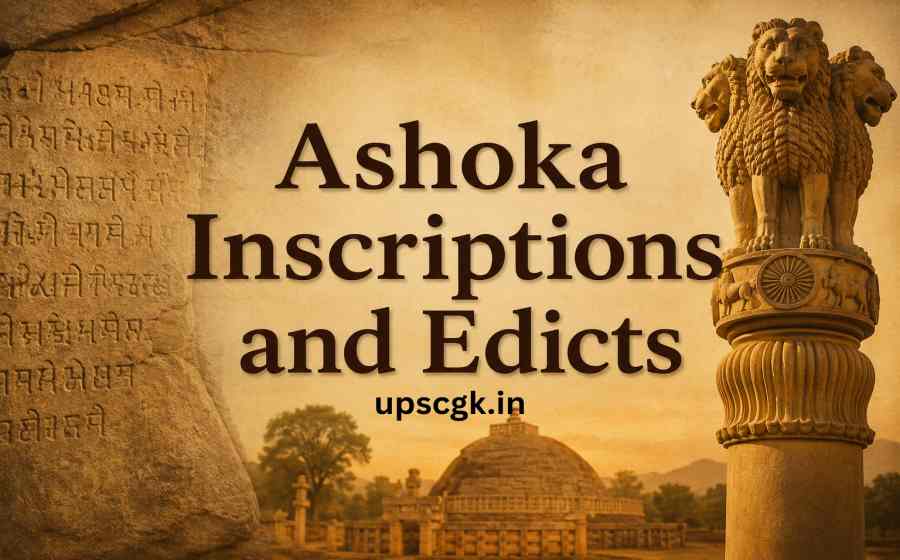
Ashoka’s inscriptions continue to inspire modern ideas of ethical leadership, social justice, religious harmony, and welfare-oriented governance. The Lion Capital of Sarnath, originally erected by Ashoka, has been adopted as the National Emblem of India, while the Ashoka Chakra appears at the center of the Indian National Flag.
Beyond their historical significance, the edicts remain enduring symbols of compassionate governance and responsible statecraft.
Summary
Ashoka’s inscriptions and edicts are among the greatest historical treasures of ancient India. They provide authentic evidence of the Mauryan Empire’s administration, social values, religious policies, and political philosophy. More importantly, they reveal the remarkable transformation of Emperor Ashoka from a powerful conqueror into a ruler guided by compassion and moral responsibility. Even after more than two thousand years, these inscriptions continue to serve as invaluable records for historians and as timeless reminders of the importance of peace, justice, tolerance, and good governance.
Also Check: History