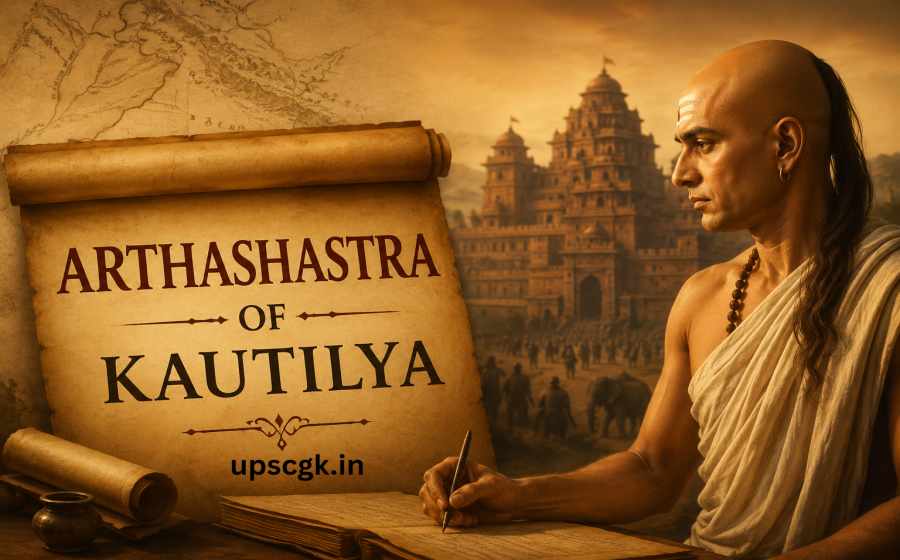
Explore the Arthashastra of Kautilya, its principles of governance, administration, economy, diplomacy, statecraft that shaped ancient Indian political thought.
Arthashastra of Kautilya
The Arthashastra is one of the most influential works on political science, administration, economics, military strategy, and governance in ancient India. Written by Kautilya, also known as Chanakya or Vishnugupta, this remarkable text laid the foundation for an efficient and well-organized state. Kautilya served as the chief advisor to Chandragupta Maurya, the founder of the Mauryan Empire, and played a crucial role in establishing one of the greatest empires in Indian history.
Unlike many ancient texts that focused primarily on religion or philosophy, the Arthashastra presents a practical guide to ruling a kingdom. It discusses taxation, law, diplomacy, intelligence, trade, agriculture, military organization, and public welfare. Even today, scholars regard it as one of the earliest and most comprehensive manuals on governance and statecraft.
Table of Contents
What is the Arthashastra?
The word “Arthashastra” is derived from two Sanskrit words:
- Artha – Wealth, prosperity, and material well-being
- Shastra – Science or treatise
Thus, Arthashastra means “The Science of Wealth and Governance.”
Although its primary focus is political administration, the text covers almost every aspect of managing a kingdom. Historians believe it was composed around the 4th century BCE, during the rise of the Mauryan Empire.
The work consists of 15 books, 150 chapters, and approximately 6,000 verses and prose passages, making it one of the most detailed political treatises of the ancient world.
Kautilya: The Master Strategist
Kautilya, popularly known as Chanakya, was a brilliant scholar, economist, teacher, and political thinker. He studied at the renowned Takshashila University and possessed deep knowledge of politics, economics, military affairs, and diplomacy.
After witnessing the decline of the Nanda dynasty, Kautilya supported Chandragupta Maurya in overthrowing the rulers and establishing the Mauryan Empire around 322 BCE. His ideas on governance became the guiding principles of the new empire.
Because of his strategic brilliance, Kautilya is often compared to political thinkers like Niccolò Machiavelli, though the Arthashastra predates The Prince by nearly 1,800 years.
Objectives of Good Governance
According to Kautilya, the primary duty of a king was to ensure the prosperity and security of the state. He believed that a ruler’s success depended on the happiness of the people.
One of the most famous principles of the Arthashastra states:
“In the happiness of his subjects lies the king’s happiness; in their welfare lies his welfare.”
This demonstrates that governance should balance authority with public welfare.
The king was expected to:
- Protect citizens from external and internal threats.
- Maintain law and order.
- Promote economic growth.
- Ensure justice.
- Encourage agriculture and trade.
- Prevent corruption among officials.
The Saptanga Theory of the State
One of the most significant contributions of the Arthashastra is the Saptanga Theory, which describes the seven essential elements of a successful state.
These are:
- Swamin – The King
- Amatya – Ministers and officials
- Janapada – Territory and population
- Durga – Fortified capital and defense
- Kosha – Treasury
- Danda – Army
- Mitra – Allies
Kautilya argued that all seven elements must function efficiently for a kingdom to remain stable and prosperous.
Administration and Bureaucracy
The Arthashastra provides detailed guidelines for establishing an efficient administrative system. Government officials were appointed based on their competence rather than family background. Various departments managed agriculture, mining, forests, commerce, taxation, roads, irrigation, and public works.
Officials were regularly inspected to ensure honesty and efficiency. Kautilya believed that corruption could weaken the state and therefore recommended strict supervision and punishment for dishonest administrators.
Economic Policies
Economic prosperity formed the backbone of Kautilya’s political philosophy.
The Arthashastra emphasizes:
- Efficient tax collection
- Agricultural development
- Irrigation projects
- Trade regulation
- State-owned industries
- Mining and metallurgy
- Forest resource management
Taxes were considered necessary for maintaining the kingdom, but they should not overburden the people. Kautilya compared taxation to a bee collecting honey without harming the flower, a ruler should collect revenue without exploiting citizens. The text also encouraged international trade while ensuring proper regulation of markets and prices.
Justice and Legal System
The Arthashastra presents an advanced legal framework based on fairness and order.
Courts dealt with:
- Civil disputes
- Criminal offences
- Property conflicts
- Commercial disagreements
- Family matters
Judges were expected to be impartial and knowledgeable. Punishments varied according to the severity of the crime and were intended to maintain discipline and social stability rather than promote unnecessary cruelty.
Diplomacy and Foreign Policy
One of the most admired aspects of the Arthashastra is its sophisticated foreign policy. Kautilya introduced the Mandala Theory, which viewed neighboring states as potential rivals while more distant kingdoms could become allies.
Foreign policy included:
- Peace treaties
- Alliances
- Strategic partnerships
- Military preparedness
- Negotiations
- Intelligence gathering
Kautilya believed diplomacy should always serve the interests of the state while avoiding unnecessary wars whenever possible.
Espionage and Intelligence
The Arthashastra gives extraordinary importance to intelligence networks.
Kautilya recommended appointing trained spies to gather information about:
- Enemy kingdoms
- Government officials
- Military activities
- Public opinion
- Internal conspiracies
Different categories of spies operated secretly to ensure the security of the kingdom. This extensive intelligence system helped rulers make informed decisions and prevent rebellions.
Military Organization
National security occupied a central place in Kautilya’s political thought.
The Arthashastra discusses:
- Recruitment of soldiers
- Military training
- Fort construction
- Battlefield strategy
- Supply management
- Defensive planning
Kautilya emphasized maintaining a disciplined and well-equipped army while ensuring that military campaigns were supported by sound economic planning.
Welfare of the People
Although the Arthashastra is often associated with political realism, it also emphasizes public welfare.
The ruler was responsible for:
- Building roads
- Developing irrigation systems
- Supporting farmers
- Preventing famines
- Protecting trade routes
- Assisting people during natural disasters
A prosperous population, according to Kautilya, strengthened the kingdom more effectively than military power alone.
Relevance in the Modern World
Many ideas from the Arthashastra continue to influence modern governance and public administration.
Its principles are reflected in:
- Strategic planning
- Economic management
- Public finance
- Anti-corruption measures
- National security
- Foreign policy
- Intelligence agencies
Business schools, management experts, and political scientists frequently study Kautilya’s ideas for lessons in leadership, decision-making, and organizational management.
Summary
The Arthashastra of Kautilya remains one of the greatest contributions of ancient India to political science and governance. Far ahead of its time, the text combines practical administration with economic planning, diplomacy, military strategy, and public welfare. Kautilya envisioned a state where strong leadership, efficient institutions, financial stability, and the well-being of citizens worked together to create a prosperous and secure kingdom.
More than two thousand years after its composition, the Arthashastra continues to inspire scholars, administrators, and policymakers across the world. Its timeless principles demonstrate that effective governance depends not only on power but also on wisdom, discipline, accountability, and the welfare of the people, making it a cornerstone of India’s rich intellectual and political heritage.
Also Check: History