
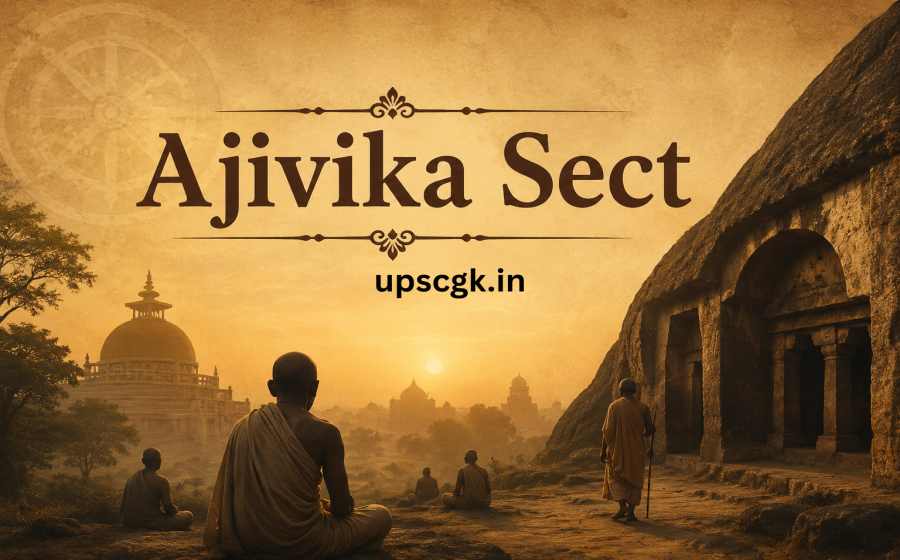
Discover the Ajivika Sect, its philosophy of destiny, founder Makkhali Gosala, beliefs, Mauryan patronage, decline and historical importance in ancient India.
Ajivika Sect
The Ajivika Sect was one of the most influential yet least understood religious and philosophical movements of ancient India. Emerging around the 6th century BCE, during the period of religious and intellectual transformation, the Ajivikas stood alongside Buddhism and Jainism as a major Shramana tradition that challenged the dominance of Vedic rituals and Brahmanical authority.
Although the sect eventually disappeared, its ideas left a significant mark on Indian philosophical thought. The Ajivikas were known for their unique belief in absolute determinism, which held that everything in the universe is governed by destiny and cannot be altered by human effort. Their philosophy distinguished them sharply from Buddhists and Jains, who emphasized karma and personal responsibility.
Table of Contents
Origin of the Ajivika Sect
The Ajivika movement arose in Magadha, a region that became the center of several non-Vedic religious traditions. The period witnessed widespread dissatisfaction with rigid social customs, elaborate sacrifices, and the authority of the priestly class. This environment encouraged the rise of reformist movements that promoted alternative paths to spiritual liberation.
The Ajivikas were one such group of wandering ascetics. They rejected many traditional religious practices and developed a distinct worldview centered on fate rather than free will.
Founder of the Ajivika Sect
The founder and most prominent teacher of the Ajivika Sect was Makkhali Gosala (also known as Goshala Maskariputra). According to historical sources, he was born into a humble family and initially lived as a wandering ascetic.
Makkhali Gosala is believed to have been a contemporary of Gautama Buddha and Mahavira, the founder of Jainism. Some Jain texts suggest that Gosala was associated with Mahavira for several years before separating due to philosophical disagreements. After parting ways, he established the Ajivika order and attracted a considerable number of followers across northern India.
Much of what is known about Gosala comes from Buddhist and Jain literature, as original Ajivika scriptures have not survived.
Core Philosophy of the Ajivika Sect
The defining feature of Ajivika philosophy was its belief in Niyati, or absolute destiny.
According to the Ajivikas:
- Every event in the universe is predetermined.
- Human beings have no control over their actions or future.
- Neither good deeds nor bad deeds can change one’s destiny.
- Liberation comes only after the soul completes a fixed cycle of births determined by fate.
This doctrine stood in sharp contrast to Buddhism and Jainism, both of which taught that individuals could shape their future through ethical conduct and spiritual practice.
The Ajivikas believed that all living beings pass through a predetermined number of births before attaining liberation, regardless of their actions.
Beliefs and Practices
Although the Ajivikas believed that destiny governed everything, they still followed a disciplined ascetic lifestyle. Their practices included:
- Renunciation of worldly possessions.
- Strict self-discipline.
- Meditation and contemplation.
- Wandering as homeless monks.
- Simple living and detachment from material comforts.
Some historical accounts describe Ajivika ascetics as practicing severe austerities, including long periods of fasting and enduring harsh environmental conditions.
Their disciplined life demonstrated spiritual commitment, even though they believed that such practices did not alter destiny but were themselves part of the predetermined cosmic order.
Difference Between Ajivika, Buddhism, and Jainism
The Ajivika Sect differed significantly from the other major Shramana traditions.
| Feature | Ajivika | Buddhism | Jainism |
|---|---|---|---|
| Main Principle | Absolute destiny (Niyati) | Karma and Middle Path | Karma and non-violence |
| Free Will | Denied | Accepted | Accepted |
| Liberation | Predetermined | Achieved through effort | Achieved through self-discipline |
| Founder | Makkhali Gosala | Gautama Buddha | Mahavira |
| View of Karma | Ineffective in changing destiny | Determines future | Determines future |
This philosophical distinction made the Ajivikas unique among India’s ancient religious schools.
Royal Patronage
The Ajivika Sect gained considerable support during the Mauryan Empire. Historical records indicate that Bindusara, the father of Emperor Ashoka, was a patron of the Ajivikas. During this period, the sect expanded across different parts of northern India.
Even after embracing Buddhism, Emperor Ashoka showed respect toward the Ajivikas. He donated the famous Barabar Caves in present-day Bihar to Ajivika monks. These rock-cut caves are among the oldest surviving cave monuments in India and reflect the importance of the sect during the Mauryan period. The polished interiors of these caves represent remarkable achievements in ancient Indian architecture and engineering.
Reasons for the Decline of the Ajivika Sect
Despite enjoying royal patronage, the Ajivika Sect gradually declined after the Mauryan period.
Several factors contributed to its disappearance:
- Loss of political support after the Mauryan Empire.
- Growing popularity of Buddhism and Jainism.
- Lack of surviving religious literature.
- Limited institutional organization.
- Gradual absorption into other religious traditions.
By the medieval period, the Ajivika Sect had virtually vanished from the Indian religious landscape.
Historical Importance of the Ajivika Sect
Although the Ajivika Sect no longer exists, it occupies an important place in the history of Indian philosophy.
Its significance includes:
- It represented one of the earliest non-Vedic philosophical traditions.
- It enriched debates on free will, destiny, and human existence.
- It contributed to the intellectual diversity of ancient India.
- It influenced discussions among Buddhist and Jain philosophers.
- It played a role in the development of ascetic traditions.
- Its association with the Barabar Caves provides valuable evidence of Mauryan art and architecture.
The Ajivikas demonstrate that ancient India was home to a wide range of philosophical perspectives, extending far beyond the better-known traditions of Buddhism and Jainism.
Ajivika Sect in UPSC and Competitive Examinations
The Ajivika Sect is an important topic for UPSC, State PSCs, SSC, and other competitive examinations. Questions are frequently asked regarding:
- Founder of the Ajivika Sect
- Doctrine of Niyati (destiny)
- Makkhali Gosala
- Differences between Ajivika, Buddhism, and Jainism
- Mauryan patronage
- Barabar Caves
- Reasons for decline
A clear understanding of these aspects helps in answering both Prelims and Mains questions related to ancient Indian history and philosophy.
Summary
The Ajivika Sect was a remarkable philosophical movement that offered a distinctive interpretation of life through its doctrine of absolute determinism. Founded by Makkhali Gosala during a period of profound intellectual change, the sect challenged conventional beliefs about karma, free will, and spiritual liberation. Although it gradually disappeared due to the rise of competing traditions and the loss of royal support, its contribution to India’s philosophical heritage remains significant. The Ajivikas remind us that ancient Indian civilization nurtured a rich diversity of ideas, encouraging debates on destiny, ethics, and the nature of human existence that continue to intrigue historians and scholars today.
Also Check: History