Explore the Sixteen Mahajanapadas of ancient India, their locations, capitals, significance and role in shaping Indian history and civilization.
Sixteen Mahajanapadas
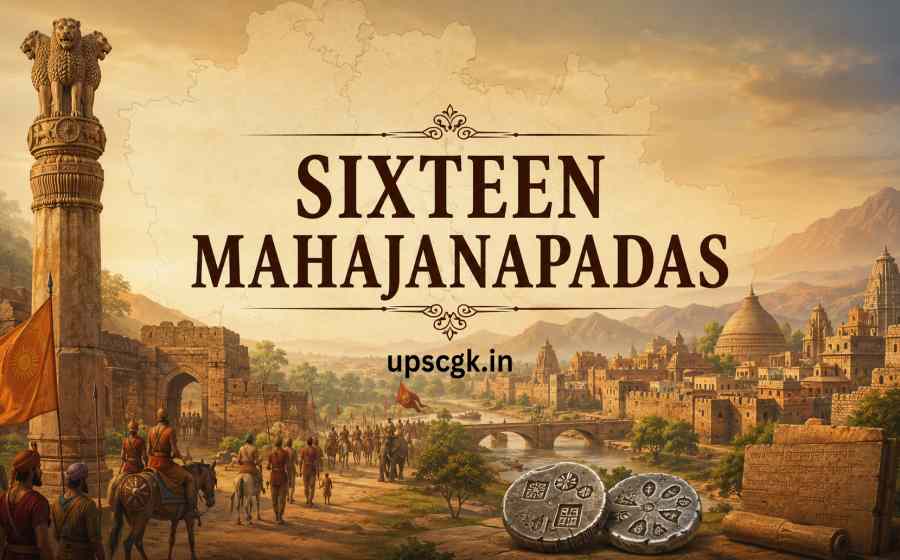
The Sixteen Mahajanapadas were the earliest large kingdoms and republics that emerged in northern and central India during the 6th century BCE. The word Mahajanapada is derived from two Sanskrit words—Maha meaning “great” and Janapada meaning “foothold of a tribe” or “territory of a people.” These states marked a significant transition from tribal societies to organized political kingdoms with defined boundaries, administrative systems, and economic structures.
The rise of the Mahajanapadas represents an important phase in Indian history because it laid the foundation for urbanization, trade, political administration, and the emergence of powerful empires such as the Mauryan Empire. The period also witnessed the rise of new religious movements like Buddhism and Jainism, which challenged the orthodox Vedic traditions.
Table of Contents
Historical Background
During the Later Vedic Period (1000–600 BCE), society underwent remarkable changes. Agriculture expanded with the widespread use of iron tools, forests were cleared for cultivation, and villages gradually developed into towns and cities. Economic prosperity encouraged trade, while political power became concentrated in larger territorial states instead of small tribal communities.
Ancient Buddhist texts such as the Anguttara Nikaya mention the existence of sixteen major states known as the Mahajanapadas. Some were hereditary monarchies, while others functioned as republican states governed by assemblies.
List of the Sixteen Mahajanapadas
| Mahajanapada | Capital | Present-Day Region |
|---|---|---|
| Anga | Champa | Bihar |
| Magadha | Rajagriha (later Pataliputra) | Bihar |
| Kasi | Varanasi | Uttar Pradesh |
| Kosala | Shravasti | Uttar Pradesh |
| Vajji | Vaishali | Bihar |
| Malla | Kushinagar and Pava | Uttar Pradesh |
| Chedi | Shuktimati | Madhya Pradesh |
| Vatsa | Kaushambi | Uttar Pradesh |
| Kuru | Indraprastha | Delhi and Haryana |
| Panchala | Ahichhatra and Kampilya | Uttar Pradesh |
| Matsya | Viratanagara | Rajasthan |
| Surasena | Mathura | Uttar Pradesh |
| Assaka (Ashmaka) | Potana | Maharashtra/Telangana |
| Avanti | Ujjain and Mahishmati | Madhya Pradesh |
| Gandhara | Taxila | Pakistan and Afghanistan |
| Kamboja | Rajapura | Afghanistan and Kashmir region |
Major Mahajanapadas
1. Magadha
Magadha emerged as the most powerful Mahajanapada and eventually became the nucleus of the first great Indian empire.
Reasons for Magadha’s Success
- Fertile alluvial plains of the Ganga basin.
- Rich deposits of iron ore in nearby regions.
- Dense forests provided timber and elephants for warfare.
- Strong rulers such as Bimbisara, Ajatashatru, and later the Nanda Dynasty.
- Excellent river transport and trade routes.
Magadha ultimately conquered several neighboring states and paved the way for the Mauryan Empire under Chandragupta Maurya.
2. Kosala
Kosala was one of the wealthiest kingdoms with Shravasti as its capital. It included the famous city of Ayodhya. King Prasenajit was among its notable rulers and maintained both alliances and conflicts with Magadha.
3. Kasi
Kasi was centered around the prosperous city of Varanasi, one of the oldest continuously inhabited cities in the world. It became famous for trade, textiles, and religious activities. Eventually, it was absorbed by Kosala.
4. Vajji Confederacy
Unlike monarchies, Vajji was a republican confederation consisting of several clans, including the Licchavis. Its capital was Vaishali, regarded as one of the earliest republics in world history.
Important decisions were taken collectively by an assembly rather than by a king.
5. Avanti
Located in western India, Avanti had two important centers:
- Ujjain
- Mahishmati
It became a major commercial hub connecting northern and southern India through important trade routes.
6. Gandhara
Situated in the northwestern region, Gandhara was internationally renowned for its center of learning at Taxila. Students from across Asia came here to study medicine, politics, military science, and philosophy.
Political System
The Mahajanapadas followed two major forms of government.
Monarchies
Most states were ruled by hereditary kings. The king was assisted by ministers, military commanders, tax collectors, and administrative officials.
Examples include:
- Magadha
- Kosala
- Kasi
- Avanti
Republics (Gana-Sanghas)
Some states were governed collectively by clan chiefs or elected representatives.
Examples include:
- Vajji
- Malla
These republics held assemblies where important decisions regarding administration, taxation, and warfare were discussed.
Economy of the Mahajanapadas
Economic growth during this period was remarkable.
Major features included:
- Extensive agriculture using iron ploughs.
- Development of irrigation systems.
- Use of Punch-Marked Coins, the earliest Indian currency.
- Flourishing internal and external trade.
- Growth of guilds (Shrenis) representing merchants and craftsmen.
- Rise of urban centers like Rajagriha, Kaushambi, Ujjain, Taxila, and Varanasi.
The increasing prosperity strengthened state revenues and military power.
Social Life
Society became more organized compared to the earlier Vedic period.
Important characteristics included:
- Expansion of towns and cities.
- Growing influence of merchants and artisans.
- Increased use of iron technology.
- Development of professional occupations.
- Expansion of education and philosophical debates.
The rigid caste system also became more prominent during this period.
Religious Developments
The 6th century BCE witnessed a religious transformation.
People began questioning elaborate Vedic rituals and animal sacrifices. This led to the rise of new religious philosophies.
Buddhism
Founded by Gautama Buddha, Buddhism emphasized the Middle Path, non-violence, and freedom from suffering.
Jainism
Founded by Mahavira, Jainism promoted non-violence (Ahimsa), truthfulness, and ascetic living.
Both religions received support from merchants and rulers of several Mahajanapadas, especially Magadha.
Decline of the Mahajanapadas
Competition among the Mahajanapadas resulted in frequent wars. Magadha gradually emerged victorious because of its superior military strength, strategic location, efficient administration, and capable rulers.
By the 4th century BCE, Magadha had absorbed most of the other Mahajanapadas, leading to the establishment of the powerful Mauryan Empire under Chandragupta Maurya.
Historical Significance
The Sixteen Mahajanapadas occupy a crucial place in Indian history because they:
- Marked the beginning of large territorial states.
- Encouraged urbanization and economic growth.
- Promoted trade and the use of coinage.
- Developed administrative and military institutions.
- Provided the setting for the rise of Buddhism and Jainism.
- Laid the political foundation for the Mauryan Empire.
- Contributed significantly to India’s cultural and intellectual development.
Summary
The Sixteen Mahajanapadas represent a turning point in the political and cultural history of ancient India. They transformed scattered tribal settlements into organized kingdoms and republics with advanced systems of governance, flourishing economies, and vibrant urban centers. Their rivalry ultimately enabled the rise of Magadha, which unified much of the Indian subcontinent under the Mauryan Empire. Understanding the Mahajanapadas is essential for comprehending the evolution of Indian civilization, state formation, and the historical context in which Buddhism and Jainism emerged. Today, they remain one of the most important topics in ancient Indian history and are frequently covered in UPSC, State PSC, SSC, and other competitive examinations.
Also Check: History