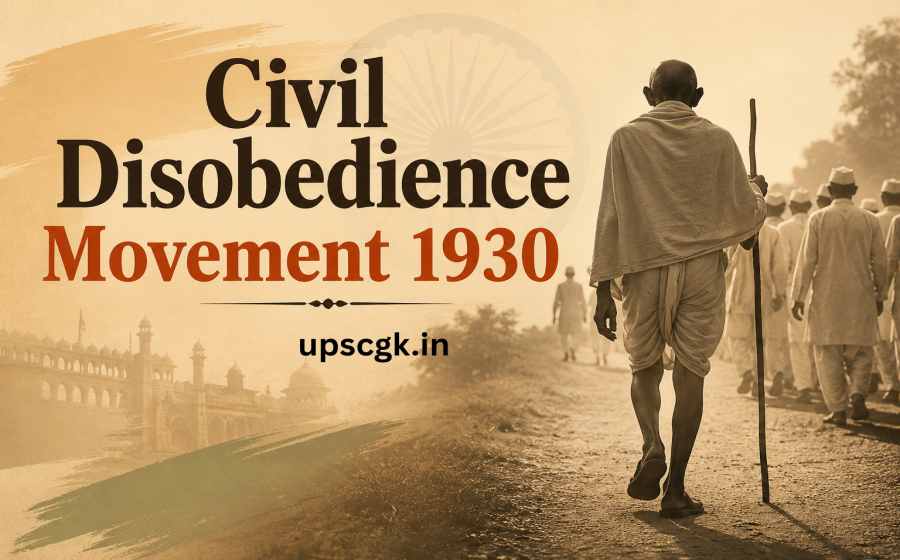
Civil Disobedience Movement 1930: Explore the causes, Dandi March, major events, impact and significance of Gandhi’s movement in India’s freedom struggle.
Civil Disobedience Movement 1930
The Civil Disobedience Movement of 1930 was one of the most significant phases of India’s struggle for independence against British rule. Led by Mahatma Gandhi, the movement aimed to challenge British authority through peaceful resistance and the deliberate violation of unjust laws. It inspired millions of Indians to participate in the freedom struggle and strengthened the demand for complete independence.
The movement began with the famous Salt Satyagraha, also known as the Dandi March, and soon spread across the country. It marked a new stage in India’s national movement by encouraging people from different regions, communities, and social backgrounds to actively oppose British policies.
Table of Contents
Background of the Civil Disobedience Movement
After the end of the Non-Cooperation Movement in 1922, the Indian National Congress continued to demand greater political rights and self-government. However, the British government showed little willingness to grant meaningful reforms.
In 1928, the arrival of the Simon Commission was strongly opposed because it did not include any Indian members. The slogan “Simon Go Back” echoed across the country. Later, in December 1929, under the presidency of Jawaharlal Nehru, the Indian National Congress adopted the goal of Purna Swaraj (Complete Independence) during its Lahore Session.
The Congress declared 26 January 1930 as Independence Day and resolved to launch a mass movement if the British government failed to meet Indian demands. When these demands were ignored, Gandhi prepared to start a nationwide campaign of civil disobedience.
Causes of the Civil Disobedience Movement
Several factors contributed to the launch of the movement:
1. Demand for Complete Independence
The Congress had officially adopted the goal of complete independence, making confrontation with British rule inevitable.
2. Failure of Constitutional Reforms
The British government refused to provide substantial self-government despite growing Indian demands.
3. Economic Hardships
Heavy taxation, low agricultural prices, and the impact of the global economic depression created widespread dissatisfaction among farmers and workers.
4. Salt Tax
The British monopoly on salt production and the tax imposed on it affected every Indian, rich or poor. Gandhi chose the salt issue because it symbolized British exploitation.
The Dandi March and Salt Satyagraha
The Civil Disobedience Movement officially began on 12 March 1930 when Gandhi started the historic Dandi March from Sabarmati Ashram in Gujarat. Accompanied by 78 followers, he walked approximately 390 kilometers to the coastal village of Dandi.
On 6 April 1930, Gandhi broke the British salt law by collecting a handful of salt from the seashore. This simple act became a powerful symbol of resistance against colonial rule.
The Salt Satyagraha attracted widespread attention in India and abroad. Thousands of people started making salt illegally, boycotting British goods, and refusing to obey colonial laws.
Major Features of the Movement
The Civil Disobedience Movement included various forms of peaceful protest:
- Violation of salt laws.
- Boycott of foreign goods and British products.
- Refusal to pay certain taxes.
- Picketing of liquor and foreign cloth shops.
- Resignation from government jobs by some Indians.
- Promotion of khadi and indigenous industries.
Women played an active role in the movement for the first time on such a large scale. Leaders like Sarojini Naidu encouraged women to participate in protests and demonstrations.
British Response
The British government reacted strongly to the growing movement. Thousands of activists were arrested, including Gandhi and many Congress leaders. Public meetings were banned, and police used force to suppress demonstrations.
Despite these measures, the movement continued to spread throughout the country. The arrest of leaders often increased public sympathy and participation.
One of the most famous incidents occurred at Dharasana Salt Works, where peaceful protesters faced severe police brutality without retaliating. International newspapers reported these events, drawing global attention to India’s freedom struggle.
Gandhi-Irwin Pact
As the movement gained momentum, negotiations took place between Gandhi and Lord Irwin.
In March 1931, the Gandhi-Irwin Pact was signed. According to the agreement:
- Political prisoners were released.
- Peaceful picketing was allowed.
- Indians could produce salt for personal use in coastal areas.
- The Congress agreed to suspend the movement temporarily.
Following the pact, Gandhi attended the Second Round Table Conference in London. However, the conference failed to achieve a satisfactory settlement.
Revival of the Movement
After the failure of the Round Table Conference, the Civil Disobedience Movement resumed in 1932. However, the British government adopted even stricter measures to suppress it.
Mass arrests, censorship, and restrictions weakened the movement. By 1934, Gandhi decided to withdraw it, recognizing that it could not continue effectively under the prevailing conditions.
Impact and Significance
The Civil Disobedience Movement had far-reaching consequences:
1. Mass Participation
Millions of Indians participated in the struggle, making it a truly national movement.
2. Increased National Consciousness
The movement strengthened the spirit of nationalism and unity among Indians.
3. International Recognition
The world became aware of India’s demand for freedom and the principles of non-violent resistance.
4. Women’s Participation
A large number of women entered active politics and public life.
5. Weakening of British Authority
Although independence was not achieved immediately, British control faced serious challenges.
6. Foundation for Future Movements
The movement prepared the ground for later campaigns, including the Quit India Movement.
Summary
The Civil Disobedience Movement of 1930 was a landmark event in India’s freedom struggle. Through peaceful resistance and mass participation, Indians demonstrated their determination to end colonial rule. Gandhi’s Salt Satyagraha transformed the freedom movement into a nationwide campaign and inspired people from all walks of life to join the cause. Although the movement did not immediately achieve independence, it significantly weakened British authority and brought India closer to the ultimate goal of freedom in 1947.
Also Check: History