
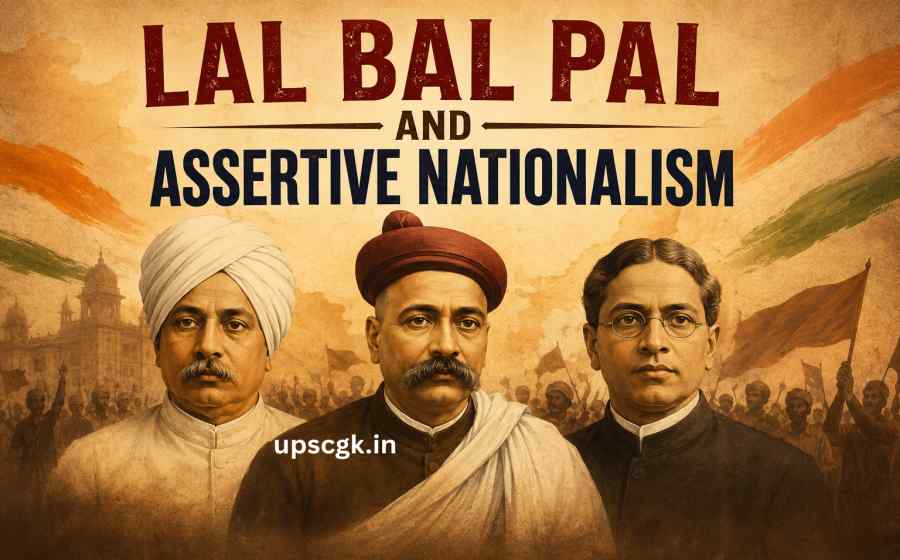
Explore Lal Bal Pal and Assertive Nationalism in India, the rise of extremist leaders, their methods, contributions and impact on the freedom movement.
Lal Bal Pal and Assertive Nationalism
The Indian freedom movement witnessed several phases, each contributing significantly to the struggle against British colonial rule. One of the most important phases emerged in the early twentieth century with the rise of Assertive Nationalism, often referred to as the Extremist phase of the Indian National Congress. This movement was led by the famous trio popularly known as Lal-Bal-Pal, Lala Lajpat Rai, Bal Gangadhar Tilak, and Bipin Chandra Pal. Their leadership marked a shift from the moderate methods of petitions and constitutional reforms to a more aggressive and self-reliant approach toward achieving self-government.
Assertive Nationalism played a crucial role in awakening political consciousness among Indians and preparing the nation for a mass-based struggle against British rule. The movement laid the foundation for future nationalist campaigns and inspired generations of freedom fighters.
Table of Contents
Background of Assertive Nationalism
During the late nineteenth century, the Moderate leaders of the Indian National Congress believed in achieving reforms through constitutional means. They submitted petitions, passed resolutions, and appealed to the British government for administrative reforms.
However, by the beginning of the twentieth century, many educated Indians became dissatisfied with these methods. Several factors contributed to the rise of assertive nationalism:
- Failure of moderate politics to achieve significant results.
- Economic exploitation and increasing poverty under British rule.
- Racial discrimination against Indians.
- The impact of international events such as Japan’s victory over Russia in 1905.
- Growing national consciousness among educated Indians.
- The Partition of Bengal in 1905 by Lord Curzon.
These developments convinced many nationalists that stronger methods were necessary to challenge colonial rule.
Who Were Lal Bal Pal?
The term “Lal-Bal-Pal” refers to three prominent nationalist leaders who became symbols of assertive nationalism.
Lala Lajpat Rai (Punjab)
Lala Lajpat Rai was known as the “Lion of Punjab.” He played a major role in spreading nationalist ideas in northern India. He actively participated in educational reforms and social service activities.
His contributions included:
- Promoting national education.
- Encouraging political activism among youth.
- Opposing British policies through public campaigns.
- Supporting the Swadeshi and Boycott movements.
His courage and dedication earned him immense respect among Indians.
Bal Gangadhar Tilak (Maharashtra)
Bal Gangadhar Tilak is often regarded as the father of assertive nationalism. He believed that political rights could not be obtained merely through petitions.
His famous declaration, “Swaraj is my birthright, and I shall have it,” became a rallying cry for the freedom movement.
Major contributions of Tilak:
- Popularized Ganapati and Shivaji festivals for political awakening.
- Used newspapers like Kesari and Mahratta to spread nationalist ideas.
- Encouraged boycott of British goods.
- Advocated self-reliance and national pride.
Tilak successfully connected politics with the common people, making nationalism a mass movement.
Bipin Chandra Pal (Bengal)
Bipin Chandra Pal was one of the leading nationalist thinkers of Bengal. He strongly supported swadeshi, national education, and economic self-reliance.
His contributions included:
- Promotion of indigenous industries.
- Public lectures advocating nationalism.
- Support for boycott movements.
- Encouragement of cultural and political awakening.
Pal emphasized the importance of self-confidence and national dignity in the struggle for freedom.
Principles of Assertive Nationalism
The Extremist leaders differed significantly from the Moderates in their approach.
Swaraj
The primary objective of the assertive nationalists was Swaraj or self-government. Unlike the Moderates, they demanded greater political autonomy rather than minor administrative reforms.
Swadeshi
The Swadeshi movement encouraged Indians to use goods produced within the country. This helped promote indigenous industries and reduce dependence on British products.
Boycott
The boycott movement urged Indians to reject British goods, institutions, and services. It became an effective economic weapon against colonial rule.
National Education
Assertive nationalists promoted educational institutions that would instill patriotism and national values among students.
Passive Resistance
They advocated peaceful resistance against unjust laws and policies. This approach later influenced larger movements under Mahatma Gandhi.
Partition of Bengal and the Swadeshi Movement
The Partition of Bengal in 1905 became a turning point in Indian nationalism. The British government claimed that the partition was carried out for administrative convenience. However, Indians viewed it as an attempt to divide people on religious lines.
The response was immediate and widespread:
- Boycott of British goods.
- Promotion of indigenous products.
- Public meetings and demonstrations.
- National education initiatives.
- Increased political participation by students and women.
The movement transformed nationalism into a mass movement and greatly strengthened the influence of Lal-Bal-Pal.
Differences Between Moderates and Extremists
| Moderates | Extremists |
|---|---|
| Believed in petitions and appeals | Believed in active resistance |
| Sought gradual reforms | Demanded Swaraj |
| Trusted British justice | Distrusted British intentions |
| Limited public participation | Encouraged mass participation |
| Constitutional methods | Boycott, Swadeshi, and passive resistance |
These differences eventually led to tensions within the Indian National Congress.
Surat Split of 1907
The growing conflict between Moderates and Extremists resulted in the Surat Split of 1907. The Congress session held at Surat witnessed severe disagreements regarding leadership and political strategy.
As a result:
- The Congress split into two factions.
- Extremist leaders faced government repression.
- Tilak was arrested and imprisoned.
Although the split temporarily weakened the movement, the ideas of assertive nationalism continued to spread throughout the country.
Impact and Significance of Assertive Nationalism
The contribution of Lal-Bal-Pal and the extremist movement was immense.
Political Awakening
They transformed nationalism from an elite movement into a popular movement involving ordinary citizens.
Promotion of Self-Reliance
The Swadeshi movement encouraged indigenous industries and economic nationalism.
Strengthening National Unity
Their efforts inspired people across different regions to unite against colonial rule.
Inspiration for Future Leaders
The methods and ideals of assertive nationalism influenced future leaders, including many revolutionaries and later mass movements.
Foundation for Independence
The assertive nationalists prepared India for more organized and widespread struggles that eventually led to independence.
Summary
Lal-Bal-Pal played a pivotal role in the evolution of India’s freedom movement. Their assertive approach challenged the limitations of moderate politics and injected new energy into the nationalist struggle. Through the principles of Swaraj, Swadeshi, Boycott, and National Education, they awakened millions of Indians and strengthened the demand for self-rule. Although they faced repression and internal political challenges, their contributions left a lasting impact on India’s journey toward independence. The rise of assertive nationalism remains one of the most significant chapters in the history of the Indian freedom struggle.
Also Check: History