
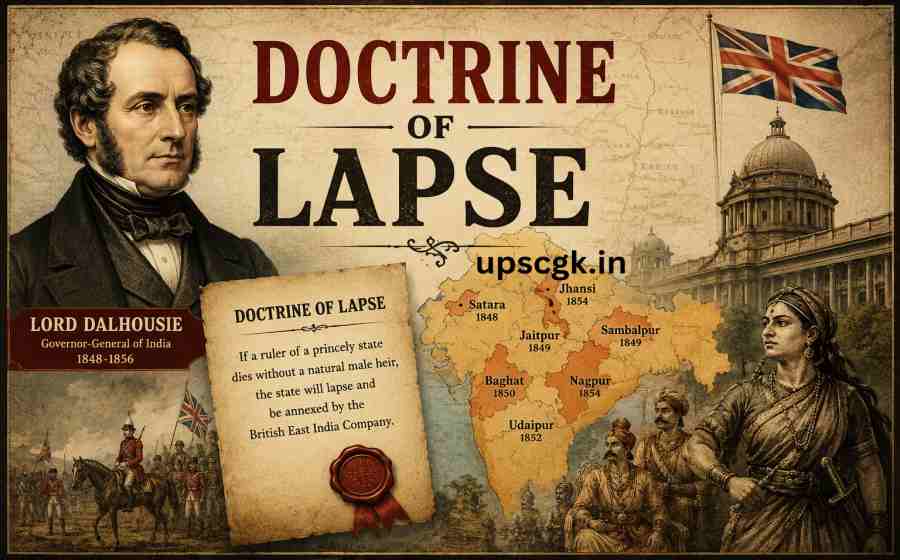
Learn about the Doctrine of Lapse, Lord Dalhousie’s annexation policy that expanded British territory in India and became a major cause of the Revolt of 1857.
Doctrine of Lapse
The Doctrine of Lapse was one of the most controversial policies introduced by the British East India Company in India. Implemented by Lord Dalhousie, who served as the Governor-General of India from 1848 to 1856, this policy became a powerful tool for expanding British territory. Through this doctrine, several Indian princely states were annexed by the British, creating widespread resentment among Indian rulers and their subjects. Historians consider it one of the major factors that contributed to the Revolt of 1857.
Table of Contents
What Was the Doctrine of Lapse?
The Doctrine of Lapse was a policy under which the British East India Company could annex a princely state if its ruler died without leaving a natural male heir. According to traditional Indian customs, a ruler could adopt a son who would inherit the throne and continue the royal lineage. However, Lord Dalhousie refused to recognize adopted heirs in many cases.
Under this policy, if a ruler died without a biological son, the state would “lapse” and become part of British territory. The British justified the doctrine by claiming that it would improve administration and bring stability. However, many Indian rulers viewed it as an unjust interference in their traditional rights and customs.
Lord Dalhousie and His Expansionist Policy
Lord Dalhousie strongly believed in expanding British control over India. He argued that annexation would lead to better governance, modern administration, and economic development. The Doctrine of Lapse became one of his most effective instruments for territorial expansion.
Dalhousie maintained that the British government had the authority to determine succession in princely states under its influence. As a result, several kingdoms lost their independence during his tenure.
States Annexed Under the Doctrine of Lapse
Several important princely states were annexed by the British under this policy. Some of the major examples include:
1. Satara (1848)
Satara, located in present-day Maharashtra, was the first major state annexed under the Doctrine of Lapse. The ruler died without a natural heir, and the British refused to recognize the adopted successor.
2. Jaitpur (1849)
The small princely state of Jaitpur was annexed after the ruler died without a biological son.
3. Sambalpur (1849)
Sambalpur, located in present-day Odisha, was also annexed under the doctrine due to the absence of a natural heir.
4. Baghat (1850)
The state of Baghat faced a similar fate when the British applied the policy and took control of the territory.
5. Udaipur (1852)
A smaller princely state named Udaipur in Central India was annexed under the Doctrine of Lapse.
6. Jhansi (1854)
Jhansi became one of the most famous examples of annexation under this policy. After the death of Raja Gangadhar Rao, his adopted son was not recognized by the British. This decision deeply angered Rani Lakshmibai, who later became one of the leading figures of the Revolt of 1857.
7. Nagpur (1854)
Nagpur was another significant state annexed under the Doctrine of Lapse. Its annexation greatly increased British influence in Central India.
Impact on Indian Rulers
The Doctrine of Lapse created fear and uncertainty among Indian princes. Many rulers believed that the British were deliberately undermining their sovereignty. Since adoption had long been accepted in Indian traditions, the rejection of adopted heirs was seen as a direct attack on established customs.
The policy also damaged the relationship between the British and the princely states. Rulers who had previously cooperated with the British began to distrust their intentions.
Impact on the Indian Population
The annexation of princely states affected not only rulers but also ordinary people. When the British took control, traditional administrative systems were often replaced by new structures. Many officials, soldiers, and nobles lost their positions and privileges.
Economic changes introduced by the British sometimes disrupted local economies. As dissatisfaction grew, public support for resistance against British rule increased in many regions.
Role in the Revolt of 1857
The Doctrine of Lapse played a significant role in creating the conditions that led to the Revolt of 1857. Many Indian rulers and nobles felt betrayed by British policies. The annexation of Jhansi became a symbol of British injustice.
Rani Lakshmibai of Jhansi emerged as one of the most prominent leaders of the revolt. Her opposition to British rule was directly linked to the annexation of her kingdom under the Doctrine of Lapse. The resentment generated by this policy contributed to the broader anti-British sentiment that fueled the uprising.
Criticism of the Doctrine
The Doctrine of Lapse faced criticism from both Indians and some British observers. Critics argued that it violated Indian customs and traditions regarding adoption and succession. They also believed that the policy was motivated more by territorial expansion than by concerns about good governance.
Many historians regard the doctrine as an aggressive imperial policy that weakened trust between the British government and Indian rulers. Its implementation demonstrated the British desire to expand their control at the expense of local autonomy.
Summary
The Doctrine of Lapse was a significant policy introduced by Lord Dalhousie to expand British territory in India. By refusing to recognize adopted heirs, the British annexed several princely states, including Satara, Jhansi, and Nagpur. Although the policy helped the British increase their territorial control, it generated widespread resentment among Indian rulers and the general population. This dissatisfaction became one of the important causes of the Revolt of 1857. Today, the Doctrine of Lapse is remembered as a key chapter in the history of British expansion in India and the growing resistance against colonial rule.
Also Check: History