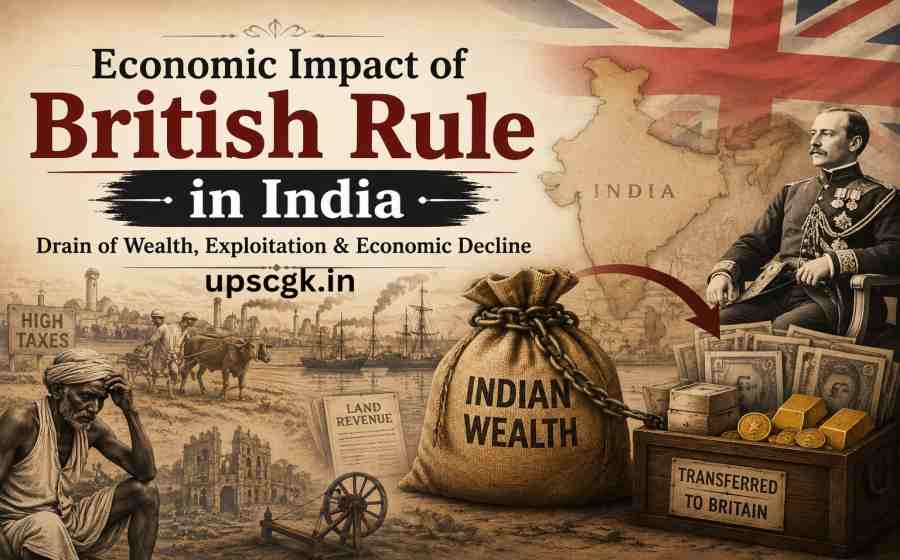
Economic Impact of British Rule in India explained through the Drain of Wealth Theory, colonial exploitation, poverty, deindustrialization and economic decline.
Economic Impact of British Rule in India
The British rule in India brought significant political and administrative changes, but its economic impact was largely detrimental to the country’s growth and prosperity. One of the most important concepts explaining this economic exploitation is the Drain of Wealth Theory, propounded by Indian nationalist leader and economist Dadabhai Naoroji. The theory highlighted how India’s wealth was systematically transferred to Britain without any adequate economic return, leading to widespread poverty and economic stagnation.
The economic exploitation of India under British colonial rule became a major issue during the Indian freedom struggle. Nationalist leaders argued that British policies were designed primarily to benefit Britain rather than India. The Drain of Wealth Theory provided a strong intellectual foundation for criticizing colonial rule and mobilizing public opinion against it.
Table of Contents
Understanding the Drain of Wealth Theory
The Drain of Wealth Theory was first developed by Dadabhai Naoroji in the late nineteenth century. In his famous book, Poverty and Un-British Rule in India, he explained how wealth produced in India was continuously transferred to Britain through various channels without any equivalent return.
According to Naoroji, this transfer of resources was not a normal trade transaction. Instead, it was an economic drain that deprived India of capital needed for investment, industrialization, and development. The result was increasing poverty and economic backwardness despite India’s rich natural and human resources.
Major Channels of Wealth Drain
1. Home Charges
One of the primary channels of wealth drain was the payment of “Home Charges.” These included administrative expenses incurred in Britain for governing India. Such expenses covered pensions of retired British officials, salaries paid in Britain, interest on public debt, and costs of maintaining the India Office in London. Since these payments were made from Indian revenues but spent in Britain, they represented a direct transfer of wealth.
2. Salaries and Remittances of British Officials
A large number of British civil servants, military officers, and administrators worked in India. While they earned their salaries from Indian revenues, a significant portion of their income was sent back to Britain.
After retirement, many officials returned to Britain and continued receiving pensions funded by Indian taxpayers. This further increased the economic drain.
3. Profits of British Companies
British-owned companies operating in India earned substantial profits from trade, plantations, railways, banking, and other sectors. Instead of reinvesting these profits in India, they were largely remitted to Britain.
As a result, the benefits of economic activities in India primarily enriched British investors rather than contributing to India’s development.
4. Unequal Trade Relations
British policies transformed India into a supplier of raw materials and a market for British manufactured goods. Raw materials such as cotton, jute, tea, and indigo were exported to Britain at low prices, while finished products were imported into India.
This unequal trade structure weakened Indian industries, particularly traditional handicrafts and textile manufacturing, leading to deindustrialization and unemployment.
5. Military and Administrative Expenditure
India often bore the cost of British military campaigns conducted outside its borders. Expenses related to wars and imperial expansion were frequently charged to Indian revenues, even when they did not serve India’s interests. Such expenditures increased the financial burden on the Indian economy.
Impact on Indian Economy
Agricultural Distress
The British introduced a revenue system that imposed heavy taxes on farmers. High land revenue demands forced many peasants into debt and poverty. Frequent famines during the nineteenth century exposed the vulnerability of the agricultural sector.
Despite recurring food shortages, colonial policies often prioritized revenue collection and exports over the welfare of farmers.
Decline of Traditional Industries
Before British rule, India was renowned for its handicrafts, textiles, and artisan industries. British industrial products flooded Indian markets and outcompeted local producers.
Millions of artisans lost their livelihoods, leading to widespread unemployment and economic hardship.
Lack of Industrial Development
The continuous outflow of wealth reduced the availability of capital within India. Without sufficient investment, industrial growth remained slow compared to many Western countries.
While railways, ports, and telegraph systems were developed, they were largely designed to facilitate British trade and administrative control rather than promote balanced economic development.
Rise in Poverty
The drain of resources contributed significantly to mass poverty. Nationalist leaders argued that India’s poverty was not due to a lack of resources but because its wealth was being systematically extracted by the colonial government. This economic exploitation widened social inequalities and lowered living standards for millions of Indians.
Criticism and Significance of the Theory
Some British economists argued that the drain was compensation for administrative services and investments made by Britain. However, Indian nationalists maintained that the scale of wealth extraction far exceeded any benefits received.
The Drain of Wealth Theory played a crucial role in awakening national consciousness. It transformed the freedom movement from a political struggle into an economic one by exposing the exploitative nature of colonial rule.
Leaders such as R. C. Dutt, Bal Gangadhar Tilak, and Gopal Krishna Gokhale supported and expanded these arguments, making economic nationalism an important component of India’s independence movement.
Summary
The economic impact of British rule on India was profound and long-lasting. Through mechanisms such as Home Charges, remittances, unequal trade, and profit transfers, a substantial portion of India’s wealth was drained to Britain. Dadabhai Naoroji’s Drain of Wealth Theory effectively exposed this exploitation and became a powerful tool in the nationalist movement.
The theory remains an important framework for understanding the economic consequences of colonialism in India. It highlights how systematic extraction of resources contributed to poverty, underdevelopment, and economic stagnation, leaving a legacy that continued to influence India’s economy even after independence.
Also Check: History