Explore the role of women in Medieval India, their social status, challenges, rights, education and contributions to politics, culture and society.
Role of Women in Medieval India
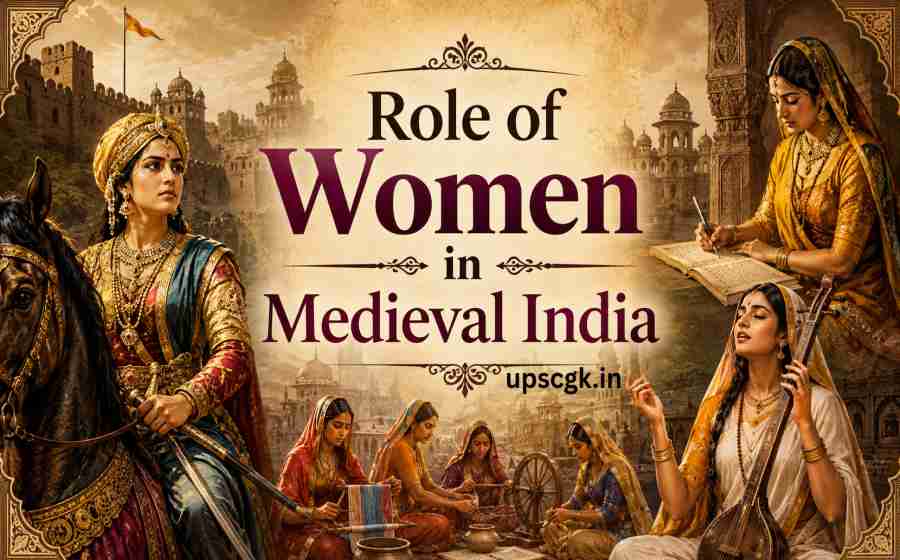
The role of women in Medieval India was complex and varied across regions, religions, and social classes. The medieval period, which broadly spans from the 8th century to the 18th century, witnessed significant political, social, and cultural transformations. During this era, the position of women experienced both progress and decline depending on the prevailing social norms and ruling powers. While many women faced restrictions in education, mobility, and property rights, several remarkable women emerged as rulers, warriors, poets, and spiritual leaders, leaving a lasting impact on Indian history.
Table of Contents
Status of Women in Medieval Society
The social status of women in Medieval India was largely influenced by patriarchal traditions. Women were generally expected to fulfill domestic responsibilities, including managing households and raising children. Their roles were often defined by family and community expectations rather than individual aspirations.
Compared to the ancient period, women in many parts of medieval India experienced a decline in social freedom. Practices such as child marriage became increasingly common, limiting educational and personal opportunities for girls. In some communities, women were married at a very young age and had little say in important life decisions.
The concept of female honor became closely linked to family prestige. As a result, restrictions on women’s movement and public participation increased in several regions. However, the experiences of women varied significantly depending on their economic status and social background.
Education and Intellectual Contributions
Educational opportunities for women were limited during much of the medieval period. Formal education was generally reserved for men, particularly among the upper classes. Despite these challenges, some women gained access to learning through royal courts, religious institutions, or family support.
Several women became respected scholars, poets, and writers. Their literary works enriched Indian culture and contributed to the development of regional languages and devotional literature. Women associated with the Bhakti movement played an important role in spreading spiritual teachings and promoting social equality.
Poet-saints such as Mirabai used devotional poetry to express their spiritual beliefs and challenge rigid social norms. Their works continue to inspire people across India today.
Women in Politics and Administration
Although political power was generally dominated by men, medieval India witnessed the rise of several influential female rulers and administrators. These women demonstrated leadership, courage, and administrative ability during challenging times.
One of the most notable examples is Razia Sultan, who became the first and only woman to rule the Delhi Sultanate. She challenged traditional gender barriers and proved her capability as a ruler.
Another prominent figure was Rani Durgavati, who courageously defended her kingdom against invading forces. Her bravery and dedication to her people made her one of the most respected women in Indian history.
Similarly, Chand Bibi played a significant role in defending the Deccan region against powerful enemies. These examples highlight that women were capable of exercising political authority despite societal limitations.
Women and the Bhakti Movement
The Bhakti movement emerged as an important social and religious force during medieval India. It emphasized devotion to God rather than rigid rituals and caste distinctions. This movement provided women with opportunities to participate in religious and spiritual activities more freely.
Female saints and devotees gained recognition through their teachings, poetry, and spiritual influence. The Bhakti movement challenged traditional social hierarchies and encouraged greater participation of women in religious life.
Women such as Akka Mahadevi and Mirabai became symbols of devotion, independence, and spiritual empowerment. Their contributions helped create a more inclusive religious environment.
Social Practices Affecting Women
Several social customs influenced the lives of women during the medieval period. Some of these practices had negative effects on women’s freedom and opportunities.
Child Marriage
Child marriage became increasingly widespread in many communities. Girls were often married before reaching adulthood, reducing their chances of receiving education or developing independent careers.
Purdah System
The purdah system, which involved the seclusion of women from public view, became more common in certain regions and social groups. It restricted women’s mobility and participation in public life.
Sati Practice
In some areas, the practice of sati emerged, where a widow was expected to sacrifice herself on her husband’s funeral pyre. Although not universally practiced, it became one of the most controversial social customs associated with the medieval period.
Restrictions on Property Rights
Many women faced limitations regarding inheritance and ownership of property. Economic dependence often reduced their social and political influence.
Economic Contributions of Women
Despite social restrictions, women played an important role in the economy. Rural women actively participated in agriculture, animal husbandry, weaving, and household industries. Their labor contributed significantly to family income and local economic development.
Women in artisan families assisted in various crafts, including textile production, pottery, embroidery, and handicrafts. In urban centers, some women engaged in trade-related activities and managed family businesses.
Royal and noble women also contributed to economic welfare by supporting charitable institutions, religious establishments, and public works projects.
Cultural and Artistic Contributions
Women made valuable contributions to medieval India’s cultural heritage. They participated in music, dance, literature, painting, and architecture. Royal courts often encouraged artistic expression, allowing talented women to gain recognition.
Many women composed devotional songs and poems that remain popular today. Their artistic achievements enriched India’s cultural traditions and helped preserve regional languages and folklore.
Summary
The role of women in Medieval India was marked by both challenges and achievements. While social customs such as child marriage, purdah, and restrictions on education limited opportunities for many women, several extraordinary individuals rose above these barriers to make significant contributions to politics, religion, literature, and culture. Female rulers, saints, poets, and warriors demonstrated remarkable leadership and resilience during a period of profound change. Understanding the experiences of women in medieval India provides valuable insight into the social history of the country and highlights the enduring strength and contributions of women throughout Indian civilization.
Also Check: History