Learn about Sher Shah Suri and his major administrative reforms, including land revenue, currency, roads and governance in medieval India.
Sher Shah Suri
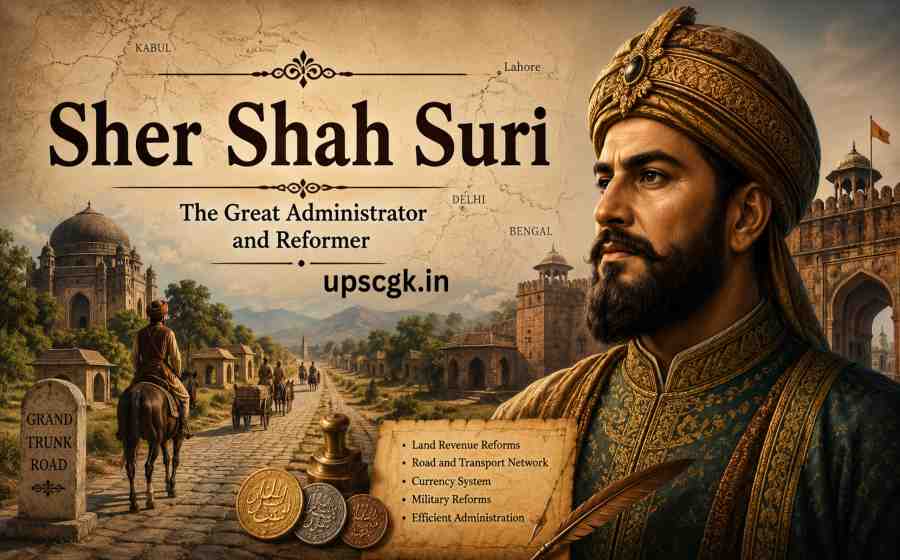
Sher Shah Suri was one of the most capable rulers in medieval Indian history. Though his reign lasted only for a short period from 1540 to 1545, his administrative reforms and governance policies left a lasting impact on India. Born as Farid Khan, he later earned the title “Sher Khan” after reportedly killing a tiger. He eventually established the Sur Empire after defeating Mughal emperor Humayun and became known as Sher Shah Suri.
Sher Shah Suri is often remembered not merely as a conqueror but as a wise administrator and reformer. His innovative systems of administration, revenue collection, road construction, currency, and military organization later influenced the policies of the Mughal emperor Akbar. Many historians consider him one of the greatest rulers of medieval India because of his practical and people-oriented administration.
Table of Contents
Central Administration
Sher Shah Suri established a highly organized central administration to ensure efficient governance across his empire. The emperor occupied the highest position and exercised complete authority. However, he was assisted by several ministers who handled specific departments.
Important departments included:
- Diwan-i-Wizarat: Responsible for revenue and finance matters.
- Diwan-i-Arz: Managed military affairs.
- Diwan-i-Rasalat: Looked after foreign relations.
- Diwan-i-Insha: Managed communication and official records.
Sher Shah closely supervised these departments and regularly reviewed their functioning. His administration focused on discipline, efficiency, and accountability.
Provincial Administration
To maintain effective control over his large empire, Sher Shah divided his territories into administrative units. The empire was divided into provinces called Sarkars, which were further divided into smaller units known as Parganas.
Each Sarkar had important officers such as:
- Shiqdar: Responsible for maintaining law and order.
- Munsif: Looked after judicial matters.
- Amin: Assessed land revenue.
- Treasurer: Managed financial resources.
This system ensured smooth administration at local levels and reduced the chances of corruption.
Land Revenue Reforms
One of Sher Shah Suri’s most significant achievements was his land revenue system. Agriculture was the backbone of the economy, and he recognized the importance of treating farmers fairly.
His land reforms included:
Measurement of Land
Sher Shah ordered proper measurement of agricultural land. The area of land was measured accurately to determine tax liability.
Classification of Land
Land was categorized according to fertility and productivity. This helped in imposing fair taxes rather than arbitrary collections.
Fixed Revenue Rates
The government fixed a specific share of produce as tax. Generally, one-third of the produce was collected as land revenue.
Written Agreements
Sher Shah introduced written agreements between farmers and the state. These agreements included:
- Patta: A document specifying the area and tax amount.
- Qabuliyat: An agreement signed by farmers accepting the terms.
This system protected farmers from exploitation by local officials and created transparency in tax collection.
Currency Reforms
Sher Shah Suri introduced important currency reforms to establish a stable economic system.
He introduced:
- Gold coins called Mohurs
- Silver coins called Rupiya
- Copper coins called Dam
The silver Rupiya became particularly significant because it later formed the basis of India’s modern currency system. Standardized coins improved trade and reduced confusion caused by different local currencies.
Road and Transport Reforms
Sher Shah understood that efficient transportation was necessary for administration, communication, and trade. Therefore, he invested heavily in road construction.
Grand Trunk Road
One of his greatest achievements was the renovation and expansion of the famous Grand Trunk Road. It connected major regions from Bengal to Punjab.
The road improved:
- Trade and commerce
- Military movement
- Administrative communication
- Cultural interaction
Sarais (Rest Houses)
Sher Shah constructed numerous Sarais along major roads. These rest houses provided:
- Accommodation for travelers
- Food and water facilities
- Security arrangements
- Separate facilities for Hindus and Muslims
Sarais also served as centers for communication and information exchange.
Postal System
He developed an efficient postal system using horse riders and messengers stationed at Sarais. This allowed quick transmission of information throughout the empire.
Military Reforms
Sher Shah Suri reorganized the military to create a disciplined and powerful army.
His military reforms included:
Branding of Horses
He introduced a system called Dagh, under which horses were branded with identification marks. This prevented fraud and ensured quality.
Soldier Registration
Soldiers were registered and their descriptions were recorded under the Chehra system.
Direct Recruitment
The ruler maintained direct control over military recruitment and payment systems, reducing corruption and improving discipline.
These measures increased military efficiency and strengthened the empire.
Judicial and Police Reforms
Sher Shah emphasized justice and law enforcement. He believed that a stable state required fair administration.
Key measures included:
- Strict punishment for criminals
- Appointment of local officers for maintaining order
- Equal treatment under law
- Strong policing systems in villages and towns
He ensured that roads remained safe for traders and travelers. Historical accounts suggest that people could travel with valuable goods without fear of theft.
Economic and Trade Reforms
Sher Shah encouraged economic development by simplifying taxes and improving infrastructure.
He:
- Reduced unnecessary taxes
- Promoted internal trade
- Improved market conditions
- Maintained stable currency standards
His policies increased business activity and strengthened the empire’s economy.
Legacy of Sher Shah Suri
Although Sher Shah Suri ruled for only five years as emperor, his administrative vision had a long-lasting influence on Indian governance. His systems of land revenue, currency, roads, and military organization were later adopted and refined by Mughal ruler Akbar.
Sher Shah demonstrated that effective administration depends not only on military power but also on fairness, organization, and public welfare. His reforms helped create a strong administrative framework that influenced future rulers.
Summary
Sher Shah Suri stands as one of India’s greatest administrators. His reforms transformed governance and laid foundations for efficient state administration. Through innovations in revenue systems, roads, currency, military organization, and public welfare, he created a model of governance that survived long after his death. His contributions remain an important chapter in Indian history and continue to be studied for their administrative excellence.
Also Check: History