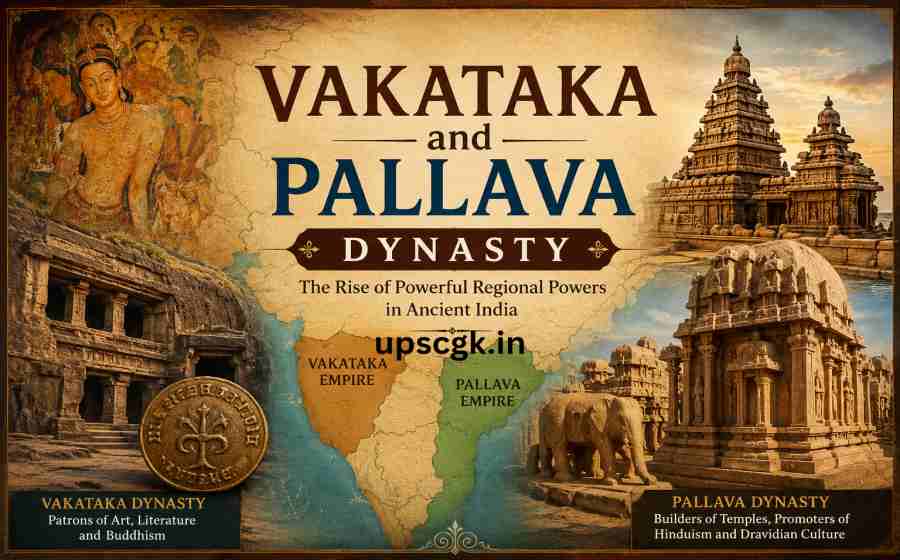
Explore the history, culture, art and achievements of the Vakataka and Pallava Dynasty and their role in shaping ancient India.
Vakataka and Pallava Dynasty
After the decline of major empires like the Satavahanas and later the Guptas, several regional kingdoms emerged in different parts of India. Among these, the Vakatakas in central India and the Pallavas in South India became two of the most influential dynasties of ancient Indian history. These regional powers played an important role in political expansion, cultural growth, religion, literature, architecture, and trade. Their contributions helped shape the future of Indian civilization.
The rise of the Vakatakas and Pallavas marks an important phase in Indian history when regional kingdoms became strong centers of administration and culture. Though they ruled different parts of India, both dynasties greatly contributed to art, temple architecture, education, and the spread of Hinduism.
Table of Contents
Rise of the Vakataka Dynasty
The Vakataka dynasty emerged in the Deccan region during the 3rd century CE after the decline of the Satavahanas. The founder of the dynasty is believed to be Vindhyashakti. However, the real expansion of the kingdom took place under Pravarasena I, who became one of the most powerful rulers of the dynasty.
The Vakatakas mainly ruled regions of present-day Maharashtra, Madhya Pradesh, and parts of Telangana. Their capital was initially located at Nandivardhana near Nagpur. The dynasty later divided into different branches, but it continued to remain influential for many years.
The Vakatakas maintained friendly relations with the Gupta Empire through marriage alliances. One of the most famous examples is the marriage of Prabhavatigupta, daughter of Gupta ruler Chandragupta II, with Vakataka king Rudrasena II. This alliance increased the political strength and cultural influence of the Vakatakas.
Administration and Society of the Vakatakas
The Vakataka rulers followed a well-organized administrative system. The kingdom was divided into provinces and districts for smooth governance. Land revenue was the main source of income, and agriculture remained the backbone of the economy.
Society during the Vakataka period was influenced by Hindu traditions and Brahmanical culture. The rulers supported Brahmins by granting land and villages. Sanskrit became an important language of administration and literature during this period.
Religion also flourished under the Vakatakas. Although Hinduism was dominant, Buddhism continued to receive support. This religious tolerance helped maintain social harmony.
Contribution of the Vakatakas to Art and Culture
The Vakatakas are especially remembered for their contribution to art and architecture. The famous Ajanta Caves reached their peak during Vakataka rule, especially under King Harishena. These caves contain beautiful Buddhist paintings, sculptures, and murals that are considered masterpieces of ancient Indian art.
The Ajanta paintings reflect themes from the life of Buddha and Jataka tales. They also provide information about the clothing, lifestyle, and culture of ancient India. The artistic achievements of the Vakatakas became an inspiration for later Indian art traditions.
The dynasty also encouraged Sanskrit literature and learning. Scholars and poets received royal patronage, helping intellectual activities flourish in the Deccan region.
Rise of the Pallava Dynasty
The Pallava dynasty emerged in South India around the 4th century CE and became one of the strongest powers in the Tamil region. Their kingdom was centered around Kanchipuram, which became a major political, cultural, and religious center.
The early history of the Pallavas is not very clear, but rulers like Simhavishnu and Mahendravarman I greatly expanded the kingdom. Later, Narasimhavarman I became one of the most famous Pallava kings after defeating the Chalukya ruler Pulakeshin II.
The Pallavas frequently fought with the Chalukyas and Pandyas for political dominance in South India. Despite these conflicts, they successfully established a strong and prosperous kingdom.
Administration and Economy of the Pallavas
The Pallavas developed an efficient system of administration. The kingdom was divided into provinces, districts, and villages. Local self-government played an important role during their rule, especially in village administration.
Agriculture was the main occupation of the people, supported by irrigation systems and tanks. Trade and commerce also flourished because of the Pallavas’ coastal location. They maintained maritime trade relations with Southeast Asian countries like Cambodia, Java, and Sri Lanka.
The Pallavas issued coins and promoted urban development. Kanchipuram became an important center of trade, education, and religion.
Pallava Contribution to Religion and Architecture
The Pallavas are best known for their remarkable contribution to temple architecture. They introduced the Dravidian style of temple architecture, which later became highly popular in South India.
Mahendravarman I started the tradition of rock-cut temples, while Narasimhavarman I built magnificent monuments at Mahabalipuram. The Shore Temple and the Pancha Rathas are among the finest examples of Pallava architecture.
The temples built by the Pallavas were not only religious centers but also places of education, art, and social activities. Their architecture influenced later dynasties like the Cholas.
Religion flourished under the Pallavas. Hinduism became more organized, especially Shaivism and Vaishnavism. At the same time, Jainism and Buddhism also existed peacefully in the kingdom.
Cultural Importance of the Pallavas
The Pallava rulers were patrons of literature, music, dance, and education. Sanskrit and Tamil literature both flourished during their rule. Kanchipuram became one of the greatest centers of learning in ancient India.
The Bhakti Movement also gained momentum during this period through the teachings of Alvars and Nayanars, who spread devotion through songs and poetry. Their teachings influenced South Indian society deeply.
Summary
The Vakatakas and Pallavas played a major role in the rise of regional powers in ancient India. The Vakatakas strengthened political and cultural life in the Deccan region and supported great artistic achievements like the Ajanta Caves. The Pallavas transformed South India through military power, trade, religion and magnificent temple architecture.
Both dynasties helped preserve and spread Indian culture, art, literature, and religion during a period of political change. Their contributions remain an important part of India’s historical and cultural heritage.
Also Check: History