
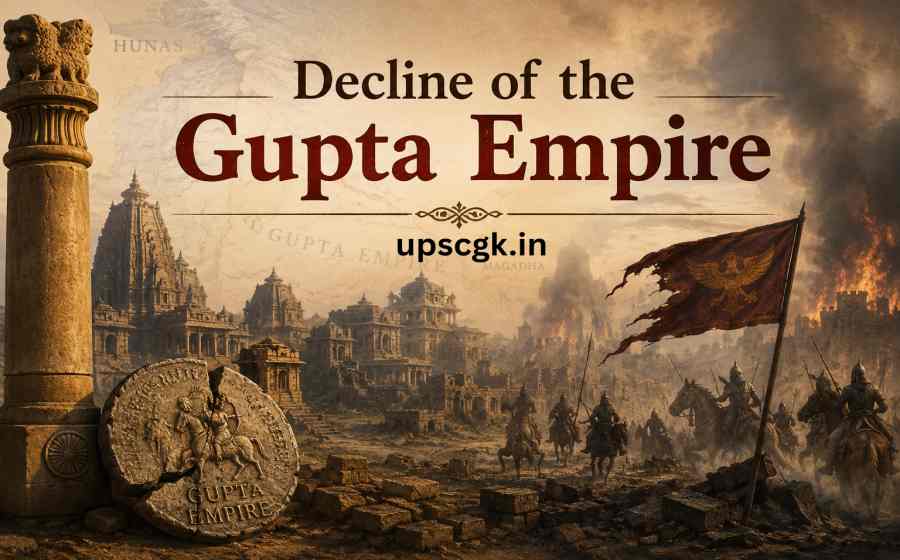
Explore the Decline of the Gupta Empire, its major causes, foreign invasions, weak rulers and lasting impact on Indian history and society.
Decline of the Gupta Empire
The Gupta Empire is considered one of the greatest empires in Indian history. Often called the “Golden Age of Ancient India,” the Gupta period witnessed remarkable progress in science, mathematics, literature, astronomy, art, architecture, trade, and education. Under rulers like Chandragupta I, Samudragupta, and Chandragupta II, the empire became politically strong and culturally advanced.
However, after nearly two centuries of prosperity, the Gupta Empire gradually declined during the late 5th and early 6th centuries CE. The fall of the empire was not caused by a single factor but by a combination of political instability, foreign invasions, economic problems, and weak administration. The decline of the Guptas also had long-term consequences that changed the course of Indian history.
Table of Contents
Background of the Gupta Empire
The Gupta Empire was founded around 320 CE by Chandragupta I. The empire expanded greatly under Samudragupta, who is often called the “Napoleon of India” because of his military achievements. During the reign of Chandragupta II, the empire reached its peak in terms of prosperity, trade, and culture.
The Gupta rulers promoted Hinduism while also supporting Buddhism and Jainism. Famous scholars such as Aryabhata and Kalidasa flourished during this period. However, after the reign of powerful kings, the empire started weakening.
Major Causes of the Decline of the Gupta Empire
1. Weak Successors
One of the most important reasons for the decline of the Gupta Empire was the rise of weak rulers after the reign of strong kings like Skandagupta. The later Gupta rulers lacked military ability, leadership qualities, and administrative skills.
As a result:
- Central authority became weak.
- Provincial governors gained more independence.
- Internal rebellions increased.
- The empire could no longer maintain unity.
Weak leadership reduced the strength and stability of the empire significantly.
2. Hun Invasions
The invasion of the Hunas, also known as the White Huns, played a major role in weakening the Gupta Empire. These foreign invaders attacked northwestern India during the 5th century CE.
Although Skandagupta successfully resisted the Hun attacks initially, continuous invasions exhausted the empire’s military and financial resources. Later rulers failed to stop them effectively.
The Hun invasions caused:
- Destruction of cities and villages
- Decline in trade and agriculture
- Loss of important territories
- Political instability
The repeated attacks weakened the empire beyond recovery.
3. Economic Decline
The Gupta Empire faced serious economic difficulties during its later phase. Constant wars and invasions increased military expenditure, while trade and agricultural production declined.
Several factors affected the economy:
- Decline in long-distance trade
- Reduced tax collection
- Damage caused by invasions
- Excessive land grants to officials and religious institutions
The practice of granting tax-free land reduced government revenue. As income decreased, the rulers struggled to maintain administration and military strength.
4. Decentralization of Administration
The Gupta rulers gradually allowed local governors and feudatories to gain more power. Over time, these local rulers became independent and stopped obeying the central authority.
This decentralization weakened the empire because:
- Provincial rulers acted independently.
- The emperor lost direct control over regions.
- Internal conflicts increased.
- Political unity disappeared.
The weakening of central administration was a major reason behind the collapse of the empire.
5. Internal Conflicts and Succession Disputes
After the death of powerful Gupta rulers, disputes over succession became common. Different princes fought for the throne, leading to civil wars and instability.
These internal conflicts weakened the empire in several ways:
- The army became divided.
- Administrative efficiency declined.
- Enemies took advantage of political confusion.
- Public confidence in rulers decreased.
The lack of a stable succession system contributed greatly to the empire’s downfall.
6. Rise of Regional Powers
As the Gupta Empire weakened, many regional kingdoms emerged in different parts of India. Local rulers declared independence and established their own dynasties.
Some important regional powers included:
- The Vakatakas in central India
- The Maukharis in northern India
- The Pushyabhutis in Thanesar
These regional kingdoms challenged Gupta authority and reduced the empire’s territorial control.
Consequences of the Decline of the Gupta Empire
1. Political Fragmentation
One of the biggest consequences of the Gupta decline was political disunity in India. After the fall of the empire, northern India was divided into many small kingdoms.
This fragmentation led to:
- Frequent wars between regional rulers
- Weak political stability
- Lack of centralized administration
India entered a period of regional politics after the Gupta era.
2. Decline in Trade and Economy
The fall of the Gupta Empire negatively affected trade and economic prosperity. Political instability disrupted trade routes and reduced commercial activities.
As a result:
- Urban centers declined
- Crafts and industries weakened
- Economic growth slowed down
Many towns lost their importance during this period.
3. Feudalism Increased
Land grants to officials and religious institutions became more common after the Gupta period. This encouraged the growth of feudalism in India.
Local landlords gained power over peasants and villages. Over time, the feudal system became an important feature of medieval Indian society.
4. Cultural Influence Continued
Even though the empire declined politically, Gupta cultural achievements continued to influence Indian civilization for centuries.
The Gupta period left a lasting impact on:
- Sanskrit literature
- Temple architecture
- Mathematics and astronomy
- Hindu religious traditions
- Art and sculpture
The cultural legacy of the Guptas remained strong even after their political fall.
5. Foreign Invasions Became Easier
Political fragmentation after the Gupta decline made India vulnerable to future invasions. Without a strong central empire, foreign invaders found it easier to attack different regions.
This situation later contributed to invasions by various foreign powers in medieval India.
Summary
The decline of the Gupta Empire was a gradual process caused by weak rulers, Hun invasions, economic problems, decentralization, internal conflicts, and the rise of regional powers. Although the empire lost its political strength, its cultural and intellectual contributions continued to shape Indian civilization for generations.
The Gupta period remains one of the most glorious chapters in Indian history. Its decline marked the end of ancient India’s classical age and the beginning of a new political and social era in the subcontinent.
Also Check: History