Discover the achievements of Science and Technology in Gupta Age, including Aryabhata and Varahamihira’s contributions to astronomy and mathematics.
Science and Technology in Gupta Age
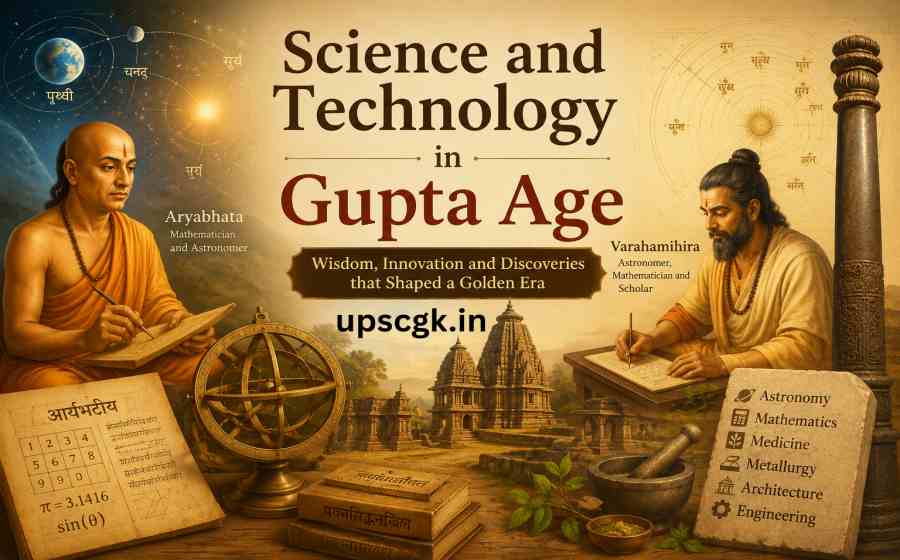
The Gupta Age is often called the “Golden Age of Ancient India” because of its extraordinary achievements in art, literature, education, science, and technology. The Gupta Empire, which ruled large parts of India from the 4th to the 6th century CE, created an environment where knowledge and innovation flourished. During this period, Indian scholars made significant progress in mathematics, astronomy, medicine, metallurgy, and engineering. Among the greatest scientists of this era were Aryabhata and Varahamihira, whose works influenced not only India but also many other civilizations.
The scientific developments of the Gupta period laid the foundation for future discoveries and proved that ancient India was a major center of learning and intellectual advancement.
Table of Contents
Growth of Scientific Knowledge in the Gupta Period
The Gupta rulers strongly supported education and scholarship. Famous universities such as Nalanda University attracted students and scholars from different regions. Subjects like astronomy, mathematics, medicine, grammar, and philosophy were widely studied.
Scientific thinking during the Gupta Age was based on observation, calculations, experimentation, and logical reasoning. Scholars wrote their findings in Sanskrit, making knowledge accessible to educated people across the empire.
Aryabhata and His Contributions
Aryabhata was one of the greatest mathematicians and astronomers of ancient India. He was born in 476 CE and wrote the famous book Aryabhatiya at a young age. His work revolutionized mathematics and astronomy.
Contributions in Mathematics
Aryabhata made remarkable discoveries in mathematics. He introduced advanced concepts that were centuries ahead of Europe.
Some of his major contributions include:
- Use of the decimal system
- Development of algebraic methods
- Accurate calculation of the value of pi
He calculated the value of pi very close to its actual value:
π≈3.1416
This was an extraordinary achievement for that time.
Aryabhata also worked on arithmetic progressions, square roots, cube roots, and trigonometry. He introduced the concept of sine functions, which later became important in global mathematics.
Contributions in Astronomy
Aryabhata challenged many traditional beliefs with scientific explanations. He correctly stated that the Earth rotates on its axis, which causes day and night. This idea was revolutionary because many people believed that the Sun moved around the Earth.
He also explained solar and lunar eclipses scientifically instead of linking them to myths and superstitions. According to Aryabhata, eclipses occur due to the shadow of the Earth and the Moon.
His astronomical calculations helped in preparing calendars and understanding planetary movements with greater accuracy.
Varahamihira and His Scientific Achievements
Another great scholar of the Gupta Age was Varahamihira. He lived during the 6th century CE and was associated with the court of King Chandragupta II.
Varahamihira wrote several important books, including Brihat Samhita and Pancha Siddhantika. These works covered astronomy, astrology, geography, architecture, weather science, and natural phenomena.
Contributions in Astronomy
Varahamihira studied planetary motions and astronomical calculations in detail. He combined Indian knowledge with Greek and Roman astronomical ideas, creating a more advanced scientific understanding.
He explained the movements of planets and stars and improved methods for predicting eclipses and celestial events. His work helped astronomers make better observations of the sky.
Contributions in Geography and Weather Science
Varahamihira also studied rainfall, clouds, earthquakes, and natural signs. He developed early ideas related to meteorology and environmental science.
In Brihat Samhita, he discussed:
- Rain prediction methods
- Underground water sources
- Architecture and town planning
- Agriculture and crop conditions
These studies show that Gupta scholars were deeply interested in practical science that could improve daily life.
Progress in Medicine
Medical science also advanced greatly during the Gupta Age. Indian doctors continued the traditions of earlier scholars like Charaka and Sushruta.
Doctors studied:
- Human anatomy
- Surgery
- Herbal medicines
- Diseases and treatments
Ayurveda became more organized and systematic. Hospitals and medical centers existed in several cities, where patients received treatment using medicinal plants and surgical techniques.
Development in Metallurgy
The Gupta period witnessed impressive progress in metallurgy. The most famous example is the Iron Pillar of Delhi, which still stands today without significant rusting despite being over 1,500 years old.
The iron pillar demonstrates the advanced knowledge of metal extraction and corrosion resistance possessed by Gupta craftsmen. Indian metalworkers were skilled in producing iron, copper, bronze, and gold objects of high quality.
Engineering and Architecture
Gupta engineers and architects made remarkable achievements in temple construction, roads, and urban planning. Temples built during this period displayed strong foundations, artistic carvings, and scientific architectural designs.
Stone-cutting techniques improved greatly, and builders used mathematical principles for symmetry and balance. Gupta architecture later influenced temple construction across India.
Importance of Science and Technology in Gupta Age
The scientific achievements of the Gupta Age had a long-lasting impact on India and the world. Indian mathematical ideas later spread to the Arab world and eventually to Europe. Concepts like the decimal system and trigonometry became essential parts of modern science.
The works of Aryabhata and Varahamihira inspired future generations of scholars and proved that ancient India possessed advanced scientific knowledge. Their discoveries continue to be studied even today.
Summary
The Gupta Age was a remarkable period of scientific and technological advancement in Indian history. Scholars made important contributions in mathematics, astronomy, medicine, metallurgy, and engineering. Great scientists like Aryabhata and Varahamihira transformed the understanding of science through observation, reasoning and calculation.
Their achievements not only enriched Indian civilization but also contributed to the development of global scientific knowledge. The Gupta Age truly deserves its title as the Golden Age of ancient India.
Also Check: History