Discover how Kanishka and Kushana Empire shaped Indian culture, Buddhism, art, trade and religion during ancient India’s golden age.
Kanishka and Kushana Empire
The Kushana Empire occupies a special place in the history of ancient India because it acted as a bridge between India, Central Asia, and the Roman world. Among all Kushana rulers, King Kanishka was the most famous and powerful. His reign marked a golden phase in cultural development, religious growth, art, literature, and international trade. Under his leadership, the Kushana Empire became one of the greatest empires of ancient times.
The Kushanas originally belonged to the Yuezhi tribe of Central Asia. After migrating towards northwestern India, they established a strong kingdom that expanded over present-day Afghanistan, Pakistan, and northern India. Kanishka, who ruled around the 2nd century CE, greatly expanded this empire and transformed it into a center of cultural and religious exchange.
Table of Contents
Rise of the Kushana Empire
The Kushanas came into India after the decline of the Indo-Greek and Shaka powers. They established their authority in regions such as Gandhara, Mathura, Kashmir, and Punjab. The founder of the Kushana power was Kujula Kadphises, but the empire reached its peak under Kanishka.
Kanishka’s empire stretched from Central Asia to the Gangetic plains. His capital was Purushapura, known today as Peshawar. Another important center of administration was Mathura. Due to its strategic location, the empire controlled important trade routes connecting India with China, Central Asia, and the Roman Empire.
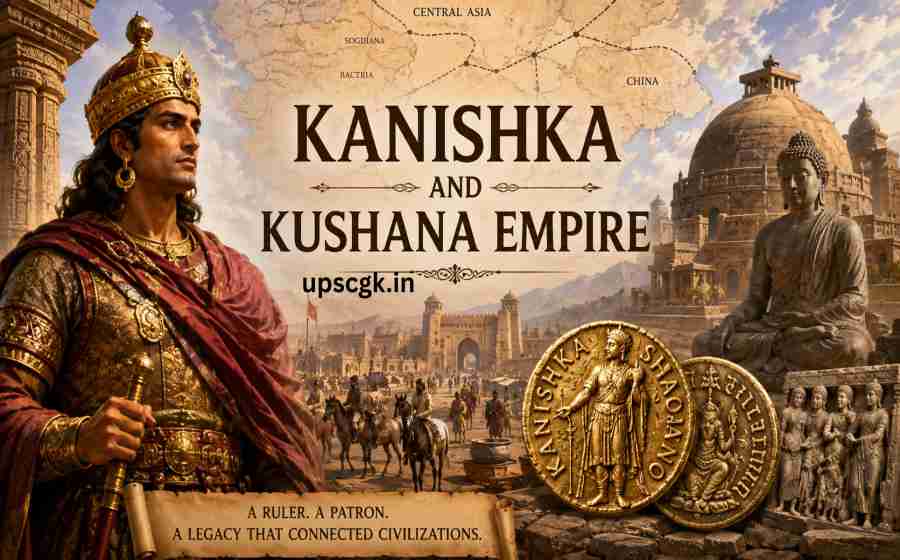
The prosperity generated from trade made the Kushana Empire wealthy and powerful. Gold coins issued during this period show the economic strength of the empire and its international connections.
Kanishka as a Great Ruler
Kanishka is remembered as one of the greatest rulers in Indian history because of his military achievements and cultural contributions. He was not only a conqueror but also a patron of religion, literature, and art.
His rule brought political stability and economic growth. Trade flourished through the famous Silk Route, which connected India with China and the Mediterranean world. Merchants carried silk, spices, textiles, precious stones, and other goods across these regions.
Kanishka also encouraged religious tolerance. Although he became a follower of Buddhism, he respected many religions. This can be seen from his coins, which contain images of Greek, Persian, Hindu, and Buddhist deities. Such practices reflected the multicultural nature of the Kushana Empire.
Contribution to Buddhism
One of the greatest achievements of Kanishka was his support for Buddhism. He played a major role in spreading Buddhism beyond India to Central Asia, China, Korea, and Japan.
Kanishka organized the Fourth Buddhist Council in Kashmir. This council was mainly associated with the Mahayana school of Buddhism. During this period, Buddhism underwent important developments. The Mahayana sect emphasized the worship of Buddha as a divine figure and promoted the idea of compassion and salvation for all people.
Due to Kanishka’s patronage, Buddhist monks traveled to foreign lands and spread Buddhist teachings. As a result, Buddhism became an international religion.
Kanishka also built many stupas, monasteries, and viharas. The famous Kanishka Stupa at Peshawar was considered one of the tallest and most magnificent Buddhist monuments of ancient times.
Development of Gandhara Art
The Kushana period witnessed remarkable progress in art and architecture, especially the Gandhara School of Art. This art style developed mainly in the Gandhara region, covering parts of present-day Pakistan and Afghanistan.
Gandhara art was unique because it combined Indian and Greek artistic traditions. Sculptures of Buddha made during this period showed Greek influence in facial features, curly hair, and flowing robes. For the first time, Buddha was represented in human form on a large scale.
Another important artistic center was Mathura. The Mathura School of Art developed a more indigenous Indian style. The sculptures from Mathura were bold, spiritual, and deeply connected with Indian traditions.
Both Gandhara and Mathura schools greatly influenced later Indian art and Buddhist sculpture across Asia.
Growth of Literature and Learning
Kanishka was a great patron of scholars and intellectuals. His court included famous Buddhist thinkers and writers.
One of the most important scholars of his court was Ashvaghosha, a renowned poet and philosopher. He wrote the famous work Buddhacharita, which describes the life of Gautama Buddha. Another important scholar was Nagarjuna, who became a leading philosopher of Mahayana Buddhism.
Medical science also advanced during this period. Charaka, the famous physician associated with Ayurveda, is believed to have lived during Kanishka’s reign. His work, the Charaka Samhita, became an important text in Indian medicine.
The Kushana period therefore contributed significantly to literature, philosophy, and scientific learning.
Religious Tolerance and Cultural Exchange
The Kushana Empire became a meeting point of different cultures and religions. Since the empire connected many regions, people from diverse backgrounds interacted with one another.
The rulers followed a policy of religious tolerance. Hinduism, Buddhism, Zoroastrianism, and Greek religious traditions coexisted peacefully. Coins issued by Kushana rulers depicted gods from multiple cultures, symbolizing harmony and inclusiveness.
This cultural interaction enriched Indian society. Indian ideas spread to Central Asia and China, while foreign artistic and cultural influences entered India. The Kushana period thus played a major role in creating a cosmopolitan civilization.
Economic Prosperity and Trade
Trade was another important feature of the Kushana Empire. The empire controlled major trade routes linking India with the Roman Empire and China.
Indian merchants exported silk, cotton textiles, spices, ivory, and precious stones. In return, gold and luxury goods came into India. The abundance of gold coins from the Kushana period proves the prosperity of the empire.
The Silk Route became a channel not only for trade but also for the spread of ideas, religion, and culture. Buddhism especially traveled through these trade routes into East Asia.
Summary
Kanishka and the Kushana Empire made lasting contributions to Indian culture and religion. Under Kanishka’s leadership, Buddhism spread across Asia, art flourished, literature advanced, and international trade expanded greatly. The Gandhara and Mathura schools of art became milestones in Indian artistic history.
The Kushana Empire also promoted cultural exchange and religious tolerance, making it one of the most progressive empires of ancient India. Even today, Kanishka is remembered as a ruler who connected civilizations and helped shape the cultural heritage of Asia.
Also Check: History