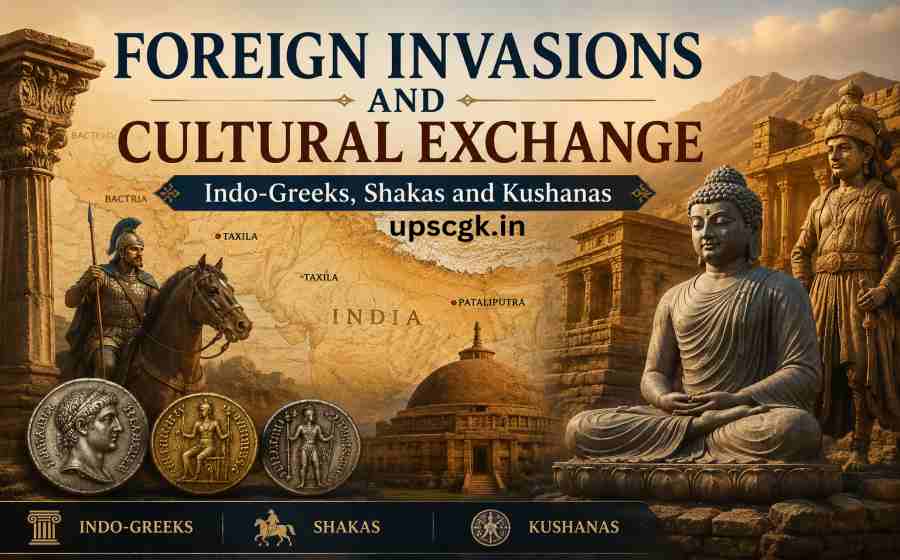
Learn about Foreign Invasions and Cultural Exchange in Ancient India through the Indo-Greeks, Shakas and Kushanas and their lasting impact.
Foreign Invasions and Cultural Exchange
Ancient India witnessed several foreign invasions that deeply influenced its political, cultural, economic, and religious life. Among the most important foreign groups were the Indo-Greeks, Shakas, and Kushanas. These invaders entered India mainly through the north-western passes after the decline of the Mauryan Empire. Although they initially came as conquerors, they gradually became part of Indian society and contributed greatly to cultural exchange and civilization.
These foreign dynasties played an important role in connecting India with Central Asia, West Asia, and the Mediterranean world. Their influence can be seen in Indian art, trade, religion, coinage, language, architecture, and administration.
Table of Contents
Background of Foreign Invasions
After the fall of the Mauryan Empire around 185 BCE, political unity in India weakened. The north-western frontier became vulnerable to invasions from Central Asia. At the same time, many tribes and kingdoms in Central Asia were being displaced due to conflicts and migrations. As a result, several foreign groups entered India and established their rule.
The Indo-Greeks were the first among them, followed by the Shakas and later the Kushanas. Despite being foreigners, these rulers adopted many Indian traditions and helped in the development of a mixed culture.
Indo-Greeks
Origin and Expansion
The Indo-Greeks were descendants of the Greeks who had settled in Bactria after the campaigns of Alexander the Great. They entered north-western India around the 2nd century BCE.
The most famous Indo-Greek ruler was Menander I, also known as Milinda. His kingdom extended over large parts of Punjab and north-western India.
Menander and Buddhism
Menander became famous for his association with Buddhism. The Buddhist text Milinda Panha records a dialogue between Menander and the Buddhist monk Nagasena. It shows Menander’s interest in Buddhist philosophy and indicates that he may have accepted Buddhism.
This interaction reflected the beginning of deep cultural exchange between Greek and Indian traditions.
Contributions of Indo-Greeks
1. Development of Coinage
The Indo-Greeks introduced high-quality gold and silver coins in India. Their coins carried portraits of kings and inscriptions in both Greek and Kharosthi scripts. This improved the Indian monetary system.
2. Spread of Hellenistic Culture
Greek influence can be seen in Indian sculpture, art, astronomy, and architecture. Indian artists adopted realistic human figures and decorative styles from Greek traditions.
3. Cultural Blending
The Indo-Greeks respected Indian religions and customs. Many Greek rulers adopted Indian titles and supported local traditions. This led to the rise of a mixed Indo-Greek culture.
Shakas
Origin of the Shakas
The Shakas, also called Scythians, were nomadic tribes from Central Asia. They entered India due to pressure from other tribes like the Yuezhis. The Shakas established their rule in western and north-western India.
The most famous Shaka ruler was Rudradaman I.
Administration and Rule
The Shakas introduced the system of Kshatrapas or satraps, which means provincial governors. This administrative system helped them manage large territories efficiently.
Their rule became strong in regions like Gujarat, Malwa, Sindh, and Maharashtra.
Cultural Contributions of Shakas
1. Promotion of Trade
The Shakas promoted both inland and overseas trade. Indian ports on the western coast became active centers of commerce with Rome and West Asia.
2. Sanskrit Inscriptions
Rudradaman’s Junagadh inscription is one of the earliest long inscriptions written in Sanskrit. This marked the growing importance of Sanskrit language in administration.
3. Religious Tolerance
The Shakas supported Hinduism, Buddhism, and Jainism. Their tolerant attitude encouraged peaceful cultural interaction.
4. Blend of Cultures
The Shakas adopted Indian customs and became integrated into Indian society. Over time, they lost their separate identity and merged with local communities.
Kushanas
Origin of Kushanas
The Kushanas were originally a branch of the Yuezhis from Central Asia. They established a powerful empire in north India and Central Asia during the 1st century CE.
The greatest Kushana ruler was Kanishka.
Empire of Kanishka
Kanishka established a vast empire extending from Central Asia to the Gangetic plains. His capital was Purushapura, modern-day Peshawar.
He is remembered as a great patron of Buddhism and culture.
Contributions of Kushanas
1. Spread of Buddhism
Kanishka strongly supported Mahayana Buddhism. Under his patronage, Buddhism spread to Central Asia, China, and other regions.
The Fourth Buddhist Council was held during his reign in Kashmir.
2. Gandhara Art
The Kushana period saw the growth of the famous Gandhara School of Art. This style combined Indian themes with Greek artistic techniques.
Buddha statues with curly hair, realistic expressions, and flowing robes reflected Greek influence.
3. Growth of Trade
The Kushanas controlled important trade routes such as the Silk Route. Trade between India, Rome, China, and Central Asia increased greatly.
India exported spices, textiles, precious stones, and ivory, while importing gold and luxury goods.
4. Advancement in Coinage
Kushana coins were beautifully designed and carried images of Greek, Persian, and Indian deities. This reflected the multicultural nature of their empire.
5. Cultural Integration
The Kushanas promoted a cosmopolitan culture where Indian, Greek, Persian, and Central Asian traditions mixed together.
Impact of Foreign Invasions on India
Foreign invasions did not only bring political changes but also transformed Indian society in many ways.
1. Cultural Exchange
These foreign rulers introduced new artistic styles, clothing, customs, and ideas. Indian culture absorbed foreign influences while also influencing outsiders.
2. Development of Art
The Gandhara School of Art emerged due to Greek and Indian interaction. Sculptures became more realistic and detailed.
3. Trade Expansion
Trade routes connecting India with Rome, China, and Central Asia expanded rapidly. This increased prosperity and urban growth.
4. Religious Spread
Buddhism spread beyond India through the support of Kushana rulers. Indian religious ideas reached many foreign lands.
5. Administrative Innovations
Systems like satrap administration and improved coinage strengthened governance and economy.
Summary
The Indo-Greeks, Shakas, and Kushanas played a major role in shaping Ancient Indian history. Though they entered India as foreign invaders, they eventually became part of Indian society. Their rule encouraged cultural exchange, trade, religious development, and artistic progress.
The interaction between Indian and foreign traditions created a rich and diverse civilization. The influence of these dynasties can still be seen in Indian art, culture, religion, and historical heritage. Their contribution proves that cultural exchange often leads to growth, innovation, and mutual understanding in human civilization.
Also Check: History