Explore Ram Manohar Lohia’s ideas on socialism, democracy and social justice and his contribution to shaping modern Indian political thought.
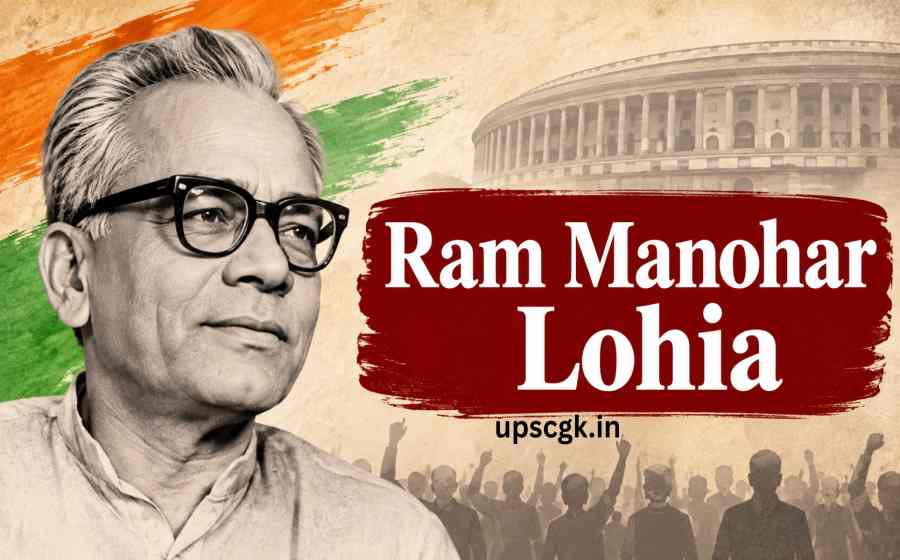
Ram Manohar Lohia
Ram Manohar Lohia was one of the most influential socialist thinkers and political leaders in modern Indian history. He played an important role in India’s freedom movement and later became a strong voice for democracy, social equality and economic justice. His political philosophy focused on reducing inequality, challenging caste discrimination, empowering ordinary people and building a more inclusive society.
Unlike many political thinkers who focused mainly on economic inequality, Lohia connected socialism with social discrimination, gender inequality, caste hierarchy and political decentralisation. His ideas continue to influence discussions on Indian democracy, social justice and inclusive development.
Table of Contents
Early Life and Political Background
Ram Manohar Lohia was born on 23 March 1910 in Akbarpur, in present-day Uttar Pradesh. His father, Hiralal Lohia, was a supporter of Mahatma Gandhi and introduced him to the Indian national movement at an early age.
Lohia studied in India and later went to Germany, where he pursued higher education at the University of Berlin. His exposure to European socialist movements and political developments influenced his understanding of economic and social inequality.
After returning to India, he joined the Indian National Congress and became associated with its socialist group. In 1934, he became one of the founding members of the Congress Socialist Party (CSP), which sought to promote socialist principles within the national movement.
During the Quit India Movement of 1942, Lohia actively participated in underground resistance against British rule and was arrested for his activities. His contribution established him as an important socialist leader in India’s independence struggle.
Lohia’s Concept of Socialism
Socialism was the central foundation of Lohia’s political philosophy. He believed that political independence alone could not create a truly free society unless economic and social inequalities were also removed.
According to Lohia, wealth and economic opportunities should not remain concentrated in the hands of a small section of society. He supported a more equal distribution of resources and opportunities so that ordinary people could participate in economic development.
However, Lohia’s socialism was different from a purely class-based approach. He argued that Indian society faced several interconnected forms of inequality, particularly caste discrimination, gender inequality and economic exploitation.
He believed that socialism must address all these problems together rather than focusing only on the conflict between rich and poor.
Lohia also supported small-scale industries, decentralised economic planning and the use of appropriate technology. He believed that economic development should generate employment and improve the living conditions of ordinary people rather than simply increase industrial production.
Democracy and Political Decentralisation
Lohia considered democracy essential for establishing a just and equal society. He believed that democracy should not be limited to elections and parliamentary institutions. Instead, people should have meaningful participation in political and administrative decision-making.
One of his most important contributions was the idea of the Four-Pillar State (Chaukhamba Raj).
According to this concept, political power should be distributed among four levels:
- Village: The village should have authority over local matters and development activities.
- District: District-level institutions should manage regional administration and planning.
- Province: State or provincial governments should handle wider administrative responsibilities.
- Centre: The central government should manage national issues and responsibilities.
Lohia believed that excessive concentration of power at the national level weakened democracy. Decentralisation would bring administration closer to citizens, encourage local participation and make governance more accountable.
His ideas remain relevant to discussions about Panchayati Raj institutions and grassroots democracy in India.
Social Justice and the Fight Against Caste Discrimination
Social justice was one of the most important aspects of Lohia’s political philosophy. He strongly opposed the caste system and believed that caste-based discrimination was a major obstacle to equality and national development.
He argued that Indian society could not become genuinely democratic while a large section of its population remained socially and economically disadvantaged.
Lohia supported greater representation and opportunities for backward communities, Scheduled Castes, Scheduled Tribes, minorities and women in education, employment and political institutions.
He advocated the principle of Special Opportunities (Vishesh Avasar) to improve the participation of historically disadvantaged groups in public life.
His approach went beyond providing equal rights in theory. He wanted practical measures that would enable disadvantaged communities to overcome historical barriers and participate equally in society.
Sapta Kranti: The Seven Revolutions
One of Lohia’s most significant contributions to political thought was the concept of Sapta Kranti (Seven Revolutions). He believed that a just society required simultaneous struggles against seven major forms of inequality and injustice.
The seven revolutions were:
- Gender Equality: Ending discrimination between men and women.
- Racial Equality: Fighting discrimination based on skin colour.
- Caste Equality: Eliminating caste-based discrimination and inequality.
- Freedom from Colonialism: Ending foreign domination and supporting the freedom of nations.
- Economic Equality: Fighting inequality created by concentrated wealth and private capital.
- Civil Liberties: Protecting individual freedom against unjust restrictions by the state.
- Non-Violence: Opposing excessive dependence on weapons and promoting peaceful resistance through Satyagraha.
Through Sapta Kranti, Lohia presented a broader understanding of socialism that connected economic equality with human dignity, freedom and social transformation.
Lohia’s Contribution to Indian Politics
After independence, Lohia emerged as an important opposition leader and a strong critic of the Congress government’s policies. He believed that a healthy democracy required a strong opposition capable of questioning those in power.
He challenged the concentration of political authority and criticised policies that, in his view, failed to address poverty and inequality.
Lohia also supported non-violent political movements and civil resistance. He believed that democratic politics should combine three important activities: constructive work, peaceful struggle against injustice and electoral participation.
His political slogan of Spade, Prison and Vote represented these three methods of social and political transformation.
He was elected to the Lok Sabha in 1963 from Farrukhabad and used Parliament to question government policies and highlight the problems of ordinary citizens.
His criticism of the government and advocacy of opposition unity contributed to the development of non-Congress political alternatives in India.
Relevance of Lohia’s Political Ideas Today
Ram Manohar Lohia’s political ideas remain significant in contemporary India. His emphasis on social justice, women’s equality, decentralisation and economic opportunities continues to be relevant to democratic debates.
His opposition to caste discrimination connects with ongoing discussions about affirmative action and the representation of disadvantaged communities.
Similarly, his Four-Pillar State offers an important perspective on decentralised governance and strengthening local democratic institutions.
His ideas also encourage policymakers to consider economic development alongside social equality, civil liberties and public participation.
Although his proposals have faced practical and political challenges, his broader vision of an inclusive and democratic society remains an important contribution to Indian political thought.
Summary
Ram Manohar Lohia was a remarkable socialist thinker who developed a distinctive political philosophy suited to India’s social and economic conditions. His ideas of socialism, democracy, social justice, Four-Pillar State and Sapta Kranti presented a comprehensive vision of an equal society.
He believed that true democracy required more than political independence and electoral participation. It also demanded economic fairness, the elimination of caste discrimination, gender equality and the protection of individual freedoms.
Also Check: Political Science