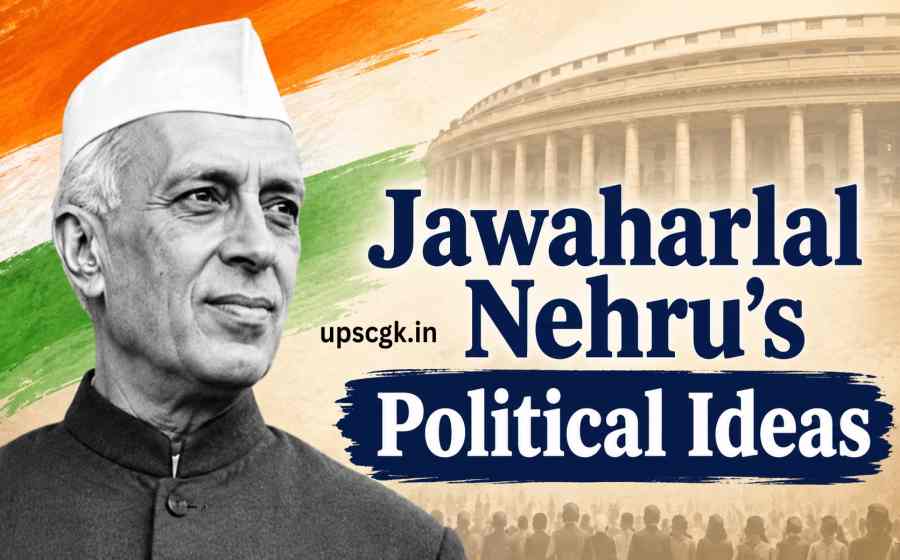
Explore Jawaharlal Nehrus political ideas on democracy, secularism and socialism and how they shaped modern India’s political foundations.
Jawaharlal Nehrus Political Ideas
Jawaharlal Nehru was one of the most influential leaders in modern Indian history and an important architect of independent India. As India’s first Prime Minister (1947–1964), he played a significant role in shaping the country’s political, economic and social institutions. His political philosophy was influenced by liberalism, democratic socialism, nationalism, secularism and scientific thinking.
Nehru believed that political independence alone was not enough to build a strong nation. India also needed democracy, social equality, economic development and religious harmony. His ideas on democracy, secularism and socialism became important foundations of India’s political development.
Table of Contents
Nehru’s Idea of Democracy
Democracy was central to Nehru’s political philosophy. He believed that every citizen should have equal political rights and opportunities to participate in the country’s governance. For him, democracy was not limited to holding elections; it also required freedom, equality, tolerance and respect for different opinions.
After independence, Nehru supported the establishment of a parliamentary democratic system based on universal adult franchise. Under this system, every adult citizen received the right to vote regardless of caste, religion, gender or economic background.
He strongly supported democratic institutions, including Parliament, an independent judiciary and a free press. He believed that political disagreements should be resolved through peaceful discussion and constitutional methods rather than violence.
Nehru also emphasised the importance of individual liberty and civil rights. He considered democratic values essential for maintaining national unity in a diverse country like India.
However, his government also faced criticism over restrictions on civil liberties, particularly during the early years of the republic. This highlights the difference between his democratic ideals and some policies followed during his premiership.
Nehru’s Idea of Secularism
Secularism was another important element of Nehru’s political thought. India is a country with diverse religious communities, languages and cultural traditions. Nehru believed that religion should not determine the rights, identity or political status of citizens.
He supported a secular state in which all religions would receive equal respect and protection. According to his vision, the government should not favour any particular religion or discriminate against citizens because of their religious beliefs.
Nehru considered communalism a serious threat to national unity and democratic development. He believed that religious divisions could weaken India’s social harmony and political stability.
His understanding of secularism was closely connected with scientific thinking, rationalism and modern education. He encouraged people to develop a scientific temper and avoid superstition and religious intolerance.
Nehru’s secular vision influenced India’s constitutional and political development. The Constitution guarantees freedom of religion and prohibits discrimination on religious grounds. Although the word “secular” was added to the Preamble through the 42nd Constitutional Amendment in 1976, the principles of religious freedom and equality were present in the Constitution from its adoption in 1950.
Nehru’s Idea of Socialism
Nehru believed that political democracy would remain incomplete without economic and social justice. He was concerned about poverty, unemployment, inequality and the concentration of wealth in a few hands.
His idea of socialism aimed to create a society where economic opportunities and resources were distributed more fairly. He supported democratic methods of achieving socialist objectives rather than revolutionary violence or the establishment of a one-party dictatorship.
Nehru favoured a mixed economy in which both the public and private sectors would contribute to national development. However, he believed that the government should play a major role in developing industries, infrastructure and essential services.
His economic approach was reflected in several initiatives:
- Five-Year Plans: Introduced systematic planning to promote economic growth and development.
- Public Sector Development: Encouraged government investment in heavy industries, steel plants, power generation and infrastructure.
- Agricultural Development: Supported irrigation projects, scientific farming and agricultural modernisation.
- Scientific and Technical Education: Promoted institutions for higher education, research and technological advancement.
The establishment of institutions such as the Indian Institutes of Technology (IITs) and the expansion of scientific research reflected his belief in modernisation and industrial development.
In 1955, the Indian National Congress adopted the goal of a “socialistic pattern of society” at its Avadi session, reflecting Nehru’s influence on India’s economic direction.
Scientific Temper and Modernisation
Nehru strongly believed that science and technology were essential for India’s progress. He wanted India to overcome poverty, illiteracy and backwardness through education, scientific research and industrial development.
He promoted rational thinking and encouraged citizens to question outdated beliefs and social practices. His concept of scientific temper was later recognised as a fundamental duty under Article 51A(h) of the Indian Constitution, which was added through the 42nd Amendment in 1976.
Nehru viewed modern science not merely as a tool for economic growth but also as a means of improving society and promoting rational decision-making.
Nehru’s Vision of International Relations
Nehru’s political ideas also influenced India’s foreign policy. He believed that newly independent countries should maintain their independence in international affairs rather than become dependent on powerful military blocs.
He became one of the leading advocates of the Non-Aligned Movement (NAM), which formally emerged at the Belgrade Conference in 1961. The movement aimed to protect the independence of countries during the Cold War.
Nehru also supported peaceful coexistence, anti-colonialism, international cooperation and disarmament. His foreign policy was influenced by the principles of the Panchsheel Agreement of 1954, which promoted peaceful relations between India and China.
Criticism of Nehru’s Political Ideas
Although Nehru made significant contributions to India’s political and economic development, his ideas and policies have also faced criticism.
His socialist economic model relied heavily on government planning and public-sector expansion. Critics argue that excessive regulation and bureaucratic controls restricted private investment and economic efficiency.
His approach to secularism has also generated political debate, particularly regarding the relationship between religion, state institutions and minority rights.
Similarly, some critics question the effectiveness of his foreign policy, especially in light of the 1962 India-China War.
Nevertheless, his commitment to parliamentary democracy, scientific development, secular governance and social justice remains an important part of India’s political history.
Summary
Jawaharlal Nehru’s political philosophy was based on the belief that democracy, secularism and socialism were essential for building a modern and progressive India. He worked to establish democratic institutions, promote religious harmony and reduce economic inequalities through planned development.
Although some of his economic and political policies remain subjects of debate, his contribution to India’s parliamentary democracy, secular outlook, scientific development and international identity remains significant. His political ideas continue to influence discussions about India’s democracy and nation-building.
Also Check: Political Science