Explore Vedic Literature in simple terms, understand Vedas, Brahmanas, Aranyakas and Upanishads, their meaning, structure and importance in Indian history.
Vedic Literature
Vedic literature forms the earliest and most important body of knowledge in ancient Indian history. It is the foundation of Indian philosophy, religion, culture, and social structure. Composed in Sanskrit and passed down orally for centuries, this literature reflects the spiritual, intellectual, and cultural life of early Aryans.
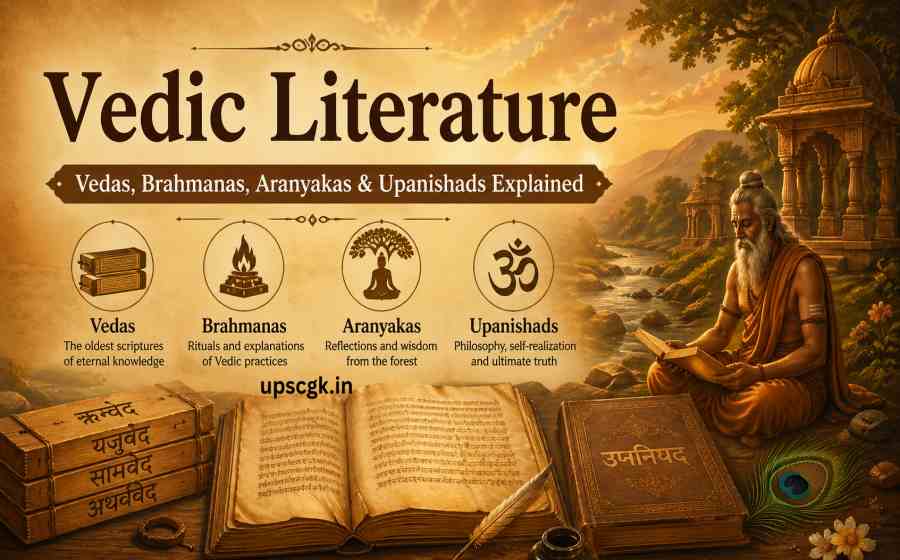
Vedic literature is broadly divided into four main categories: Vedas, Brahmanas, Aranyakas, and Upanishads. Each of these has a distinct purpose and contributes to a deeper understanding of ancient Indian civilization.
Table of Contents
1. The Vedas – The Oldest Sacred Texts
The Vedas are the oldest known scriptures in the world, believed to be composed between 1500 BCE and 500 BCE. The word “Veda” means knowledge. These texts are considered Shruti (that which is heard) and were passed orally from generation to generation.
There are four Vedas:
- Rigveda: The oldest Veda, containing hymns dedicated to various gods like Indra, Agni, and Varuna. It gives insight into early Vedic society and religious practices.
- Samaveda: Known as the Veda of melodies, it consists mainly of chants derived from the Rigveda and used in rituals.
- Yajurveda: Contains formulas and instructions for performing sacrifices and rituals.
- Atharvaveda: Includes spells, charms, and hymns related to everyday life, health, and protection.
The Vedas mainly focus on rituals, prayers, and the worship of natural forces. They also reflect the early social and political structure of Vedic society.
2. Brahmanas – Ritualistic Explanations
The Brahmanas are prose texts that explain the rituals and ceremonies described in the Vedas. They act as guides for priests, detailing how sacrifices (yajnas) should be performed.
Key features of Brahmanas:
- Explain the meaning and significance of Vedic rituals
- Provide detailed instructions for conducting sacrifices
- Emphasize the importance of rituals in maintaining cosmic order
Some well-known Brahmanas include:
- Aitareya Brahmana (associated with Rigveda)
- Shatapatha Brahmana (associated with Yajurveda)
The Brahmanas show a shift from simple hymns to complex rituals, indicating the growing importance of priestly authority in society.
3. Aranyakas – The Forest Texts
The Aranyakas form the transitional phase between ritualistic and philosophical thought. The word “Aranyaka” means “forest,” as these texts were studied by sages in forests during meditation and retreat.
Key characteristics:
- Focus on symbolic interpretation of rituals
- Move away from external rituals toward internal understanding
- Serve as a bridge between Brahmanas and Upanishads
The Aranyakas reflect a shift in thinking, from performing rituals to understanding their deeper meaning. They encourage contemplation and spiritual reflection rather than mere mechanical practice.
4. Upanishads – The Essence of Philosophy
The Upanishads represent the highest level of Vedic thought and philosophy. They are often called Vedanta, meaning “the end of the Vedas.”
Main ideas of Upanishads:
- Concept of Brahman (ultimate reality)
- Concept of Atman (individual soul)
- Unity of Atman and Brahman
- Karma (action) and rebirth
- Liberation (Moksha)
Unlike earlier texts, the Upanishads focus on knowledge and self-realization rather than rituals. They explore deep philosophical questions like:
- What is the nature of reality?
- Who am I?
- What happens after death?
Famous Upanishads include:
- Isha Upanishad
- Kena Upanishad
- Katha Upanishad
- Chandogya Upanishad
- Brihadaranyaka Upanishad
These texts laid the foundation for later Indian philosophies, including Vedanta, Yoga, and Buddhism.
Summary
Vedic literature is not just a collection of ancient texts, it is a complete system of knowledge that evolved over time. Starting from the ritualistic hymns of the Vedas, moving through the detailed explanations in the Brahmanas, transitioning into the reflective Aranyakas, and finally reaching the deep philosophical insights of the Upanishads, this literature shows a clear intellectual progression.
Understanding Vedic literature is essential for grasping the roots of Indian civilization, spirituality, and philosophy. Even today, its teachings continue to influence millions of people around the world.
Also Check: History