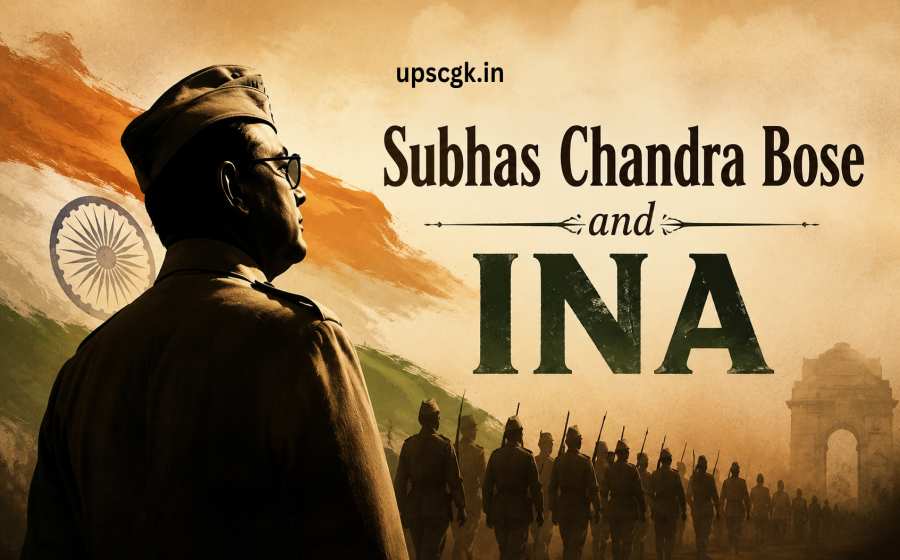
Learn about Subhas Chandra Bose and INA, their role in India’s freedom struggle, military campaigns, Azad Hind Government and lasting legacy.
Subhas Chandra Bose and INA
The Indian freedom struggle witnessed the contributions of numerous leaders and movements that collectively paved the way for India’s independence. Among these leaders, Subhas Chandra Bose occupies a unique place due to his revolutionary approach and unwavering commitment to ending British rule. While many freedom fighters followed non-violent methods, Bose believed that armed resistance was necessary to secure India’s freedom. His leadership of the Indian National Army (INA), also known as the Azad Hind Fauj, became one of the most significant chapters in India’s independence movement.
Table of Contents
Early Life and Political Career of Subhas Chandra Bose
Subhas Chandra Bose was born on 23 January 1897 in Cuttack. He was an intelligent student and successfully passed the Indian Civil Services (ICS) examination in England. However, driven by patriotism, he resigned from the prestigious service and joined the struggle for India’s freedom.
Bose quickly rose within the ranks of the Indian National Congress and became known for his strong nationalist views. He served as the President of the Congress in 1938 and 1939. However, ideological differences with leaders such as Mahatma Gandhi led him to resign from the position. Bose favored more aggressive methods against British rule and later formed the Forward Bloc in 1939.
Escape from India and International Support
The British government viewed Bose as a threat and placed him under house arrest. In January 1941, he made a dramatic escape from India and traveled through Afghanistan and the Soviet Union before reaching Germany. There, he sought international support for India’s independence.
During the Second World War, Bose believed that Britain’s enemies could assist India’s struggle for freedom. He later moved to Southeast Asia, where a large number of Indian prisoners of war and expatriates were available to support the cause of liberation.
Formation of the Indian National Army (INA)
The Indian National Army was initially formed in 1942 by Mohan Singh with the support of the Indian Independence League. However, the INA gained real momentum when Subhas Chandra Bose assumed leadership in 1943.
Upon his arrival in Singapore, Bose reorganized the army and transformed it into a disciplined military force dedicated to liberating India from British rule. He gave the famous slogan:
“Give me blood, and I will give you freedom.”
This powerful call inspired thousands of Indians to join the movement.
Azad Hind Government
In October 1943, Bose established the Provisional Government of Free India, commonly known as the Azad Hind Government. This government declared war against Britain and sought international recognition.
Several countries recognized the Azad Hind Government. Bose adopted the salutation “Jai Hind,” which later became a popular national slogan in independent India. He was widely addressed as “Netaji,” meaning respected leader.
Military Campaigns of the INA
The primary objective of the INA was to enter India and inspire a mass uprising against British rule. Alongside Japanese forces, the INA advanced toward India’s northeastern frontier.
The most significant campaigns took place in the regions of:
- Imphal
- Kohima
The INA successfully crossed into Indian territory and raised the Indian national flag in some liberated areas. However, due to difficult terrain, lack of supplies, adverse weather conditions, and the changing course of World War II, the campaigns eventually failed.
Despite military setbacks, the bravery and determination of INA soldiers left a deep impact on the Indian population.
The Rani of Jhansi Regiment
One of the most remarkable aspects of the INA was the formation of the Rani of Jhansi Regiment, an all-women combat unit. It was led by Lakshmi Sahgal.
The regiment symbolized women’s active participation in the freedom struggle and challenged traditional social norms. It remains one of the earliest examples of a women’s military force in modern Asia.
INA Trials and Public Response
After the defeat of Japan in 1945, many INA soldiers were captured by British authorities. The British government decided to put INA officers on trial at the historic Red Fort in Delhi.
The trials generated massive public sympathy across India. People from different regions, religions, and political backgrounds united in support of the INA soldiers. Demonstrations and protests erupted throughout the country.
The INA trials significantly weakened British authority and strengthened nationalist sentiment. Many historians believe that the widespread support for the INA contributed to Britain’s decision to leave India.
Death and Legacy of Subhas Chandra Bose
According to official accounts, Subhas Chandra Bose died in a plane crash in August 1945 near Taipei. However, the circumstances surrounding his death have remained a subject of debate and speculation for decades.
Bose’s contribution to India’s independence movement remains immense. His courage, determination, and vision inspired millions of Indians. Although the INA did not achieve military victory, it played a crucial psychological and political role in weakening British rule.
Today, Subhas Chandra Bose is remembered as one of India’s greatest freedom fighters. His slogan “Jai Hind” continues to resonate as a symbol of patriotism and national pride.
Summary
Subhas Chandra Bose and the Indian National Army represented the militant and revolutionary dimension of India’s freedom struggle. Through his leadership, Bose mobilized thousands of Indians to fight for independence and challenged the British Empire through armed resistance. The INA’s campaigns, the formation of the Azad Hind Government, and the public reaction to the INA trials significantly influenced the final phase of India’s independence movement. Netaji’s legacy continues to inspire generations, reminding Indians of the sacrifices made for the nation’s freedom.
Also Check: History