Explore parliamentary and presidential governments, their key features, differences, advantages and disadvantages, with examples from different countries.
Parliamentary and Presidential Government
Government systems determine how political power is organised, exercised and controlled within a country. Two of the most widely recognised democratic systems are the parliamentary system and the presidential system. Both aim to establish representative government and ensure political accountability, but they differ in the distribution of executive power, the relationship between the legislature and executive, and the method of selecting the head of government.
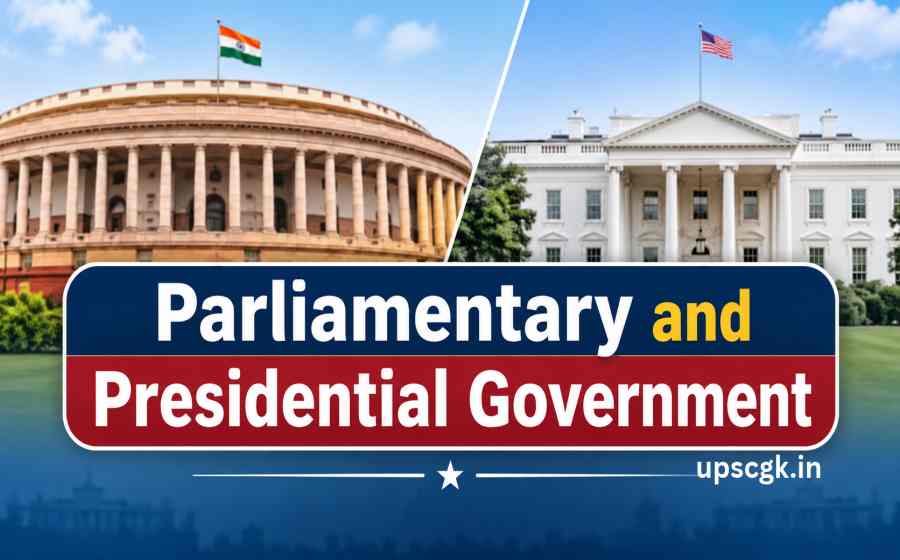
Countries such as India and the United Kingdom follow the parliamentary system, while the United States follows the presidential system. Understanding these two models helps explain how different democracies function.
Table of Contents
Parliamentary System of Government
A parliamentary system is a form of democratic government in which the executive is drawn from the legislature and remains accountable to it. The Prime Minister is generally the head of government and exercises executive authority with the support of the Council of Ministers.
In this system, the head of state and head of government are usually two different positions. For example, India has a President as its constitutional head of state and a Prime Minister as the head of government.
Key Features of the Parliamentary System
1. Dual Executive: There are two executive positions: the head of state and the head of government. The head of state performs constitutional or ceremonial functions, while the Prime Minister leads the government.
2. Collective Responsibility: The Council of Ministers is collectively responsible to the lower house of Parliament. In India, the Union Council of Ministers is collectively responsible to the Lok Sabha.
3. Close Relationship Between Legislature and Executive: The Prime Minister and ministers are generally members of the legislature. The executive participates in parliamentary proceedings and is answerable to elected representatives.
4. Leadership of the Prime Minister: The Prime Minister leads the Council of Ministers, coordinates government policies and plays a central role in administration.
5. Possibility of Dissolution: The lower house may be dissolved before completing its full term under constitutional rules, leading to fresh elections.
Examples
India, the United Kingdom, Canada, Australia and Japan follow parliamentary forms of government, although their constitutional arrangements differ.
Presidential System of Government
A presidential system is a democratic form of government in which the President serves as both the head of state and the head of government. The President generally exercises executive powers independently of the legislature and is elected separately from it, either directly or through an electoral mechanism.
The United States is the most prominent example of a presidential system. Its President heads the executive branch and serves a constitutionally fixed term.
Key Features of the Presidential System
1. Single Executive: The President serves as both the head of state and head of government, combining ceremonial and executive responsibilities.
2. Separation of Powers: The executive, legislature and judiciary have constitutionally defined powers and operate as separate branches of government.
3. Fixed Tenure: The President normally holds office for a fixed constitutional term and cannot be removed simply because of political disagreement with the legislature.
4. Independent Executive: The President appoints ministers or secretaries who are generally responsible to the President rather than members of the legislature.
5. Checks and Balances: Different branches of government can limit one another’s powers to prevent excessive concentration of authority.
Examples
The United States, Brazil and Mexico follow presidential systems, with variations in their constitutional structures.
Differences Between Parliamentary and Presidential Government
Although both systems are based on democratic principles, they differ significantly in their political and constitutional arrangements.
| Basis | Parliamentary System | Presidential System |
|---|---|---|
| Executive structure | Dual executive | Single executive |
| Head of government | Prime Minister | President |
| Head of state | Usually separate | President |
| Executive selection | Emerges from the legislature | Elected separately from the legislature |
| Relationship with legislature | Close relationship | Separation of powers |
| Tenure | Depends on legislative confidence and constitutional rules | Generally fixed term |
| Responsibility | Executive accountable to Parliament | President not politically responsible to legislature |
| Removal | No-confidence motion or constitutional procedures | Impeachment or other constitutional procedures |
| Cabinet | Ministers generally drawn from legislature | Ministers usually appointed from outside the legislature |
| Political stability | May face instability due to loss of majority | Fixed tenure generally provides continuity |
Advantages of the Parliamentary System
The parliamentary system offers several important advantages:
- Greater accountability: The government must maintain the confidence of the elected lower house and answer questions raised by legislators.
- Coordination: The close relationship between the executive and legislature can make lawmaking and policy implementation easier.
- Flexibility: A government that loses legislative support can be replaced without waiting for the next regular election.
- Representative government: Different political parties and groups may participate in government through coalition arrangements.
Disadvantages of the Parliamentary System
Despite its advantages, the parliamentary model also has certain limitations:
- Political instability: Coalition governments or weak majorities may result in frequent changes in government.
- Concentration of power: A Prime Minister with a strong parliamentary majority may exercise considerable influence over the legislature.
- Party dominance: Party discipline can sometimes restrict independent decision-making by legislators.
- Policy uncertainty: Changes in government may affect the continuity of certain policies.
Advantages of the Presidential System
The presidential system also offers several benefits:
- Stable tenure: A fixed presidential term provides continuity in executive leadership.
- Clear leadership: The President has clearly defined executive responsibilities.
- Separation of powers: Independent branches help prevent the concentration of authority.
- Direct accountability: Voters can evaluate the President’s performance in a separate presidential election.
Disadvantages of the Presidential System
Some important limitations include:
- Possibility of deadlock: Disagreements between the President and legislature may delay legislation and government decisions.
- Concentration of executive authority: Significant powers vested in one individual may create concerns about excessive presidential authority.
- Limited flexibility: Replacing an ineffective President before the end of the term is generally difficult.
- Political polarisation: Separate elections for the executive and legislature may produce competing political mandates.
Parliamentary vs Presidential Government: Which Is Better?
Neither system is universally better. The effectiveness of a government depends on its constitutional framework, political culture, democratic institutions and leadership.
The parliamentary system is often preferred for its legislative accountability and flexibility, while the presidential system offers greater executive independence and continuity through fixed terms.
Some countries have also adopted semi-presidential systems, which combine elements of both models. France is a prominent example, with an elected President and a Prime Minister who leads the government.
Summary
Parliamentary and presidential systems represent two important approaches to democratic governance. The parliamentary model emphasises cooperation between the executive and legislature, whereas the presidential model gives greater importance to the separation of powers and institutional checks and balances.
India’s adoption of the parliamentary system reflects its emphasis on collective responsibility and legislative accountability. The United States, on the other hand, demonstrates how a presidential system operates through separate branches of government.
Also Check: Political Science