
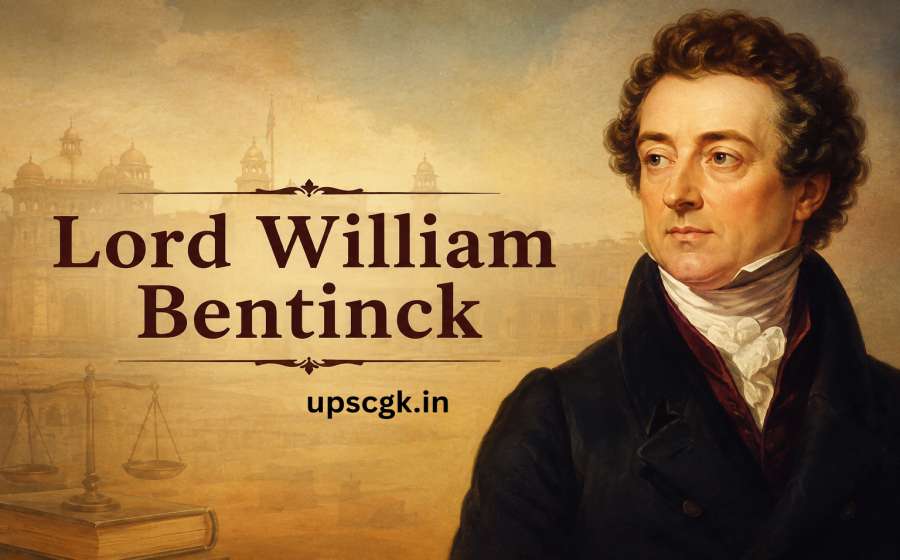
Lord William Bentinck introduced landmark social and administrative reforms, including the abolition of Sati, educational changes and judicial reforms in India.
Lord William Bentinck
Lord William Bentinck served as the Governor-General of India from 1828 to 1835 and is regarded as one of the most progressive administrators during the early British rule in India. His tenure marked the beginning of significant social, administrative, educational, and financial reforms that aimed to modernize the colonial administration. Although many of his policies primarily served British interests, several reforms also contributed to long-term social change in India.
Bentinck believed in reducing unnecessary government expenditure while improving governance. His administration focused on abolishing harmful social customs, reforming the judicial system, encouraging modern education, and strengthening administrative efficiency. His period in office is often considered a turning point in the history of British India.
Table of Contents
Background of Lord William Bentinck
Before becoming Governor-General, Lord William Bentinck had served as the Governor of Madras. He assumed office at a time when the East India Company faced financial difficulties, administrative inefficiency, and increasing criticism regarding certain social practices in India.
Influenced by liberal thinkers and reformers such as Raja Ram Mohan Roy, Bentinck introduced several measures that sought to improve governance while maintaining British authority.
Social Reforms
Abolition of Sati (1829)
The most celebrated reform introduced by Lord William Bentinck was the abolition of the Sati system, a practice in which a widow was forced or expected to immolate herself on her husband’s funeral pyre.
Several Indian social reformers, particularly Raja Ram Mohan Roy, had strongly campaigned against this inhuman custom. After studying the issue and consulting religious scholars and administrators, Bentinck passed Regulation XVII of 1829, declaring the practice illegal and punishable by law.
This reform became a milestone in the history of social justice in India and reflected the government’s willingness to intervene in social customs considered inhumane.
Suppression of Thuggee
Bentinck’s administration also launched an extensive campaign against the Thuggee gangs, who were notorious for robbery and murder across different parts of India.
The campaign was led by Colonel William Sleeman, whose systematic efforts resulted in the arrest and punishment of thousands of Thugs. This significantly improved public safety and security on major trade routes.
Efforts Against Female Infanticide
Although attempts had been made earlier, Bentinck strengthened measures to discourage female infanticide, especially in regions where the practice was prevalent. Administrative officers were instructed to monitor affected areas and enforce existing laws more effectively.
Educational Reforms
One of the most significant contributions of Lord William Bentinck was the promotion of English education in India.
Introduction of English as the Medium of Education
In 1835, following the recommendations of Thomas Babington Macaulay, Bentinck accepted the policy of promoting English education through Macaulay’s Minute.
The government decided that educational funds would primarily support English-language education and Western scientific knowledge instead of traditional Sanskrit and Persian institutions.
This decision laid the foundation for modern education in India and produced a new class of educated Indians who later played an important role in the Indian freedom movement.
Promotion of Western Learning
The new educational policy encouraged the study of science, mathematics, philosophy, medicine, and modern literature. It also increased the establishment of English-medium schools and colleges.
While critics argued that this policy neglected indigenous education, it undoubtedly accelerated the spread of modern ideas and intellectual awakening.
Administrative Reforms
Financial Reforms
When Bentinck assumed office, the East India Company faced serious financial challenges. He introduced strict measures to reduce government expenditure.
His financial reforms included:
- Reduction of excessive salaries and allowances.
- Elimination of unnecessary administrative expenses.
- Better supervision of revenue collection.
- Greater efficiency in public administration.
These measures significantly improved the Company’s financial condition.
Judicial Reforms
Bentinck reorganized the judicial system to make it more accessible and efficient.
Important judicial reforms included:
- Expansion of lower courts.
- Appointment of qualified Indian judges in subordinate courts.
- Simplification of legal procedures.
- Reduction in delays in the justice delivery system.
These reforms improved the functioning of the judiciary, although higher judicial positions largely remained under British control.
Inclusion of Indians in Administration
Lord William Bentinck believed that capable Indians should be appointed to lower administrative and judicial posts.
Qualified Indians were increasingly employed as:
- Deputy Magistrates
- Subordinate Judges
- Revenue Officials
This policy not only reduced administrative costs but also provided educated Indians with greater opportunities in government service.
Revenue and Economic Measures
Bentinck paid special attention to improving revenue administration.
His government worked to:
- Increase efficiency in land revenue collection.
- Minimize corruption among revenue officials.
- Improve record-keeping.
- Encourage better supervision of district administration.
Although these measures primarily aimed to increase Company revenue, they also introduced greater administrative discipline.
Military Reforms
To reduce expenditure, Bentinck introduced several military economies.
These included:
- Reduction in military allowances.
- Curtailment of unnecessary expenses.
- Administrative restructuring within the army.
These financial measures strengthened the Company’s budget but were not always welcomed by British military officers.
Significance of Bentinck’s Reforms
The reforms introduced by Lord William Bentinck had lasting consequences for Indian society and administration.
Some of the major achievements include:
- Abolition of the Sati system.
- Promotion of modern English education.
- Suppression of Thuggee.
- Improvement in judicial administration.
- Better financial management.
- Increased participation of Indians in lower government services.
- Greater administrative efficiency across British India.
Many historians regard him as one of the most reform-minded Governor-Generals of the East India Company era.
Criticism of His Reforms
Despite their importance, Bentinck’s reforms have also faced criticism.
Some limitations include:
- Educational reforms favored English over traditional Indian education.
- Administrative reforms mainly benefited British governance.
- Revenue policies continued to burden many peasants.
- Higher administrative positions remained inaccessible to most Indians.
Therefore, while his reforms brought modernization, they were designed within the framework of colonial rule.
Legacy of Lord William Bentinck
Lord William Bentinck occupies a unique place in Indian history because he combined administrative efficiency with social reform. His abolition of Sati remains one of the most significant humanitarian achievements of British rule in India. His educational reforms created the foundation of India’s modern education system, while his administrative changes improved governance and judicial administration.
Although many of his policies were intended to strengthen British control, they also unintentionally contributed to the rise of an educated Indian middle class that later became instrumental in the struggle for independence.
Summary
Lord William Bentinck’s tenure marked a significant phase in the evolution of British administration in India. His social reforms, especially the abolition of Sati and suppression of Thuggee, reflected humanitarian concerns, while his educational and administrative reforms laid the groundwork for modern governance and learning. Despite criticisms regarding colonial motives, his contributions remain an important chapter in the history of India.
Also Check: History