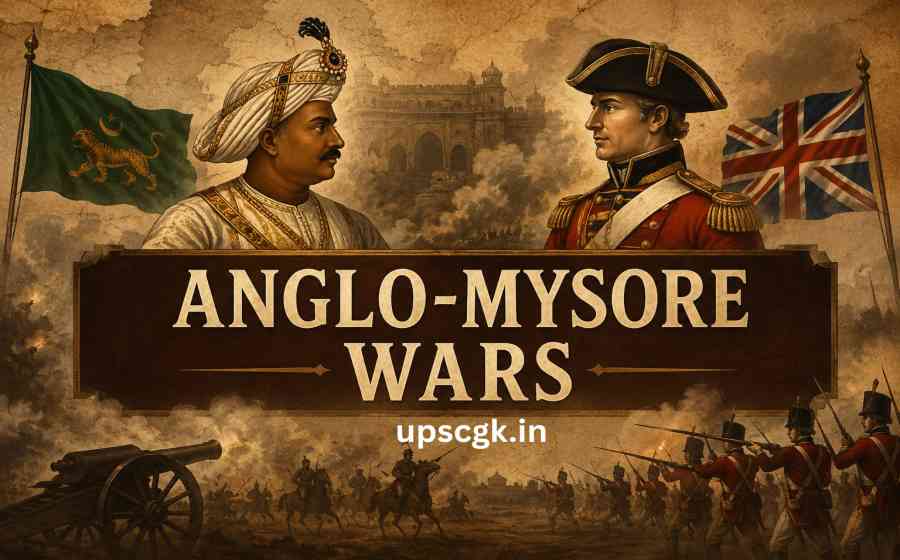
Learn about the Anglo-Mysore Wars – Hyder Ali and Tipu Sultan, their causes, major battles, treaties and impact on British expansion in India.
Anglo-Mysore Wars
The Anglo-Mysore Wars were a series of four major military conflicts fought between the Kingdom of Mysore and the British East India Company between 1767 and 1799. These wars played a decisive role in shaping the political future of India during the eighteenth century. The remarkable leadership of Hyder Ali and his son Tipu Sultan transformed Mysore into one of the strongest Indian states capable of challenging British expansion.
Unlike many Indian rulers who entered alliances with the British, Hyder Ali and Tipu Sultan consistently resisted colonial domination. Their military innovations, diplomatic efforts, and determination made the Anglo-Mysore Wars one of the most significant chapters in Indian history.
Table of Contents
Background of the Anglo-Mysore Wars
During the eighteenth century, the Mughal Empire had weakened considerably, allowing regional powers to emerge across India. Mysore, located in southern India, became one of the most powerful kingdoms under the leadership of Hyder Ali.
At the same time, the British East India Company sought to expand its influence in South India. The rivalry between the British, the French, the Marathas, and the Nizam of Hyderabad created a complex political environment. Mysore’s growing military strength and strategic location threatened British ambitions, making conflict almost inevitable.
Hyder Ali: The Founder of Mysore’s Military Power
Hyder Ali was not born into a royal family but rose through the ranks of the Mysore army due to his military talent and administrative skills. By 1761, he became the de facto ruler of Mysore.
Hyder Ali introduced several reforms:
- Strengthened the army with modern artillery.
- Adopted European military techniques.
- Encouraged the manufacture of weapons.
- Improved revenue administration.
- Built alliances against the British.
His modernization of the military enabled Mysore to become one of the strongest powers in southern India.
First Anglo-Mysore War (1767–1769)
Causes
- British attempts to expand their influence in South India.
- Conflict over territorial control.
- Changing alliances among the British, the Nizam of Hyderabad, and the Marathas.
Major Events
Initially, the British formed an alliance with the Nizam of Hyderabad against Mysore. However, Hyder Ali successfully broke this alliance and launched rapid military campaigns.
He advanced close to Madras (now Chennai), forcing the British to negotiate peace.
Treaty of Madras (1769)
The war ended with the Treaty of Madras, under which:
- Both sides agreed to restore conquered territories.
- They promised mutual assistance if attacked by another power.
Although the treaty temporarily restored peace, mutual distrust remained.
Second Anglo-Mysore War (1780–1784)
Causes
The British failed to honour the Treaty of Madras by refusing to assist Hyder Ali against the Marathas. Additionally, British occupation of the French port of Mahé, which Hyder Ali considered under his protection, further increased tensions.
Major Events
Hyder Ali launched a massive invasion of the Carnatic region. One of the biggest British defeats occurred at the Battle of Pollilur (1780), where Mysore’s forces destroyed a British army. This battle demonstrated the effectiveness of Mysore’s artillery and the famous iron-cased rockets.
During the war, Hyder Ali died in 1782, and his son Tipu Sultan assumed command of the Mysore army. Tipu continued the struggle with determination.
Treaty of Mangalore (1784)
The war concluded with the Treaty of Mangalore, which restored conquered territories and prisoners on both sides.
This treaty was one of the few agreements where the British negotiated with an Indian ruler on relatively equal terms.
Tipu Sultan: The Tiger of Mysore
Tipu Sultan succeeded Hyder Ali and became one of the most famous rulers in Indian history.
He was known for:
- Administrative reforms.
- Promotion of agriculture and trade.
- Modernization of the army.
- Diplomatic relations with France, Turkey, and Afghanistan.
- Continued resistance against British expansion.
Tipu Sultan also encouraged the use of advanced military technology, especially the famous Mysorean rockets, which later inspired the development of British Congreve rockets.
Third Anglo-Mysore War (1790–1792)
Causes
Tipu Sultan attacked the Kingdom of Travancore, an ally of the British East India Company.
The British formed a powerful alliance with:
- The Marathas
- The Nizam of Hyderabad
Major Events
Governor-General Lord Cornwallis personally led British forces.
After several campaigns, the British captured important forts and surrounded Srirangapatna, the capital of Mysore.
Treaty of Seringapatam (1792)
Tipu Sultan was forced to accept harsh conditions:
- Surrendered nearly half of Mysore’s territory.
- Paid a large war indemnity.
- Sent two of his sons as hostages until payment was completed.
The treaty significantly weakened Mysore but did not end Tipu’s resistance.
Fourth Anglo-Mysore War (1799)
Causes
Governor-General Lord Wellesley adopted an aggressive expansion policy.
The British feared Tipu Sultan’s attempts to strengthen ties with France during the period of the French Revolutionary Wars.
Major Events
The British, supported by the Marathas and the Nizam of Hyderabad, launched a final campaign against Mysore.
After intense fighting, the Siege of Srirangapatna (1799) ended with the storming of the fortress.
Tipu Sultan died while defending his capital on 4 May 1799.
His death marked the end of organized resistance by Mysore against British rule.
Results of the Anglo-Mysore Wars
The Anglo-Mysore Wars had far-reaching consequences:
- Mysore lost its position as a major military power.
- Large territories came under British control.
- The Wodeyar dynasty was restored under British supervision.
- The British established political dominance in South India.
- French influence in southern India declined significantly.
- The East India Company became the strongest political power in the region.
Military Innovations of Mysore
One of the most remarkable features of Mysore’s army was its technological advancement.
Mysorean Rockets
Hyder Ali and Tipu Sultan developed iron-cased rockets, which were more powerful and accurate than earlier versions used elsewhere.
These rockets:
- Had greater range.
- Created psychological fear among enemy troops.
- Were effectively used in several battles, especially at Pollilur.
British officers later studied these weapons, leading to the development of the Congreve Rocket, which was widely used in European wars.
Why Hyder Ali and Tipu Sultan Remain Important
Hyder Ali and Tipu Sultan are remembered for their determined resistance against British colonial expansion.
Their contributions include:
- Building a modern Indian army.
- Introducing military innovations.
- Strengthening state administration.
- Encouraging economic development.
- Defending the independence of Mysore against one of the world’s most powerful colonial forces.
Although Mysore was eventually defeated, their courage and leadership inspired later generations in India’s struggle against colonial rule.
Summary
The Anglo-Mysore Wars (1767–1799) marked a turning point in the history of British expansion in India. Hyder Ali laid the foundation of a powerful and modern state, while Tipu Sultan carried forward the struggle with extraordinary determination. Despite facing overwhelming military and political challenges, both rulers became symbols of resistance against colonial domination.
The defeat of Mysore enabled the British East India Company to establish supremacy in South India, paving the way for further territorial expansion across the Indian subcontinent.
Also Check: History