
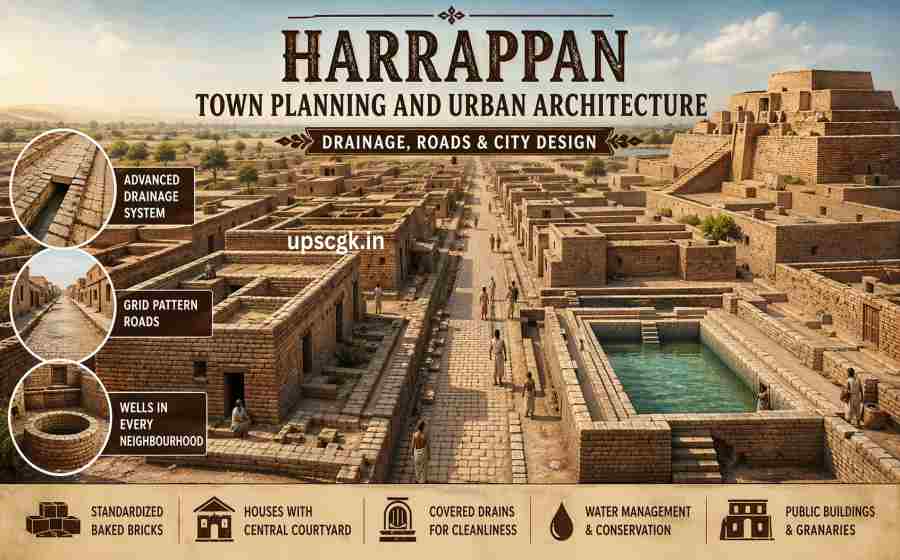
Explore Harappan town planning and Urban Architecture, featuring advanced drainage systems, grid-pattern roads of the Indus Valley Civilization.
Harappan Town Planning and Urban Architecture
The urban planning of the Harappan Civilization, also known as the Indus Valley Civilization (c. 2600–1900 BCE), stands as one of the earliest and most remarkable examples of well-organized city life in human history. The cities built during this period demonstrate a high level of sophistication in terms of engineering, sanitation, and architectural design. Excavations at major sites such as Harappa, Mohenjo-daro, Dholavira, and Lothal reveal that the Harappans possessed advanced knowledge of urban planning that was far ahead of its time.
Table of Contents
Grid Pattern and City Layout
One of the most striking features of Harappan cities was their grid-based layout. The entire city was divided into blocks using a network of straight roads that intersected each other at right angles. This systematic arrangement reflects careful planning and a strong understanding of geometry.
Cities were generally divided into two main parts: the Citadel and the Lower Town. The citadel was built on an elevated platform and likely housed important public buildings, administrative centers, and possibly residences of elite members of society. The lower town was more expansive and contained residential areas where common people lived.
This division not only ensured better organization but also helped in managing floods and maintaining security. The uniformity in city design across different Harappan sites suggests the presence of a centralized authority or a shared cultural framework guiding urban development.
Roads and Streets
The roads in Harappan cities were wide, straight, and well-laid. Main roads ran in north-south and east-west directions, forming a grid pattern. Secondary lanes and smaller streets branched out from these main roads, connecting residential areas.
The width of roads was consistent, and some major streets were wide enough to accommodate carts and heavy movement. Street corners were often rounded to facilitate easier turning of vehicles. This indicates that transportation and movement within the city were carefully considered during planning.
Moreover, houses were constructed along these roads in a uniform manner, often with entrances facing the streets. The standardized layout ensured efficient use of space and ease of navigation.
Advanced Drainage System
Perhaps the most impressive aspect of Harappan urban architecture was its highly developed drainage system. Almost every house in the city was connected to a well-structured drainage network. Wastewater from homes was directed into covered drains that ran along the streets.
These drains were made of baked bricks and were often covered with removable slabs, allowing for easy cleaning and maintenance. The presence of inspection holes at regular intervals further indicates that the system was designed for long-term use and upkeep.
Each house had its own bathroom and sometimes even a private well. Wastewater from bathrooms was channeled into the street drains through small pipes or channels. This level of attention to sanitation was unparalleled in ancient times and highlights the Harappans’ concern for hygiene and public health.
Water Management and Wells
Water management was another key feature of Harappan cities. A large number of wells have been discovered, especially in Mohenjo-daro, suggesting that access to clean water was a priority. Many houses had their own wells, while public wells were also available for community use.
In cities like Dholavira, sophisticated systems for rainwater harvesting and storage were developed. Reservoirs and water tanks were constructed to store water, ensuring a steady supply even during dry periods. This demonstrates the Harappans’ ability to adapt to environmental conditions and manage natural resources efficiently.
Residential Architecture
Harappan houses were built using standardized baked bricks, which were strong and durable. The uniform size of bricks across different cities indicates a regulated system of construction.
Most houses followed a similar pattern: they were built around a central courtyard, which provided light and ventilation. Rooms opened into this courtyard, ensuring privacy and comfort. Houses varied in size, suggesting differences in social status, but even smaller homes were well-planned and equipped with basic amenities.
Doors and windows were strategically placed to enhance airflow while maintaining privacy. Interestingly, houses often did not open directly onto main roads, which may have been done to reduce noise and maintain cleanliness.
Public Buildings and Structures
Harappan cities also featured impressive public structures. The Great Bath of Mohenjo-daro is one of the most famous examples. It was a large, well-constructed water tank, possibly used for ritual bathing. The presence of such structures indicates the importance of community activities and possibly religious practices.
Granaries, assembly halls, and warehouses have also been discovered, suggesting organized storage and distribution systems. The dockyard at Lothal indicates maritime trade and advanced knowledge of engineering.
Urban Planning Significance
The uniformity and sophistication of Harappan town planning highlight several important aspects:
- Scientific approach: Use of geometry and standard measurements
- Civic sense: Focus on cleanliness and sanitation
- Administrative control: Evidence of centralized planning
- Sustainability: Efficient use of resources like water and space
The Harappans achieved a level of urban planning that would not be seen again in many parts of the world for centuries.
Summary
Harappan town planning and urban architecture represent a milestone in the history of human civilization. The advanced drainage systems, well-organized road networks, and carefully designed city layouts demonstrate not only technical expertise but also a deep understanding of community living and environmental management.
Even today, modern urban planners can learn valuable lessons from the Harappan approach to city design. Their emphasis on sanitation, sustainability, and structured development makes the Indus Valley Civilization a timeless example of intelligent urban planning.
Also Check: History