Explore Emergency Provisions in India, including National, State and Financial Emergencies, their constitutional articles, powers and effects.
Emergency Provisions in India
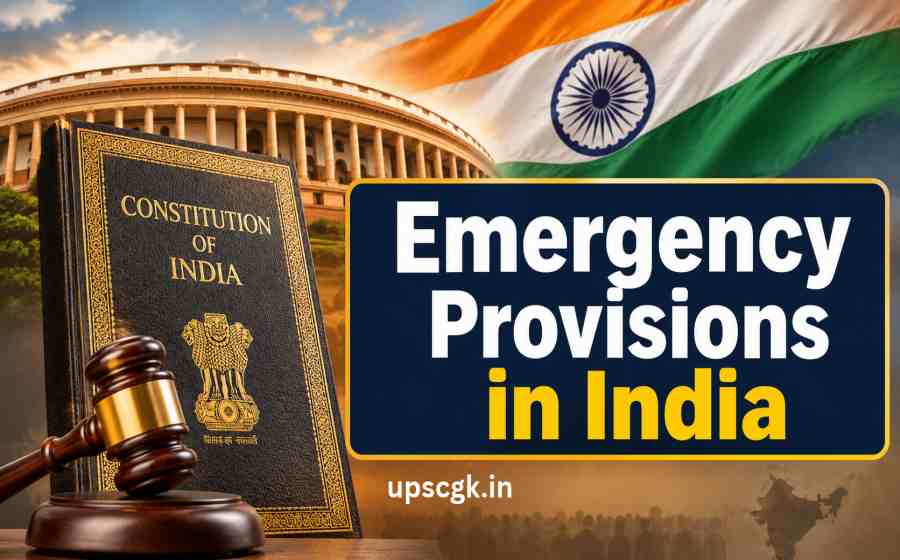
The Constitution of India provides special provisions to deal with extraordinary situations that may threaten the country’s security, constitutional machinery or financial stability. These provisions are known as Emergency Provisions and are included in Part XVIII of the Indian Constitution, covering Articles 352 to 360.
Emergency Provisions allow the Central Government to take special measures during serious crises. They aim to protect national unity, maintain constitutional governance and ensure financial stability. However, these powers must be exercised according to constitutional procedures and democratic principles.
The Indian Constitution provides for three types of emergencies: National Emergency, State Emergency (President’s Rule) and Financial Emergency.
Table of Contents
1. National Emergency (Article 352)
A National Emergency can be proclaimed by the President of India when the security of the country or any part of its territory is threatened by war, external aggression or armed rebellion.
Article 352 empowers the President to declare an emergency when such a serious threat exists. The provision may also be used when there is an imminent danger of war, external aggression or armed rebellion.
Grounds for National Emergency:
- War: When India is involved in an armed conflict with another country.
- External Aggression: When the country faces an attack or threat from an external force.
- Armed Rebellion: When an organised armed uprising threatens the country’s security or constitutional order.
Procedure and Approval:
The President can issue a National Emergency proclamation only after receiving the written decision of the Union Cabinet. The proclamation must be approved by both Houses of Parliament within one month.
Approval requires a special majority, meaning a majority of the total membership of each House and at least two-thirds of members present and voting.
Once approved, the emergency remains in force for six months. It can be extended for further six-month periods through parliamentary approval.
Effects of National Emergency:
- The Central Government gains greater authority over the states.
- Parliament can legislate on subjects in the State List.
- The distribution of financial resources between the Centre and states may be modified under Article 354.
- Certain Fundamental Rights may be affected according to Articles 358 and 359, subject to constitutional safeguards.
- Under Article 358, Article 19 is automatically affected only during emergencies declared on the grounds of war or external aggression.
The 44th Constitutional Amendment Act, 1978 introduced important safeguards to prevent the misuse of National Emergency powers.
2. State Emergency or President’s Rule (Article 356)
State Emergency, commonly known as President’s Rule, is imposed when the constitutional machinery of a state fails and the state government cannot function according to the provisions of the Constitution.
Under Article 356, the President can proclaim President’s Rule based on a report from the Governor or otherwise, when satisfied that constitutional governance in the state has become impossible.
Procedure and Approval:
A proclamation under Article 356 must be approved by both Houses of Parliament within two months. Once approved, it remains effective for six months.
Parliament can extend President’s Rule every six months, but it cannot normally continue beyond three years. Extension beyond one year is permitted only when the constitutional conditions under Article 356 are satisfied, including a National Emergency in operation in the whole or relevant part of India and an Election Commission certification regarding difficulties in holding elections.
Effects of President’s Rule:
- The President assumes certain functions of the state government.
- The Governor administers the state on behalf of the President.
- Parliament exercises the legislative powers of the state legislature.
- The State Council of Ministers is removed from office.
- The High Court’s constitutional powers and position remain protected.
Important Supreme Court Judgment:
In the landmark S. R. Bommai v. Union of India (1994) case, the Supreme Court established important limitations on the use of Article 356.
The judgment confirmed that the President’s decision to impose President’s Rule is subject to judicial review. It also emphasised that the majority of a state government should ordinarily be tested on the floor of the Legislative Assembly.
This judgment strengthened federalism and helped prevent the arbitrary dismissal of elected state governments.
3. Financial Emergency (Article 360)
A Financial Emergency can be declared when the financial stability or credit of India or any part of its territory is threatened.
Article 360 gives the President the authority to proclaim a Financial Emergency to address serious financial difficulties that may affect the country’s economic stability.
Procedure and Approval:
A Financial Emergency proclamation must be approved by both Houses of Parliament within two months. If approved, it continues until it is revoked. Unlike National Emergency and President’s Rule, the Constitution does not prescribe a fixed six-month renewal period or a maximum duration for Financial Emergency.
Effects of Financial Emergency:
- The Central Government can issue directions to states regarding financial discipline.
- States may be required to follow specified principles of financial propriety.
- The President can direct reductions in salaries and allowances of certain categories of government employees.
- Directions may include reductions in the salaries and allowances of Supreme Court and High Court judges.
- State Money Bills may be required to be reserved for the President’s consideration.
Important Fact: India has never proclaimed a Financial Emergency under Article 360 since the Constitution came into force in 1950.
4. Important Constitutional Articles Related to Emergency Provisions
The following constitutional articles deal with different aspects of emergency powers in India:
| Article | Subject |
|---|---|
| Article 352 | Proclamation of National Emergency |
| Article 353 | Effect of National Emergency |
| Article 354 | Modification of revenue distribution during Emergency |
| Article 355 | Duty of the Union to protect states |
| Article 356 | President’s Rule in states |
| Article 357 | Exercise of legislative powers under President’s Rule |
| Article 358 | Suspension of Article 19 during certain emergencies |
| Article 359 | Suspension of enforcement of certain Fundamental Rights |
| Article 360 | Financial Emergency |
5. Important Amendments and Historical Background
The Emergency Provisions have undergone important changes through constitutional amendments.
38th Constitutional Amendment Act, 1975: It attempted to make the President’s satisfaction in proclaiming an emergency final and conclusive, limiting judicial review.
42nd Constitutional Amendment Act, 1976: It expanded several emergency-related powers and strengthened the authority of Parliament and the Central Government during emergencies.
44th Constitutional Amendment Act, 1978: It introduced major safeguards following the misuse of emergency powers during the 1975–1977 Emergency. It replaced the expression “internal disturbance” with “armed rebellion” as a ground for National Emergency, introduced the written Cabinet recommendation requirement and strengthened protection for Fundamental Rights.
India has experienced National Emergency three times: in 1962 during the India-China War, in 1971 during the India-Pakistan conflict, and in 1975 on the ground of internal disturbance.
Summary
Emergency Provisions are an important part of the Indian Constitution because they provide a constitutional mechanism to deal with extraordinary national, political and financial crises. Articles 352, 356 and 360 establish three different types of emergencies, each with specific conditions and procedures.
Although these provisions strengthen the authority of the Central Government during exceptional circumstances, parliamentary approval, judicial review and constitutional safeguards are essential to prevent their misuse. The 44th Constitutional Amendment and the Supreme Court’s judgment in the S. R. Bommai case have played significant roles in protecting democracy and federalism in India.
Also Check: Political Science