
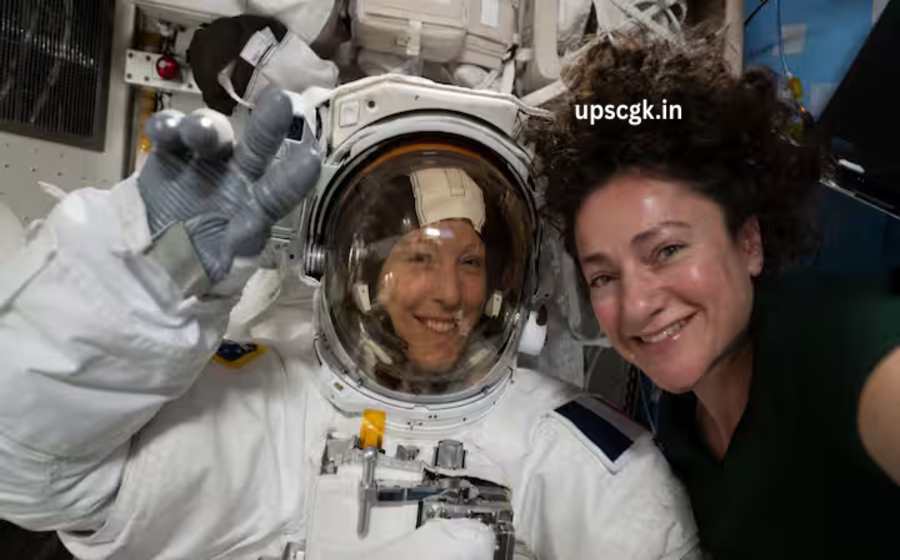
Sophie Adenot Makes History as the first French woman to perform a spacewalk, marking a milestone in European space exploration and human spaceflight.
Sophie Adenot Makes History
European Space Agency (ESA) astronaut Sophie Adenot created history on 18 August 2026 by becoming the first French woman to perform a spacewalk. She also became the second European woman to conduct an extravehicular activity (EVA), following Italian astronaut Samantha Cristoforetti’s spacewalk in 2022.
Adenot conducted the historic spacewalk alongside NASA astronaut Anil Menon outside the International Space Station (ISS). Designated U.S. Spacewalk 97 (EVA-97), the operation was intended primarily to replace a failed Space-to-Ground Antenna (SGANT) mounted on the station’s Z1 truss.
The spacewalk lasted 6 hours and 23 minutes, beginning at 8:29 a.m. EDT and ending at 2:52 p.m. EDT. It was the 282nd spacewalk supporting ISS assembly, maintenance and upgrades.
Table of Contents
What is a Spacewalk?
A spacewalk, technically known as an extravehicular activity (EVA), takes place when astronauts leave the protected environment of a spacecraft or space station and work in the vacuum of space.
Astronauts performing an EVA wear specially designed spacesuits that provide oxygen, temperature regulation, communication systems and protection from the harsh space environment. Such operations are carefully planned because even routine maintenance becomes highly complex when carried out hundreds of kilometres above Earth.
Before her historic EVA, Adenot underwent extensive preparation, including more than 150 hours of underwater training at the European Astronaut Centre in Cologne and NASA’s Johnson Space Center in Houston. Underwater training helps astronauts practise movements and procedures in an environment that simulates some aspects of microgravity.
U.S. Spacewalk 97 and the SGANT Antenna
The main objective of EVA-97 was to work on a Space-to-Ground Antenna (SGANT) located on the ISS’s Z1 truss.
The antenna is an important part of the station’s communications infrastructure. It supports high-speed transmission of data between the orbital laboratory and NASA’s Mission Control Center in Houston. Maintaining this equipment is important for reliable communications and the continued operation of the ISS.
The original plan was to remove the failed antenna, retrieve a spare unit from an external storage platform, install it on the Z1 truss and establish the necessary electrical and data connections.
However, the operation proved more difficult than expected.
Antenna Replacement Could Not Be Completed
Although Adenot and Menon successfully removed the failed communications antenna, they encountered delays while dealing with electrical connections and stubborn bolts. The additional time required for these tasks meant that the astronauts could not complete installation of the replacement antenna during EVA-97.
The astronauts therefore secured the failed equipment and ended the spacewalk after 6 hours and 23 minutes.
The incomplete antenna replacement demonstrates the unpredictable nature of space-based maintenance. Even a task that has been extensively rehearsed on Earth can take longer in orbit because astronauts must work in bulky spacesuits while handling equipment in microgravity and following strict safety procedures.
A further spacewalk is planned to finish the antenna installation.
Support From Inside the ISS
A spacewalk is not the work of the astronauts outside the station alone. It requires extensive coordination between the spacewalkers, crew members inside the ISS and mission controllers on Earth.
NASA astronauts Jessica Meir and Jack Hathaway supported Adenot and Menon from inside the station. They assisted the spacewalkers with their spacesuits and operated the Canadarm2 robotic arm during the operation.
Canadarm2 is a large robotic manipulator installed on the ISS. It is used for a variety of tasks, including moving equipment, supporting astronauts during external maintenance and assisting with station assembly and cargo operations.
During EVA-97, Menon used the robotic arm to access the work area while Adenot remained connected to the station’s structure with safety equipment.
Importance of Sophie Adenot’s Achievement
Sophie Adenot’s spacewalk represents an important milestone for both France and European human spaceflight.
Before this achievement, Adenot had already made history in February 2026 by becoming the second French woman to travel into space, following Claudie Haigneré. Her first EVA added another milestone to her career and made her the first French woman to venture outside a spacecraft for a spacewalk.
Her achievement also places her alongside Samantha Cristoforetti as only the second European woman to perform a spacewalk. Cristoforetti completed her historic EVA during her 2022 mission aboard the ISS.
Importance for the International Space Station
The ISS depends on regular maintenance and upgrades to remain operational. Spacewalks allow astronauts to repair equipment, install new systems, upgrade power infrastructure and maintain critical external components.
EVA-97 was particularly significant because the SGANT forms part of the station’s communication infrastructure. Although the replacement could not be completed during this EVA, the astronauts successfully removed the failed unit and advanced the repair operation.
The mission therefore highlights the importance of human intervention in maintaining complex orbital infrastructure.
Key Facts
- Astronaut: Sophie Adenot
- Agency: European Space Agency (ESA)
- Country: France
- Historic achievement: First French woman to perform a spacewalk
- European milestone: Second European woman to conduct a spacewalk
- Date: 18 August 2026
- Spacewalk: U.S. Spacewalk 97 / EVA-97
- Spacewalk partner: NASA astronaut Anil Menon
- Duration: 6 hours 23 minutes
- Location: International Space Station
- Main equipment: Space-to-Ground Antenna (SGANT)
- ISS location: Z1 truss
- Robotic arm: Canadarm2
- ISS support: Jessica Meir and Jack Hathaway
- ISS milestone: 282nd spacewalk supporting assembly, maintenance and upgrades
Summary
Sophie Adenot’s historic spacewalk on 18 August 2026 marked a significant achievement in European space exploration. By becoming the first French woman to conduct an EVA and the second European woman to perform a spacewalk, she added a new chapter to France’s human-spaceflight history.
Although the planned replacement of the SGANT antenna was not completed because of technical difficulties and time constraints, the astronauts successfully removed the failed unit and secured it. The mission also demonstrated how astronauts, robotic systems and ground controllers work together to maintain the International Space Station.
Also Check: Current Affairs