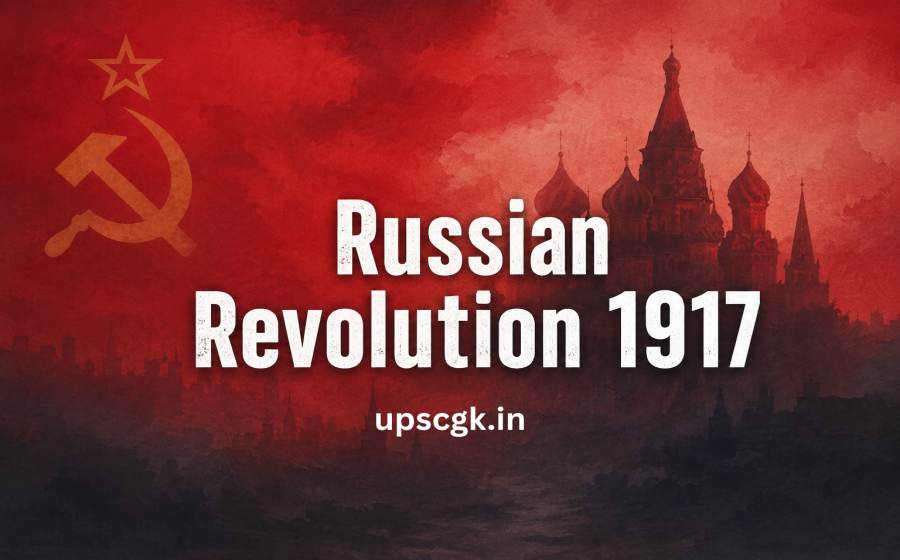
Explore the Russian Revolution 1917, its causes, major events and the rise of the Bolsheviks and Mensheviks that transformed Russia and world history.
Russian Revolution 1917
The Russian Revolution of 1917 was one of the most significant political events in modern world history. It brought an end to the centuries-old rule of the Romanov dynasty, destroyed the Russian monarchy, and eventually led to the establishment of the world’s first major socialist state. The revolution did not occur as a single event. Instead, it developed through a series of political crises, popular protests, workers’ movements, military mutinies, and struggles between different revolutionary groups.
Among the most influential political forces were the Bolsheviks and the Mensheviks, two factions that emerged from the Russian socialist movement. Although both groups were inspired by Marxist ideas, they differed sharply over the methods, leadership, and pace of revolution. The Bolsheviks, led by Vladimir Lenin, ultimately gained control of the revolutionary movement and seized power in October 1917. The Russian Revolution changed not only Russia but also the course of global politics. It inspired communist movements across the world and created a new ideological rivalry that shaped much of the twentieth century.
Table of Contents
Background of the Russian Revolution
Before 1917, Russia was ruled by the Romanov dynasty under Tsar Nicholas II. The country remained largely autocratic, and the Tsar held enormous political authority. Unlike many Western European nations, Russia had limited democratic institutions and faced growing demands for political reform.
Russian society was deeply unequal. The majority of the population consisted of peasants, many of whom lived in poverty. Industrialisation had created a growing working class in major cities such as Petrograd and Moscow. Factory workers often experienced poor working conditions, low wages, and long working hours.
Political opposition also increased during the late nineteenth and early twentieth centuries. Socialist, liberal, and revolutionary groups criticised the Tsarist government and demanded political and economic change.
The situation worsened after Russia’s defeat in the Russo-Japanese War of 1904–05. Economic hardship and public anger contributed to the Revolution of 1905, which forced Tsar Nicholas II to introduce limited reforms and establish the Duma, or parliament. However, the Tsar continued to retain substantial power.
The Rise of Bolsheviks and Mensheviks
The Bolsheviks and Mensheviks originated within the Russian Social Democratic Labour Party (RSDLP), a Marxist political organisation.
In 1903, the party experienced a major split. The division was based on disagreements over party organisation and revolutionary strategy.
The Bolsheviks, meaning “majority,” were led by Vladimir Lenin. Lenin believed that the revolutionary movement required a disciplined and highly organised party of committed professional revolutionaries. He argued that such a party could provide leadership to workers and guide the revolution.
The Mensheviks, meaning “minority,” supported a broader and more inclusive political organisation. They believed that Russia needed to pass through a democratic and capitalist stage before a socialist revolution could successfully take place.
The names Bolshevik and Menshevik originated from a particular party vote and did not always reflect their actual numerical strength. However, the two factions gradually developed into separate political movements.
Major Differences Between Bolsheviks and Mensheviks
The Bolsheviks and Mensheviks shared some common Marxist principles, but their approach to revolution was different.
The Bolsheviks supported a tightly organised revolutionary party with strong central leadership. Lenin believed that the working class needed a disciplined organisation capable of taking decisive political action.
The Mensheviks preferred a larger and more democratic party that could include a broader range of socialist supporters. They were generally more willing to cooperate with liberal and moderate political groups.
Another major difference concerned the nature of the revolution. The Mensheviks believed that Russia first needed to develop a modern capitalist economy and democratic political system. Only after these stages could a socialist revolution emerge.
The Bolsheviks, especially under Lenin’s leadership, argued that revolutionary conditions in Russia could allow the working class and its allies to move toward socialist transformation more rapidly.
These differences became increasingly important during the revolutionary events of 1917.
The February Revolution of 1917
Russia’s participation in World War I created enormous pressure on the country. The Russian army suffered heavy casualties, while food shortages and inflation caused severe hardship among ordinary people.
In February 1917, protests began in Petrograd. Workers went on strike, and large demonstrations demanded bread and political change. Soldiers eventually joined the protesters instead of suppressing them.
The authority of the Tsar collapsed, and Nicholas II abdicated. The Romanov dynasty, which had ruled Russia for more than three centuries, came to an end.
After the fall of the monarchy, a Provisional Government was established. At the same time, workers’ and soldiers’ councils known as Soviets gained significant influence.
This created a situation often described as dual power, in which the Provisional Government held formal authority while the Soviets possessed considerable popular and political influence.
The Mensheviks and other moderate socialist groups initially played an important role in the Soviets. The Bolsheviks, however, gradually increased their influence by criticising the Provisional Government.
Lenin and the April Theses
Vladimir Lenin returned to Russia in April 1917 after years in exile. He immediately challenged the policies of the Provisional Government.
In his famous April Theses, Lenin called for:
- An end to Russia’s participation in World War I.
- No support for the Provisional Government.
- Transfer of power to the Soviets.
- Redistribution of land.
- A movement toward socialist transformation.
The Bolshevik slogan “Peace, Land and Bread” became extremely popular among soldiers, peasants, and workers.
While the Provisional Government continued the war, economic conditions remained difficult. The Bolsheviks used this growing dissatisfaction to strengthen their political position.
The October Revolution
By the autumn of 1917, the Provisional Government had lost much of its public support. The Bolsheviks had gained increasing influence in important Soviets, particularly in Petrograd.
In October 1917, the Bolsheviks organised an armed uprising. Under the leadership of Lenin and other revolutionary figures, including Leon Trotsky, Bolshevik forces took control of key locations in Petrograd.
The Provisional Government was overthrown, and the Bolsheviks established a new government based on Soviet authority.
The October Revolution marked the beginning of Bolshevik rule in Russia. Although the transfer of power in Petrograd occurred relatively quickly, the Bolsheviks still faced serious opposition across the country.
What Happened to the Mensheviks?
After the Bolshevik takeover, the Mensheviks became increasingly marginalised. Many Menshevik leaders criticised the Bolshevik seizure of power and opposed the establishment of one-party political control.
During the years of civil conflict that followed the revolution, the Bolshevik government gradually restricted political opposition. The Mensheviks lost influence, and many of their members faced political repression or were forced into exile.
The Bolsheviks eventually became the dominant political force and established a communist system under the leadership of the Communist Party.
Russian Civil War and the Creation of the Soviet Union
Following the October Revolution, Russia entered a period of intense conflict known as the Russian Civil War. The Bolshevik Red Army fought against various anti-Bolshevik forces, commonly known as the White armies, along with several other political and regional groups.
Despite enormous economic destruction and human suffering, the Bolsheviks emerged victorious.
In 1922, the Union of Soviet Socialist Republics (USSR) was formally established. The Soviet Union became the first major state based on communist principles and played a central role in international politics throughout the twentieth century.
Significance of the Russian Revolution
The Russian Revolution of 1917 had consequences far beyond Russia. It demonstrated that a revolutionary socialist movement could overthrow an established political system and create a new form of government.
The revolution inspired communist and socialist movements in Asia, Europe, Africa, and Latin America. It also created fear among capitalist governments and contributed to the growth of anti-communist political movements.
For India, the Russian Revolution was particularly important because its ideas influenced several leaders, workers’ organisations, and political movements. The success of the revolution encouraged debates about socialism, economic equality, workers’ rights, and anti-imperialism.
The rise of the Soviet Union also transformed international relations and eventually contributed to the ideological division between communist and capitalist powers during the Cold War.
Summary
The Russian Revolution of 1917 was a turning point in world history. The collapse of Tsarist rule, the failure of the Provisional Government, and the growing power of the Bolsheviks transformed Russia into a revolutionary state.
The conflict between the Bolsheviks and Mensheviks reflected deeper disagreements about how socialism should be achieved and what kind of political organisation was necessary for revolution. The Bolsheviks, led by Vladimir Lenin, ultimately proved more successful in gaining control during the crisis of 1917. The revolution resulted in the establishment of Soviet Russia and later the Soviet Union, creating a political system that influenced global events for decades.
Also Check: History