Learn about the Surat Split of 1907, its causes, clash between Moderates and Extremists, key events, effects and significance in India’s freedom struggle.
Surat Split
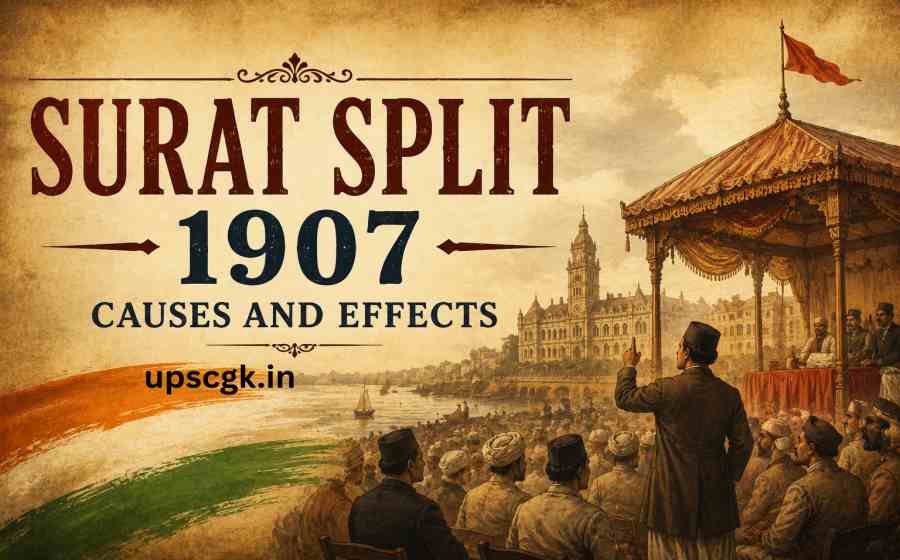
The Surat Split of 1907 was a major turning point in the history of the Indian National Congress. It marked the formal division between the Moderates and the Extremists, two groups that had developed different approaches toward achieving political reforms and freedom from British rule. The split took place during the annual session of the Indian National Congress at Surat in December 1907.
The conflict reflected growing differences within the nationalist movement over political methods, leadership, the pace of reforms, and the nature of resistance against British rule. Although the division weakened the Congress temporarily, it also revealed the growing political consciousness and increasing demand for stronger action against colonial rule.
Table of Contents
Background of the Surat Split
The Indian National Congress was founded in 1885. During its early years, the organization was largely dominated by leaders known as Moderates. Important Moderate leaders included Dadabhai Naoroji, Gopal Krishna Gokhale, Surendranath Banerjee, and Pherozeshah Mehta.
The Moderates believed that political progress could be achieved through constitutional and peaceful methods. They relied on petitions, speeches, resolutions, public meetings, and appeals to British authorities. Their objective was to secure greater participation of Indians in administration and gradually expand self-government.
By the beginning of the twentieth century, however, a younger group of nationalists became dissatisfied with this approach. Leaders such as Bal Gangadhar Tilak, Lala Lajpat Rai, and Bipin Chandra Pal argued that stronger political pressure was necessary. They emphasized Swadeshi, boycott, national education, and mass mobilization. This group came to be known as the Extremists, though they preferred a more assertive form of nationalism.
Rise of Differences Between Moderates and Extremists
The differences between the two groups became particularly sharp after the Partition of Bengal in 1905. The British decision to divide Bengal generated widespread opposition and gave rise to the Swadeshi and Boycott Movements.
The Extremists wanted the Congress to adopt more aggressive methods and extend the Swadeshi movement into a broader national struggle. They supported the boycott of British goods and encouraged Indians to develop indigenous industries and institutions.
The Moderates supported Swadeshi but were more cautious about extending the movement through mass agitation and confrontation with the colonial government.
Another major difference concerned the meaning of Swaraj. While the Moderates generally sought gradual constitutional reforms, the Extremists increasingly demanded self-government and were willing to use stronger methods to achieve it.
Immediate Causes of the Surat Split
Several factors contributed to the division of the Congress in 1907.
1. Differences Over Political Methods
The most important disagreement concerned the methods of the national movement. Moderates favored constitutional methods, while Extremists supported boycott, Swadeshi, passive resistance, and broader public mobilization.
2. Disagreement Over Leadership
Leadership became a major source of tension during the Congress sessions of 1906 and 1907. The choice of Congress president became closely connected with the struggle between the two groups.
At the Calcutta Session of 1906, Dadabhai Naoroji was chosen as president. The session adopted important resolutions relating to Swaraj, Swadeshi, Boycott, and National Education.
The Extremists wanted these policies to remain central to Congress activities, while the Moderates were concerned about their implementation and political consequences.
3. The Question of the Congress Presidency in 1907
The Congress session was originally expected to be held at Nagpur, but the venue was shifted to Surat, which was considered more favorable to the Moderates.
The Extremists supported Lala Lajpat Rai for the presidency, while the Moderates backed Rash Behari Ghosh.
Eventually, Rash Behari Ghosh was selected as president. The dispute over the presidency intensified tensions between the two factions.
4. Disagreement Over the Calcutta Resolutions
The Extremists wanted the Congress to continue firmly supporting the four major resolutions associated with the 1906 Calcutta Session: Swaraj, Swadeshi, Boycott, and National Education.
The Moderates were reluctant to endorse these measures in the same aggressive form. This disagreement contributed significantly to the breakdown of cooperation.
What Happened at Surat in 1907?
The annual Congress session began in December 1907 amid intense tension. Arguments between the two groups escalated over the choice of president and the Congress programme.
The situation eventually became chaotic. There were heated exchanges between delegates, and the session descended into disorder. Chairs and other objects were reportedly thrown during the confrontation, forcing the session to be suspended.
As a result, the Congress effectively split into the Moderate and Extremist factions. The incident became known as the Surat Split.
Effects of the Surat Split
The Surat Split had several important consequences for the Indian nationalist movement.
1. Temporary Weakening of the Congress
The immediate effect was the weakening of the Indian National Congress. The organization lost unity at a crucial time when the nationalist movement was gaining momentum.
The Moderates dominated the Congress organization after the split, while the Extremists were largely pushed outside its formal structure.
2. Government Repression
The division made it easier for the British government to target radical nationalist leaders.
Bal Gangadhar Tilak was arrested in 1908 and sentenced to imprisonment. Several other nationalist activists also faced repression.
The colonial government used measures such as prosecutions, arrests, and restrictions to suppress revolutionary and nationalist activities.
3. Growth of Revolutionary Nationalism
The weakening of the constitutional nationalist movement contributed to the growth of revolutionary activities in different parts of India.
Some young nationalists became increasingly convinced that constitutional politics alone could not challenge British rule.
4. Decline of Unity Within the National Movement
The split demonstrated the serious ideological differences that existed within Indian nationalism. Instead of presenting a united political front, nationalist leaders became divided over strategy and leadership.
This reduced the immediate effectiveness of the Congress.
5. Reunion of the Two Groups
The split was not permanent. Changing political circumstances gradually created conditions for reconciliation. The Lucknow Session of the Indian National Congress in 1916 witnessed the reunion of the Moderates and Extremists.
The Lucknow period also became significant because the Congress reached an agreement with the All-India Muslim League, commonly known as the Lucknow Pact.
Significance of the Surat Split
The Surat Split should not be viewed simply as a failure of the nationalist movement. It represented an important stage in the evolution of Indian nationalism.
The conflict highlighted a fundamental question: Should India achieve political freedom through gradual constitutional reform or through stronger popular pressure and mass resistance?
The Extremist approach helped introduce greater emphasis on self-reliance, Swadeshi, national education, and public participation. The Moderates, meanwhile, played an important role in developing political awareness, constitutional understanding, economic criticism of colonial rule, and the early institutional foundations of Indian nationalism.
Thus, both groups contributed to the development of the freedom struggle, even though they disagreed sharply over methods.
Summary
The Surat Split of 1907 was a critical episode in the history of the Indian National Congress and the freedom movement. It resulted from growing disagreements between Moderates and Extremists over political methods, leadership, Swadeshi, Boycott, and the nature of Swaraj.
Although the split temporarily weakened the Congress and enabled greater colonial repression, it also reflected the growing intensity of Indian nationalism. The later reunion of the two factions at Lucknow in 1916 demonstrated that differences in political strategy could eventually be overcome when national interests demanded unity.
Also Check: History