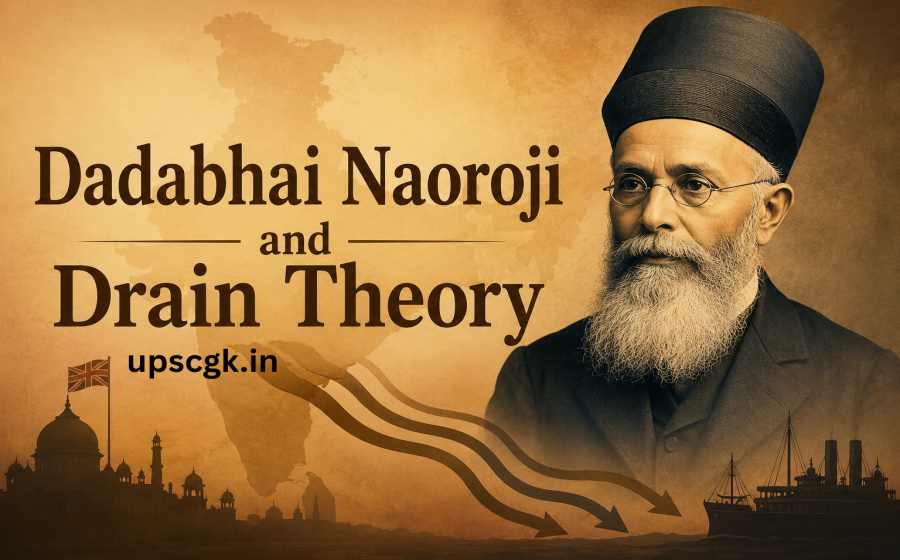
Dadabhai Naoroji and Drain Theory explains how British rule drained India’s wealth and fueled poverty, economic nationalism and the freedom movement.
Dadabhai Naoroji and Drain Theory
Dadabhai Naoroji was one of the earliest Indian nationalists to systematically examine the economic consequences of British colonial rule in India. Known as the “Grand Old Man of India,” he played a major role in connecting economic exploitation with the growth of Indian nationalism. His most important contribution in this field was the Drain Theory, which argued that a substantial portion of India’s wealth was being transferred to Britain without an equivalent economic return to India.
Naoroji developed this argument during the second half of the 19th century and presented it in speeches, writings, and eventually in his famous book Poverty and Un-British Rule in India. His analysis challenged the British claim that colonial rule was economically beneficial to India.
Table of Contents
Who Was Dadabhai Naoroji?
Dadabhai Naoroji was born in 1825 in Bombay (now Mumbai). He became a teacher, intellectual, businessman, social reformer, and political leader. He was among the founders of the Indian National Congress and served as its president three times.
Naoroji also achieved international political recognition when he became the first Asian to be elected to the British House of Commons, representing Finsbury Central in 1892.
His political career in Britain gave him an opportunity to directly question British policies toward India. He used this position to draw attention to Indian poverty and the economic consequences of colonial administration.
What Was the Drain Theory?
The Drain Theory was Naoroji’s explanation of how India’s economic resources were continuously transferred to Britain under colonial rule.
According to Naoroji, India was not simply experiencing poverty because of internal weaknesses or lack of resources. Instead, a major reason was the systematic outward transfer of wealth generated within India.
The central idea was that India was losing wealth when payments made from Indian revenues ended up benefiting Britain without creating corresponding productive investment within India.
Naoroji described this process as an “economic drain.” He argued that when wealth left India on a large scale, fewer resources remained available for domestic investment, industrial development, employment, and improvements in living standards.
Main Causes of the Economic Drain
Naoroji identified several channels through which India’s wealth was transferred to Britain.
1. Salaries and Pensions of British Officials
A significant number of senior administrative positions were occupied by British officials. Their salaries were paid from Indian revenues, but much of their income was eventually taken or remitted to Britain.
Similarly, pensions paid to retired British officials represented another flow of Indian revenue outside the country.
2. Home Charges
The British government imposed various expenses on Indian revenues that were paid in Britain. These were commonly referred to as Home Charges.
They included expenses associated with administration, pensions, interest payments, and other obligations connected with British rule.
Naoroji considered these payments an important component of the economic drain because Indian revenues were being used to meet expenses outside India.
3. Interest on Public Debt
India incurred public debt, including obligations associated with British policies and infrastructure projects. Interest on certain debts was payable in Britain.
Naoroji argued that such payments contributed to the continuous movement of Indian resources abroad.
4. Profits of British Companies
British companies operating in India generated profits from Indian economic activity. A substantial portion of these profits was transferred to Britain rather than being reinvested within India.
Naoroji believed this weakened the development of Indian industries and reduced the amount of capital available for domestic economic growth.
5. Remittances by British Personnel
British employees, soldiers, officials, and other residents in India frequently sent part of their earnings to Britain.
From Naoroji’s perspective, these remittances represented another channel through which income generated in India left the country.
6. Unequal Economic Structure
Naoroji also criticized the broader colonial economic system. India supplied raw materials and agricultural products while British manufactured goods entered Indian markets.
This relationship encouraged India to remain a supplier of raw materials and a consumer of foreign manufactured products, limiting the development of indigenous industries.
Why Did Naoroji Consider the Drain Harmful?
Naoroji argued that the drain was particularly damaging because it represented a one-sided transfer of resources.
If money circulated within India, it could support businesses, workers, farmers, traders, and industries. However, when a significant portion of national income was transferred overseas, the same resources could not contribute to India’s internal economic development.
This created what Naoroji regarded as a vicious cycle:
Low domestic investment – weak industrial growth – limited employment – widespread poverty – continued economic dependence.
He therefore linked colonial economic policies directly with the poverty of the Indian population.
Naoroji’s Estimate of the Drain
Naoroji attempted to quantify the amount of wealth leaving India. His estimates changed over time as he examined different categories of payments and available evidence.
He argued that the annual drain could amount to tens of millions of pounds, a substantial sum for the Indian economy of the period.
The precise figures have been debated by later historians because colonial statistics were incomplete and the definition of the drain varied. Nevertheless, the importance of Naoroji’s argument did not depend entirely on the exact numerical estimate.
His larger contribution was demonstrating that colonial economic institutions themselves could systematically transfer resources from one country to another.
Drain Theory and Indian Poverty
Naoroji’s economic analysis was closely connected with his concern about Indian poverty.
He rejected the argument that poverty was simply the result of India’s population, climate, social conditions, or supposed lack of economic ability.
Instead, he emphasized the effects of colonial policies and the removal of resources from India.
His famous work, Poverty and Un-British Rule in India, brought these arguments together and became an important text in the development of Indian economic nationalism.
Role in the Growth of Economic Nationalism
The Drain Theory became one of the intellectual foundations of Indian economic nationalism.
Early nationalist leaders such as Dadabhai Naoroji, Romesh Chandra Dutt, and Mahadev Govind Ranade examined colonial economic policies and highlighted their effects on Indian agriculture, industries, trade, and public finance.
Their arguments transformed political criticism from a discussion of administrative grievances into a broader critique of the colonial economic structure.
Economic nationalism encouraged Indians to question:
- British control over Indian industries
- The export of Indian raw materials
- The import of British manufactured goods
- High taxation
- Discriminatory economic policies
- The use of Indian revenues for British interests
Thus, the Drain Theory helped establish an economic basis for the demand for greater Indian political control.
Drain Theory and the Indian National Congress
Naoroji’s ideas strongly influenced the early Indian National Congress.
The Congress initially pursued constitutional reforms rather than demanding immediate independence. Economic criticism formed an important part of its early political program.
Nationalist leaders argued that Indians needed greater representation in administration and financial decision-making because colonial officials were making decisions that directly affected India’s economic resources.
The Drain Theory therefore strengthened the argument that political freedom and economic development were closely connected.
Criticism of the Drain Theory
Although highly influential, the Drain Theory has also been examined critically by historians.
Some scholars have argued that Naoroji’s calculations sometimes combined different categories of payments and that not every transfer of money represented a purely unproductive drain.
For example, expenditure on railways, administration, military services, and infrastructure could also have generated economic benefits within India, even though British interests played a major role in these projects.
There is also debate over whether all British earnings and remittances should be treated as a net loss, since some economic activity created employment and services in India.
Nevertheless, these criticisms do not eliminate the broader significance of Naoroji’s work. His analysis opened a systematic debate about who benefited from colonial economic growth and who bore its costs.
Significance of Drain Theory
The Drain Theory is important for understanding the relationship between colonialism, poverty, economic nationalism, and the rise of Indian nationalism.
Important Points to remember the following key points:
- Dadabhai Naoroji is associated with the Drain Theory.
- He was popularly known as the Grand Old Man of India.
- He was one of the early leaders of the Indian National Congress.
- He became the first Indian/Asian elected to the British House of Commons.
- His major work was Poverty and Un-British Rule in India.
- He argued that India’s wealth was being transferred to Britain through several channels.
- Home Charges, pensions, salaries, profits, interest payments, and remittances were among the important channels he discussed.
- The theory helped strengthen economic nationalism.
- It connected colonial economic exploitation with Indian poverty.
- It contributed to the intellectual foundations of the Indian nationalist movement.
Summary
Dadabhai Naoroji’s Drain Theory was a landmark in the economic critique of British colonial rule. By examining the movement of wealth between India and Britain, Naoroji argued that Indian poverty could not be understood without considering the structure of colonial exploitation.
His greatest contribution was not merely estimating the amount of wealth leaving India but explaining why colonial economic relations prevented India from retaining and productively using its own resources.
The Drain Theory gave Indian nationalism an important economic foundation. It helped early nationalists demonstrate that political subordination had direct economic consequences and that genuine economic development required greater control over India’s resources.
Also Check: History