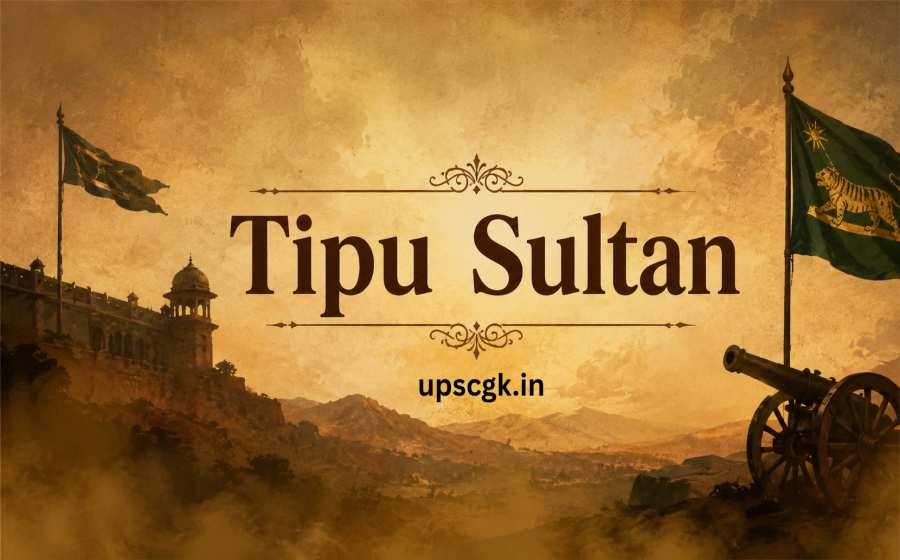
Tipu Sultan was known for his administrative reforms, military innovations and determined resistance against British rule in 18th-century India.
Tipu Sultan
Tipu Sultan, popularly known as the “Tiger of Mysore,” was one of the most remarkable rulers in Indian history. He ruled the Kingdom of Mysore from 1782 to 1799 after succeeding his father, Hyder Ali. Tipu Sultan is remembered not only for his administrative reforms and military innovations but also for his determined resistance against British expansion in India. At a time when the British East India Company was steadily increasing its influence, Tipu Sultan emerged as one of its strongest opponents.
His reign was marked by economic development, modernization of the army, promotion of trade, and diplomatic efforts with foreign powers. Though he ultimately lost his life in the Fourth Anglo-Mysore War, his courage and commitment to defending his kingdom have earned him a significant place in Indian history. For UPSC aspirants, Tipu Sultan remains an important topic in Modern Indian History due to his contributions to governance, military strategy, and anti-colonial resistance.
Table of Contents
Early Life and Accession
Tipu Sultan was born on 20 November 1750 in Devanahalli near present-day Bengaluru. He was the eldest son of Hyder Ali, the ruler of Mysore. From an early age, Tipu received education in military tactics, administration, languages, and diplomacy. He accompanied his father in several military campaigns, gaining valuable experience in warfare.
After Hyder Ali’s death in 1782 during the Second Anglo-Mysore War, Tipu Sultan ascended the throne of Mysore. He inherited a powerful kingdom but also the challenge of confronting British ambitions in southern India.
Administrative Reforms
Tipu Sultan introduced several reforms aimed at strengthening his kingdom and improving governance.
Efficient Revenue Administration
Tipu reorganized the land revenue system to increase agricultural productivity and ensure stable state income. Revenue officials were closely supervised, and records of land and cultivation were maintained more systematically. He sought to reduce corruption and improve tax collection without excessively burdening cultivators.
Provincial Administration
The kingdom was divided into several administrative provinces, each governed by appointed officials responsible for revenue, justice, and law enforcement. This decentralized system improved efficiency while maintaining strong central control.
Judicial System
Tipu Sultan worked to strengthen the judicial administration by appointing judges and ensuring quicker settlement of disputes. Both civil and criminal matters received greater administrative attention during his reign.
Promotion of Agriculture
Agriculture formed the backbone of Mysore’s economy. Tipu encouraged farmers by improving irrigation facilities, promoting the cultivation of commercial crops such as sugarcane and sandalwood, and bringing more land under cultivation. These measures increased agricultural output and state revenue.
Economic and Commercial Policies
Tipu Sultan believed that economic strength was essential for political independence.
State-Controlled Trade
He established state monopolies over valuable commodities like sandalwood, pepper, cardamom, and teak. These products generated substantial revenue and strengthened the financial position of the kingdom.
Encouragement of Foreign Trade
Tipu promoted international trade with countries such as France, Arabia, Persia, Turkey, and the Ottoman Empire. He established trading centers and encouraged merchants to expand overseas commerce.
Development of Industries
Under his rule, Mysore witnessed growth in silk production, textiles, sugar manufacturing, weapon production, and shipbuilding. Government workshops produced high-quality arms and military equipment.
Introduction of New Coinage
Tipu issued new gold, silver, and copper coins bearing Persian inscriptions. He also introduced a new calendar and standardized weights and measures to improve commercial transactions.
Military Reforms
One of Tipu Sultan’s greatest achievements was the modernization of his military.
Modern Army
Inspired by European military methods, especially the French, Tipu reorganized his army into disciplined infantry, cavalry, artillery, and engineering units. Soldiers received regular salaries and systematic training.
Mysorean Rockets
Tipu Sultan significantly improved the use of iron-cased rockets in warfare. These rockets had greater range and accuracy than many contemporary weapons and were effectively used against British forces. Their success later inspired the development of the British Congreve rockets.
Strong Fortifications
He strengthened major forts across Mysore, including the capital Srirangapatna, making them difficult for enemy forces to capture.
Resistance to British Rule
Tipu Sultan devoted much of his reign to resisting British expansion in southern India.
Second Anglo-Mysore War (1780–1784)
Although the war had begun during Hyder Ali’s reign, Tipu continued the struggle after becoming ruler. The conflict ended with the Treaty of Mangalore (1784), one of the few agreements in which the British treated an Indian ruler as an equal. Both sides restored conquered territories.
Third Anglo-Mysore War (1790–1792)
The British formed a powerful alliance with the Marathas and the Nizam of Hyderabad against Mysore. Despite fierce resistance, Tipu suffered defeat.
Under the Treaty of Seringapatam (1792):
- Mysore lost nearly half of its territory.
- Tipu paid a large war indemnity.
- Two of his sons were temporarily handed over as hostages to guarantee compliance with the treaty.
Although the treaty weakened Mysore, Tipu immediately began rebuilding his military and economy.
Diplomatic Efforts
Realizing the growing strength of the British, Tipu sought alliances with France, the Ottoman Empire, Afghanistan, and other powers. His objective was to create a united front against British expansion. However, these diplomatic efforts achieved limited practical success.
Fourth Anglo-Mysore War (1799)
The British, led by Governor-General Lord Wellesley, launched another campaign against Mysore. British forces, supported by their allies, laid siege to Srirangapatna.
On 4 May 1799, Tipu Sultan fought courageously until his death while defending the capital. His famous determination is reflected in the saying:
“It is better to live like a tiger for one day than like a sheep for a thousand years.”
With his death, Mysore came under British influence, marking a significant step in British domination over southern India.
Achievements of Tipu Sultan
- Strengthened the administrative machinery of Mysore.
- Promoted agriculture and irrigation.
- Encouraged domestic and international trade.
- Modernized the military using advanced technology.
- Developed the famous Mysorean rockets.
- Supported industrial production and state enterprises.
- Defended Indian sovereignty against British expansion for nearly two decades.
Historical Significance
Tipu Sultan occupies a unique position in Indian history as one of the earliest rulers to challenge British colonial expansion through military strength, administrative reforms, and diplomatic initiatives. His governance reflected a combination of centralized administration, economic planning, and technological innovation.
Historians continue to debate certain aspects of his policies, but there is broad agreement that his resistance significantly delayed British consolidation in southern India. His military innovations, especially rocket technology, influenced warfare beyond India.
Summary
Tipu Sultan remains one of the most influential rulers of eighteenth-century India. His administration promoted economic development, efficient governance, and military modernization, while his unwavering resistance made him a symbol of the struggle against British imperialism. Although he fell in battle during the Fourth Anglo-Mysore War, his legacy continues to inspire discussions on leadership, patriotism, and statecraft. For UPSC aspirants, understanding Tipu Sultan’s administration, reforms, and resistance provides valuable insight into the political and military history of pre-colonial and early colonial India.
Also Check: History