
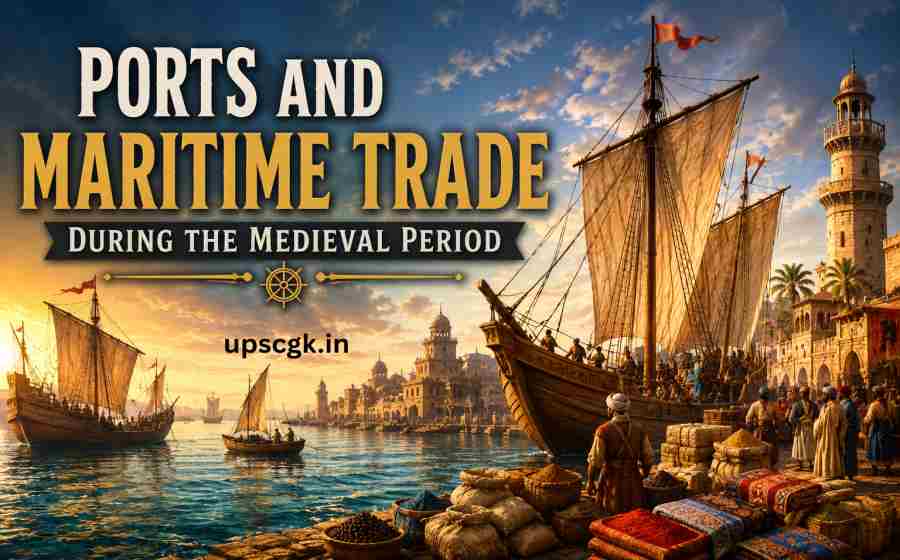
Explore the ports and maritime trade during the medieval period. Learn how Indian ports connected Asia, Africa and Europe through thriving ocean commerce.
Ports and Maritime Trade During the Medieval Period
The medieval period, spanning roughly from the 8th to the 16th century, witnessed remarkable growth in maritime trade across the Indian Ocean. While overland trade routes like the Silk Road remained important, sea routes became the backbone of international commerce due to their ability to transport larger quantities of goods over long distances at lower costs. India’s strategic geographical location, surrounded by the Arabian Sea, the Bay of Bengal, and the Indian Ocean, made it a vital center of global maritime trade.
Indian ports flourished as bustling commercial hubs where merchants from Arabia, Persia, East Africa, Southeast Asia, and China exchanged goods, cultures, and ideas. Maritime trade during this period not only enriched kingdoms economically but also facilitated cultural interactions, technological exchange, and the spread of religions.
Table of Contents
Importance of Maritime Trade in the Medieval Period
Maritime trade played a crucial role in strengthening the economies of medieval kingdoms. Coastal cities prospered due to customs duties, shipbuilding, and international trade. Trade networks linked distant civilizations and encouraged diplomatic relations among rulers.
The advantages of sea trade included:
- Transportation of bulk goods at lower costs.
- Faster long-distance trade compared to difficult land routes.
- Expansion of commercial networks across continents.
- Cultural and technological exchanges between civilizations.
- Growth of prosperous port cities and merchant communities.
Major Ports of Medieval India
Several ports along India’s western and eastern coasts became internationally renowned centers of trade.
1. Calicut (Kozhikode)
Located on the Malabar Coast, Calicut emerged as one of the busiest ports under the Zamorin rulers.
Major Exports:
- Black pepper
- Cardamom
- Cinnamon
- Coconut products
Imports:
- Horses from Arabia
- Gold and silver
- Silk
- Luxury goods
Arab, Persian, and later Chinese merchants frequently visited Calicut, making it one of Asia’s richest trading centers.
2. Cambay (Khambhat)
Situated in present-day Gujarat, Cambay became an important commercial port connecting India with the Persian Gulf and East Africa.
Its famous exports included:
- Cotton textiles
- Indigo
- Beads
- Precious stones
The port was known for its skilled artisans and thriving merchant guilds.
3. Surat
Although Surat gained greater prominence in the later medieval period, it became an important gateway for trade with the Middle East and the Red Sea.
The port handled:
- Textiles
- Spices
- Silk
- Sugar
- Indigo
Surat later became the principal port of the Mughal Empire.
4. Masulipatnam
Located on the Coromandel Coast, Masulipatnam served as an important eastern port.
Major exports included:
- Cotton fabrics
- Rice
- Salt
- Dyed cloth
The port connected India with Southeast Asia and China.
5. Nagapattinam
Nagapattinam played a major role in trade with Sri Lanka, Southeast Asia, and the kingdoms of the Malay Archipelago.
It also became an important center for Buddhist and Hindu cultural exchanges.
Important Maritime Trade Routes
Indian merchants participated in an extensive network of sea routes connecting multiple regions.
Western Route
This route linked:
- Western India
- Arabian Peninsula
- Persian Gulf
- Red Sea
- East Africa
Goods eventually reached Mediterranean markets through Arab traders.
Eastern Route
This connected:
- Bengal
- Coromandel Coast
- Sri Lanka
- Myanmar
- Indonesia
- Malaysia
- China
These routes helped spread Indian culture and commerce throughout Southeast Asia.
Major Commodities Traded
India exported a wide range of valuable products that were highly sought after in foreign markets.
Exports
- Black pepper
- Cardamom
- Cinnamon
- Cotton textiles
- Silk fabrics
- Indigo
- Sugar
- Rice
- Ivory
- Precious stones
- Sandalwood
- Steel (especially Wootz steel)
Imports
- Arabian horses
- Gold
- Silver
- Copper
- Silk from China
- Porcelain
- Dates
- Glassware
- Luxury goods
- Perfumes
The spice trade remained one of the most profitable sectors of medieval commerce.
Role of Merchant Communities
Several merchant communities dominated maritime commerce during the medieval period.
Some prominent trading groups included:
- Gujarati merchants
- Tamil merchants
- Arab traders
- Persian merchants
- Chettiars
- Marakkayars
- Jewish merchants
These communities established commercial colonies in foreign ports, enabling smooth trade across regions.
Merchant guilds also regulated business practices, ensured quality control, and provided financial support to traders.
Shipbuilding and Navigation
Indian shipbuilders possessed advanced knowledge of constructing large wooden vessels suitable for long-distance voyages.
Key features included:
- Strong teakwood construction
- Large cargo capacity
- Durable hulls
- Skilled craftsmanship
Navigation depended heavily on:
- Monsoon winds
- Star positions
- Coastal landmarks
- Traditional nautical knowledge
Arab sailors and Indian navigators mastered the seasonal monsoon system, allowing predictable voyages across the Indian Ocean.
Influence of Monsoon Winds
The discovery and understanding of monsoon wind patterns transformed Indian Ocean trade.
Summer Monsoon
Ships sailed from Arabia toward India using southwest monsoon winds.
Winter Monsoon
Northeast monsoon winds carried ships back toward Arabia and East Africa.
This natural wind cycle enabled regular international trade and reduced travel risks.
Foreign Traders in Indian Ports
Indian ports welcomed merchants from numerous regions.
Important foreign traders included:
- Arabs
- Persians
- Chinese
- Malays
- Indonesians
- East Africans
- Venetians
Arab merchants, in particular, dominated Indian Ocean trade for several centuries before the arrival of European powers.
Chinese expeditions under Admiral Zheng He in the 15th century further strengthened maritime relations with Indian ports.
Economic Impact
Maritime trade generated immense wealth for coastal kingdoms.
Its economic contributions included:
- Increased state revenue through customs duties.
- Development of prosperous port cities.
- Expansion of shipbuilding industries.
- Growth of handicraft production.
- Creation of employment for merchants, sailors, and artisans.
Many medieval rulers actively protected sea routes and encouraged foreign trade to strengthen their economies.
Cultural Impact of Maritime Trade
Trade was not limited to the exchange of goods. It also promoted cultural interactions.
Important cultural influences included:
- Spread of Hinduism and Buddhism to Southeast Asia.
- Introduction of Islam through Arab traders.
- Exchange of languages and scripts.
- Sharing of architectural styles.
- Growth of multicultural port cities.
These interactions shaped the social and cultural landscape of many regions across Asia.
Decline of Traditional Maritime Networks
Towards the end of the medieval period, maritime trade underwent significant changes.
Major reasons included:
- Arrival of Portuguese naval power in the Indian Ocean.
- European control over strategic sea routes.
- Decline of some traditional Indian ports.
- Shifting patterns of global trade.
Despite these changes, Indian maritime commerce continued to remain significant under later empires.
Legacy of Medieval Maritime Trade
The maritime trade networks established during the medieval period laid the foundation for India’s long-standing role in global commerce. Ancient ports evolved into vibrant commercial centers that connected civilizations across continents. The exchange of goods, technologies, religions, and cultures through these sea routes fostered economic prosperity and strengthened international relations.
Many modern ports continue to thrive in regions that were once flourishing medieval trading centers, reflecting the enduring importance of India’s maritime heritage.
Summary
Ports and maritime trade during the medieval period played a transformative role in shaping India’s economic, cultural, and political history. Strategic coastal ports such as Calicut, Cambay, Surat, Masulipatnam, and Nagapattinam connected India with Asia, Africa, and Europe through vast oceanic trade networks. Merchant communities, skilled shipbuilders, and the effective use of monsoon winds enabled centuries of prosperous commerce. The legacy of this maritime tradition continues to influence India’s position in global trade even today, making it an essential chapter in the study of medieval history and world commerce.
Also Check: History