Explore the Medieval Education System in India, its institutions, curriculum, teaching methods, languages and lasting impact on Indian society and culture.
Medieval Education System in India
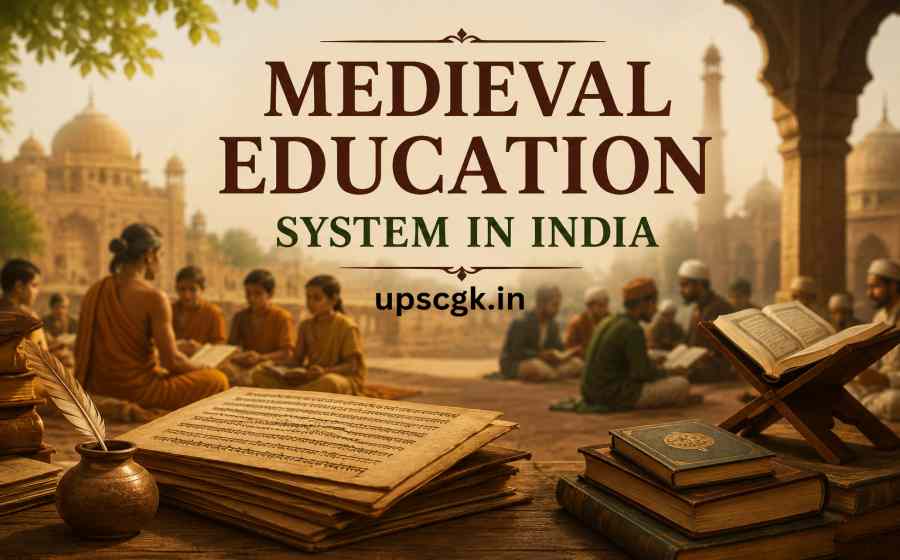
The Medieval Education System in India developed between the 8th and 18th centuries under the rule of various regional kingdoms, the Delhi Sultanate, and the Mughal Empire. This period witnessed the coexistence of traditional Hindu educational institutions alongside Islamic centers of learning, creating a rich and diverse educational landscape. Education was closely associated with religion, morality, philosophy, administration, and practical knowledge. Although access to education was limited to certain sections of society, medieval India made significant contributions to literature, science, mathematics, medicine, and architecture through its educational institutions.
The education system during this period reflected India’s cultural diversity and helped preserve knowledge while introducing new ideas from Central Asia and Persia. The combination of indigenous traditions and Islamic influences shaped the intellectual development of medieval India.
Table of Contents
Background of Medieval Education
Following the decline of ancient universities such as Nalanda and Vikramashila due to invasions and political instability, education shifted primarily to smaller institutions. Hindu temples, monasteries, and village schools continued to provide education, while the arrival of Muslim rulers introduced new institutions such as Maktabs and Madrasas.
Education remained largely decentralized. Wealthy rulers, religious organizations, local communities, and charitable individuals funded educational institutions. The curriculum varied depending on the institution’s religious and administrative objectives.
Major Educational Institutions
1. Gurukuls and Pathshalas
Traditional Hindu education continued through Gurukuls and Pathshalas, especially in villages and temple towns.
Features:
- Students lived with their teachers (gurus) in Gurukuls.
- Pathshalas generally operated within villages.
- Education focused on moral values and discipline.
- Teaching was often free, supported by donations from society.
These institutions remained important centers for preserving Sanskrit literature and religious traditions.
2. Maktabs
Maktabs served as elementary schools primarily for Muslim children.
Their main objectives included:
- Learning the Quran
- Reading and writing Arabic and Persian
- Basic arithmetic
- Religious ethics and moral education
Children usually began attending Maktabs at an early age before progressing to higher education.
3. Madrasas
Madrasas were institutions of higher learning established under the Delhi Sultanate and later expanded during the Mughal period.
Subjects taught included:
- Islamic theology
- Law (Sharia)
- Arabic grammar
- Persian literature
- Logic
- Philosophy
- Mathematics
- Astronomy
- Medicine
Many graduates entered government administration as judges, scholars, teachers, and officials.
Curriculum of Medieval Education
The curriculum varied according to religious traditions and regional practices.
Hindu Educational Curriculum
Students studied:
- Vedas
- Upanishads
- Sanskrit grammar
- Philosophy
- Mathematics
- Astronomy
- Ayurveda
- Literature
- Ethics
- Logic
Advanced learners also studied poetry, music, architecture, and political science.
Islamic Educational Curriculum
Madrasas emphasized:
- Quranic studies
- Hadith
- Islamic jurisprudence
- Persian language
- Arabic language
- Calligraphy
- Mathematics
- Geography
- Astronomy
- Medicine
- History
Persian became the official language of administration under many Muslim rulers, increasing its importance in education.
Medium of Instruction
Different languages were used depending on the institution.
- Sanskrit dominated Hindu educational institutions.
- Arabic was used for religious instruction.
- Persian became the language of administration and higher education during the Sultanate and Mughal periods.
- Regional languages such as Hindi, Bengali, Tamil, Telugu, Kannada, Marathi, and Gujarati gradually gained importance in local schools.
The development of regional literature encouraged wider access to education among local populations.
Teaching Methods
Teaching was primarily oral and interactive.
Common methods included:
- Memorization
- Recitation
- Discussions
- Debates
- Storytelling
- Question-answer sessions
- Practical demonstrations
Teachers emphasized discipline, respect, and character building. Manuscripts were handwritten, making books scarce and valuable. Students copied texts manually as part of their learning process.
Role of Teachers
Teachers enjoyed high social status during medieval India.
Their responsibilities included:
- Imparting knowledge
- Guiding students morally
- Preserving religious traditions
- Advising rulers
- Producing scholarly works
Teachers often lived simple lives and were respected by both rulers and common people.
Patronage of Education
Many rulers actively promoted education.
Delhi Sultanate
Several Sultans established Madrasas and libraries.
Notable contributions included:
- Construction of educational institutions
- Scholarships for deserving students
- Appointment of scholars in royal courts
Mughal Empire
The Mughal rulers greatly expanded educational opportunities.
Babur encouraged literary culture through his own writings.
Humayun established libraries and promoted astronomy.
Akbar introduced a more liberal educational policy by encouraging both religious and secular subjects. His reforms aimed to create a balanced curriculum including philosophy, mathematics, ethics, and history.
Jahangir and Shah Jahan continued supporting scholars and educational institutions.
Although Aurangzeb focused more on Islamic education, Madrasas continued to receive royal patronage.
Libraries and Centers of Learning
Libraries became important centers for preserving manuscripts.
Royal courts maintained extensive collections of books on:
- Religion
- Science
- Medicine
- History
- Literature
- Philosophy
Scholars translated numerous Sanskrit works into Persian, promoting intellectual exchange between Hindu and Islamic traditions.
Education for Women
Women’s education was limited during medieval India, though exceptions existed.
Royal families often educated princesses in:
- Literature
- Poetry
- Music
- Persian
- Arabic
- Administration
Some notable educated women included:
- Razia Sultan
- Gulbadan Begum
- Jahanara Begum
- Zeb-un-Nissa
Among common people, educational opportunities for girls remained limited due to prevailing social customs.
Strengths of the Medieval Education System
The medieval education system possessed several positive features.
- Preserved India’s intellectual traditions.
- Promoted moral and ethical values.
- Produced skilled administrators and scholars.
- Encouraged multilingual learning.
- Advanced studies in astronomy, medicine, mathematics, and literature.
- Fostered cultural interaction between different communities.
- Supported the growth of regional languages and literary traditions.
Limitations of the Medieval Education System
Despite its achievements, several challenges existed.
- Education was not universally accessible.
- Social hierarchy restricted educational opportunities.
- Women’s education remained limited.
- Religious instruction often dominated secular subjects.
- Scientific experimentation received less emphasis compared to theoretical learning.
- Handwritten manuscripts limited the spread of knowledge.
Legacy of Medieval Education
The Medieval Education System laid the foundation for India’s later intellectual and cultural development. Traditional Gurukuls, Pathshalas, Maktabs, and Madrasas preserved valuable knowledge while contributing to literature, philosophy, law, mathematics, medicine, and governance. The interaction between Hindu and Islamic educational traditions enriched India’s cultural heritage and encouraged the growth of regional languages.
Many educational practices introduced during the medieval period, such as teacher-student respect, moral education, multilingual learning, and institutional patronage, continued to influence Indian society even after the arrival of European educational models during the colonial era.
Summary
The Medieval Education System in India was a unique blend of indigenous traditions and Islamic scholarship. While education remained limited to certain sections of society, it played a crucial role in preserving knowledge, developing administrative skills, promoting literature, and fostering cultural exchange. Institutions such as Gurukuls, Pathshalas, Maktabs, and Madrasas contributed significantly to India’s intellectual history. Understanding this educational system helps us appreciate how medieval India nurtured learning despite political changes and social challenges, leaving behind a lasting legacy that continues to shape Indian education and culture today.
Also Check: History