Discover the achievements and legacy of Krishnadevaraya, the greatest Vijayanagara ruler. Learn about his victories, administration, culture and contributions.
Krishnadevaraya
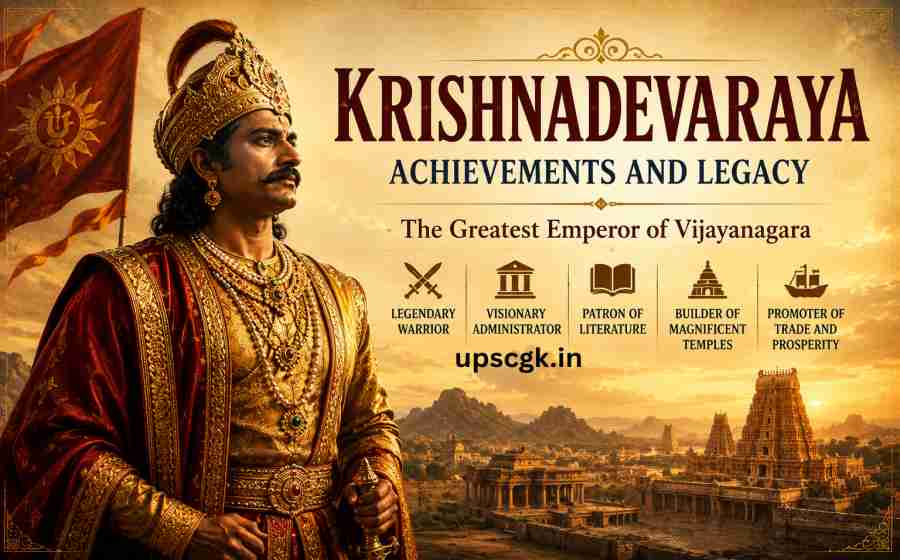
Krishnadevaraya is regarded as one of the greatest rulers in Indian history. He was the most illustrious emperor of the Vijayanagara Empire and ruled from 1509 to 1529 CE. His reign marked the golden age of the empire, characterized by military success, efficient governance, economic prosperity, and remarkable achievements in literature, art, and architecture. His leadership transformed Vijayanagara into one of the most powerful kingdoms in South India and earned him admiration from both Indian and foreign travelers.
Krishnadevaraya’s reign remains an important chapter in medieval Indian history, and his contributions continue to inspire historians and scholars.
Table of Contents
Early Life and Coronation
Krishnadevaraya belonged to the Tuluva dynasty, the third ruling dynasty of the Vijayanagara Empire. He ascended the throne in 1509 CE after the death of his elder half-brother, Viranarasimha Raya. At the time of his accession, the empire faced threats from neighboring kingdoms and internal political instability.
Despite these challenges, Krishnadevaraya quickly established himself as a capable military commander and administrator. His coronation marked the beginning of a period of expansion, stability, and prosperity for the Vijayanagara Empire.
Military Achievements
One of Krishnadevaraya’s greatest accomplishments was his remarkable military leadership. Through a series of successful campaigns, he strengthened the empire and expanded its territories.
Victory over the Bahmani Successor States
After the decline of the Bahmani Sultanate, several Deccan Sultanates emerged. Krishnadevaraya successfully fought against these kingdoms, particularly Bijapur and Bidar, securing Vijayanagara’s northern frontiers.
Conquest of Raichur Doab
The fertile Raichur Doab, located between the Krishna and Tungabhadra rivers, had long been contested between Vijayanagara and the Deccan Sultanates.
In 1520 CE, Krishnadevaraya defeated the Sultan of Bijapur, Ismail Adil Shah, in the famous Battle of Raichur. This victory significantly enhanced the prestige and military strength of the Vijayanagara Empire.
Campaigns against Odisha
Krishnadevaraya launched successful campaigns against the Gajapati rulers of Odisha. He captured important territories, including Udayagiri and Kondavidu, and later concluded peace through diplomatic alliances.
These victories extended Vijayanagara’s influence over much of South India.
Efficient Administration
Krishnadevaraya was not only a great warrior but also an efficient administrator who ensured peace and prosperity within his kingdom.
His administration was based on the Nayankara System, under which military chiefs called Nayakas were granted land in return for military service and local administration. This system strengthened both governance and defense.
The emperor maintained a disciplined army, ensured law and order, and personally supervised important administrative matters.
He paid close attention to public welfare, encouraging irrigation, agriculture, and trade to improve the lives of his subjects.
Economic Prosperity
Under Krishnadevaraya’s rule, the Vijayanagara Empire became one of the wealthiest kingdoms in Asia. Agriculture flourished due to the construction and maintenance of tanks, canals, and irrigation systems. Fertile lands produced abundant crops such as rice, sugarcane, cotton, and spices.
Trade expanded significantly through ports on the western and eastern coasts. Merchants from Portugal, Persia, Arabia, and Southeast Asia traded horses, textiles, spices, precious stones, and metals with Vijayanagara.
Foreign travelers like Domingo Paes and Fernao Nuniz described the capital city of Vijayanagara as one of the richest and most magnificent cities in the world.
Patron of Literature
Krishnadevaraya was among the greatest patrons of literature in Indian history. His court became famous for the Ashtadiggajas, a group of eight eminent Telugu poets who elevated Telugu literature to new heights.
The most celebrated among them was Allasani Peddana, often called the “Father of Telugu Poetry.”
Krishnadevaraya himself was a talented scholar and author. His famous Telugu work, Amuktamalyada, is considered one of the finest classics of Telugu literature. The work discusses kingship, governance, devotion, and social values.
He also encouraged literature in Sanskrit, Kannada, and Tamil, promoting multilingual cultural development.
Promotion of Art and Architecture
Krishnadevaraya greatly contributed to the architectural heritage of South India. During his reign, magnificent temples, towering gopurams (gateway towers), mandapas, and sculptures were constructed or renovated.
Some notable architectural contributions include:
- Expansion of the Virupaksha Temple at Hampi.
- Construction of the impressive Krishna Temple.
- Additions to the Vittala Temple Complex, famous for its iconic Stone Chariot and musical pillars.
- Development of temples across South India through generous royal patronage.
The Vijayanagara style of architecture reached its peak during his reign and continues to attract visitors from around the world.
Religious Policy
Krishnadevaraya was a devout follower of Vaishnavism, yet he practiced remarkable religious tolerance. He generously supported Hindu temples dedicated to Vishnu, Shiva, and other deities. At the same time, he respected followers of different sects and faiths. His inclusive approach promoted religious harmony throughout the empire.
Foreign Relations
Krishnadevaraya maintained cordial relations with the Portuguese, who had established settlements on India’s western coast.
The Portuguese supplied high-quality Arabian horses, which greatly strengthened the Vijayanagara cavalry. In return, they benefited from flourishing trade relations with the empire.
These diplomatic ties contributed to economic growth and military modernization.
Legacy of Krishnadevaraya
Krishnadevaraya’s legacy extends far beyond his military victories. He transformed Vijayanagara into the strongest power in South India through visionary leadership, efficient governance, and cultural patronage.
His reign represented the high point of medieval South Indian civilization, marked by prosperity, stability, and artistic excellence.
Even after his death in 1529 CE, his administrative systems, literary contributions, and architectural monuments continued to influence later rulers. Although the Vijayanagara Empire eventually declined after the Battle of Talikota (1565), Krishnadevaraya’s achievements remained unmatched.
Today, he is remembered as an ideal ruler whose reign symbolized strength, wisdom, justice, and cultural brilliance. His contributions to literature, temple architecture, administration, and military organization have secured him a permanent place among India’s greatest monarchs.
Summary
Krishnadevaraya stands as one of the finest emperors in Indian history. His extraordinary military campaigns protected and expanded the Vijayanagara Empire, while his administrative reforms ensured peace and prosperity. His patronage of literature, architecture, religion, and trade created a vibrant cultural environment that flourished during his reign.
Often described as the greatest ruler of the Vijayanagara Empire, Krishnadevaraya’s achievements continue to inspire generations. His reign remains a shining example of capable leadership, cultural richness, and national strength, making him one of the most celebrated figures in India’s historical heritage.
Also Check: History