Learn about the Battle of Talikota, its causes, key events and how the fall of Vijayanagara transformed the political and cultural landscape of South India.
Battle of Talikota
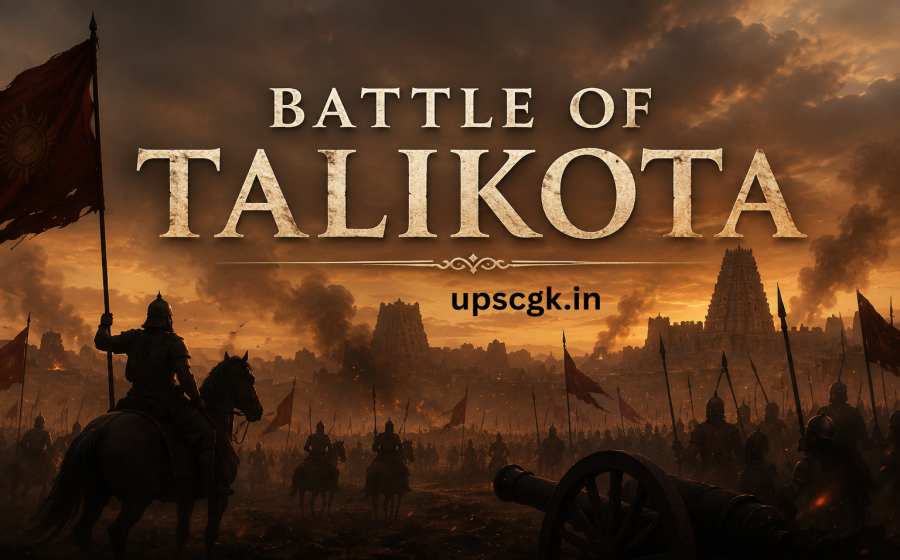
The Battle of Talikota, fought on 26 January 1565, is regarded as one of the most decisive battles in Indian history. It marked the decline of the mighty Vijayanagara Empire, which had dominated South India for over two centuries. The battle was fought between the forces of Vijayanagara under Aliya Rama Raya and a united alliance of the Deccan Sultanates. The defeat of Vijayanagara led to the destruction of its capital, Hampi, and altered the political balance of southern India for centuries.
The battle is significant not only because it ended the supremacy of the Vijayanagara Empire but also because it demonstrated the importance of military alliances, modern artillery, and political diplomacy in medieval warfare.
Table of Contents
Background of the Vijayanagara Empire
The Vijayanagara Empire was founded in 1336 by Harihara I and Bukka Raya I on the banks of the Tungabhadra River. Over the years, it emerged as the strongest Hindu kingdom in South India, serving as a barrier against repeated invasions from the Deccan Sultanates.
During the reign of Krishnadevaraya (1509–1529), the empire reached the peak of its military strength, economic prosperity, and cultural achievements. However, after his death, internal political instability increased. Aliya Rama Raya, the son-in-law of Krishnadevaraya, became the real power behind the throne.
Rama Raya frequently intervened in the politics of the Deccan Sultanates, often supporting one Sultan against another. Although this policy initially strengthened Vijayanagara, it eventually united the Sultanates against a common enemy.
Causes of the Battle of Talikota
Several factors contributed to the outbreak of the battle:
1. Political Rivalry
Rama Raya’s interference in the affairs of the Deccan kingdoms angered the rulers of Bijapur, Ahmadnagar, Golconda, Bidar, and Berar.
2. Formation of a United Alliance
The Deccan Sultanates realized that individual campaigns against Vijayanagara had failed. Therefore, they temporarily forgot their mutual rivalries and formed a united military alliance.
3. Strategic Importance of the Raichur Doab
The fertile region between the Krishna and Tungabhadra rivers had long been disputed between Vijayanagara and Bijapur. Control over this area was economically and militarily valuable.
4. Growth of Vijayanagara’s Influence
The increasing political and military dominance of Vijayanagara threatened the independence of the Deccan Sultanates.
5. Military Modernization
The Sultanates had acquired skilled artillery experts and advanced firearms from foreign sources, giving them a technological advantage over Vijayanagara’s traditional military structure.
The Opposing Forces
Vijayanagara Empire
- Commander: Aliya Rama Raya
- Large infantry force
- Powerful cavalry
- Massive war elephants
- Traditional military formations
Deccan Sultanate Alliance
The alliance consisted of:
- Bijapur
- Ahmadnagar
- Golconda
- Bidar
The Sultanates possessed:
- Well-trained cavalry
- Effective field artillery
- Skilled Turkish and Persian gunners
- Better coordination among allied forces
Course of the Battle
The battle took place near the villages of Talikota and Rakkasagi-Tangadigi, close to the Krishna River in present-day Karnataka.
Initially, the Vijayanagara army gained the upper hand through its numerical superiority and experienced soldiers. However, the course of the battle changed dramatically due to several critical developments.
One of the most important turning points was the defection of the Gilani brothers, who had previously served in Vijayanagara’s army. During the battle, they switched sides and joined the Sultanate alliance, creating confusion within Rama Raya’s forces.
The Sultanates then launched coordinated attacks supported by artillery. Their cannons inflicted heavy damage on Vijayanagara’s formations, while their cavalry attacked from multiple directions.
Aliya Rama Raya, who was leading from the front despite his advanced age, was captured during the battle. He was executed on the battlefield, causing panic among Vijayanagara’s troops. Without their leader, the army collapsed, and the Sultanate alliance secured a decisive victory.
Destruction of Vijayanagara
Following the victory, the allied armies marched towards the imperial capital Vijayanagara (Hampi). The once magnificent city was subjected to widespread destruction. Temples, palaces, markets, and public buildings were looted and demolished. Historical accounts describe the city as one of the richest urban centres in Asia before the battle. Although the empire continued under the Aravidu dynasty, it never regained its former strength or political dominance.
Consequences of the Battle
1. Decline of the Vijayanagara Empire
The battle ended Vijayanagara’s position as the dominant power in South India.
2. Political Fragmentation
Several regional kingdoms, including Mysore, Madurai, Keladi, and Thanjavur, gradually became more independent.
3. Rise of the Deccan Sultanates
The Sultanates temporarily strengthened their political influence across the Deccan region.
4. Destruction of Hampi
One of the greatest urban centres of medieval India suffered irreversible destruction, though many monuments survive today as UNESCO World Heritage sites.
5. Shift in Military Strategy
The battle highlighted the growing importance of:
- Gunpowder weapons
- Field artillery
- Mobile cavalry
- Military alliances
Traditional reliance on elephants and mass infantry became increasingly ineffective.
6. Cultural Impact
Although the capital was destroyed, Vijayanagara’s artistic traditions, literature, temple architecture, and administrative practices continued through successor kingdoms across South India.
Historical Importance
The Battle of Talikota represents a major turning point in Indian medieval history. It demonstrated that political unity among rival states could overcome even the strongest empire. The battle also marked the increasing dominance of gunpowder technology in Indian warfare.
Despite its military defeat, the Vijayanagara Empire left a lasting legacy in architecture, literature, music, administration, and temple construction. The ruins of Hampi continue to symbolize the empire’s former glory and remain among India’s most significant historical sites.
Legacy of Vijayanagara
Even after its political decline, the cultural influence of Vijayanagara endured for centuries. The Nayaka kingdoms carried forward its traditions in temple building, classical music, dance, and governance. Many famous South Indian temples received patronage inspired by the Vijayanagara style.
Today, the Battle of Talikota is remembered as both the fall of a powerful empire and a reminder of how political divisions, technological change, and strategic alliances can reshape the course of history.
Summary
The Battle of Talikota (1565) was fought between the Vijayanagara Empire led by Aliya Rama Raya and the combined forces of the Deccan Sultanates. The alliance’s superior artillery, coordinated strategy, and the defection of key commanders led to Vijayanagara’s defeat. Rama Raya’s death and the subsequent destruction of Hampi marked the beginning of the empire’s decline. Although the Vijayanagara Empire survived briefly under the Aravidu dynasty, it never recovered its former power. The battle remains one of the most significant turning points in medieval Indian history, influencing the political, military, and cultural landscape of South India for generations.
Also Check: History