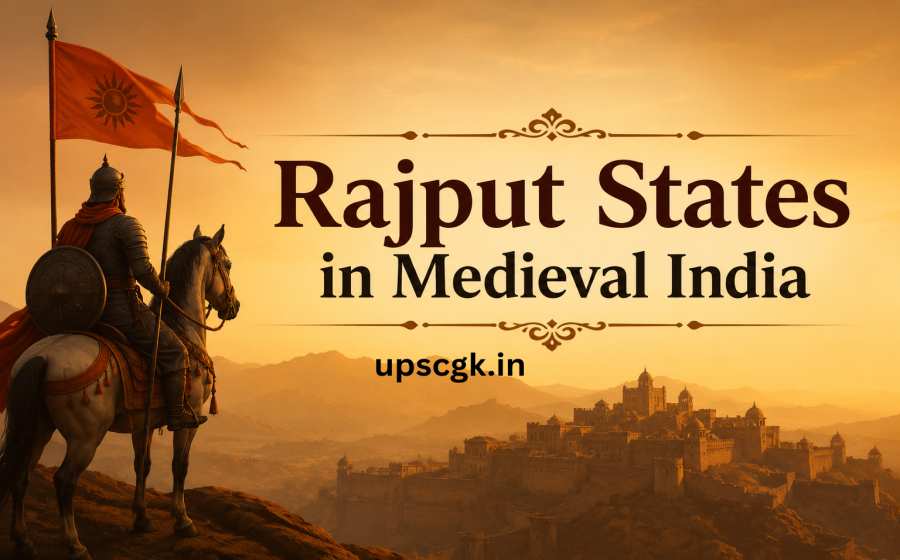
Explore the rise of Rajput States in Medieval India, their administration, major dynasties, culture, military traditions and lasting historical legacy.
Rajput States in Medieval India
The Rajput States played a significant role in shaping the political, cultural, and military history of Medieval India. Emerging after the decline of the Gurjara-Pratihara Empire around the 10th century, the Rajputs established numerous independent kingdoms across northern and western India. Their courage, strong sense of honor, administrative abilities, and patronage of art and architecture made them one of the most influential warrior communities in Indian history.
Although the Rajput kingdoms were often divided and engaged in conflicts with one another, they fiercely defended their territories against foreign invasions for centuries. Their resistance against Turkic and Mughal rulers, along with their contributions to literature, architecture, and regional governance, left a lasting impact on India’s historical development.
Table of Contents
Origin of the Rajputs
The origin of the Rajputs has been debated by historians for many years. Several theories have been proposed regarding their ancestry.
- The Agnikula Theory, mentioned in later literary works, suggests that some Rajput clans emerged from a sacred fire pit on Mount Abu.
- Another theory states that the Rajputs were descendants of ancient Kshatriya dynasties such as the Solar (Suryavanshi) and Lunar (Chandravanshi) lineages.
- Some historians believe that various local warrior groups and foreign tribes, including the Huns and Gurjaras, gradually merged into the Rajput community over time.
Today, historians generally agree that the Rajputs evolved through a combination of different warrior clans who gained political power between the 7th and 12th centuries.
Rise of Rajput States
Following the weakening of large empires like the Gurjara-Pratiharas and Rashtrakutas, many regional chiefs established independent kingdoms. Between the 8th and 12th centuries, Rajput rulers expanded their territories across Rajasthan, Gujarat, Central India, Uttar Pradesh, and parts of Madhya Pradesh.
These kingdoms often competed with one another for territorial expansion but also developed strong regional identities. Their capitals became important centers of trade, religion, education, and culture.
Major Rajput Dynasties
Chauhans (Chahamanas)
The Chauhans ruled over Ajmer and Delhi. The most famous ruler was Prithviraj Chauhan III, celebrated for his military achievements and bravery.
Prithviraj defeated Muhammad Ghori in the First Battle of Tarain (1191) but suffered defeat in the Second Battle of Tarain (1192). This defeat marked an important turning point, paving the way for the establishment of Turkish rule in North India.
Sisodias of Mewar
The Sisodias ruled the kingdom of Mewar with Chittorgarh and later Udaipur as their capitals.
Important rulers included:
- Rana Kumbha
- Rana Sanga
- Maharana Pratap
Maharana Pratap became a symbol of Rajput resistance after fighting the Mughal forces under Emperor Akbar in the Battle of Haldighati (1576). Although the battle did not produce a decisive victory, his determination to preserve Mewar’s independence became legendary.
Solankis (Chaulukyas)
The Solankis ruled Gujarat between the 10th and 13th centuries. Their reign witnessed economic prosperity, flourishing trade, and magnificent temple construction.
The famous Sun Temple at Modhera was built during their rule and remains an architectural masterpiece.
Paramaras
The Paramaras ruled Malwa with Dhar as their capital. Their most renowned king was Bhoja, remembered not only as a capable ruler but also as a scholar, philosopher, and patron of education.
King Bhoja established educational institutions and supported Sanskrit literature, science, medicine, and architecture.
Chandelas
The Chandela dynasty ruled Bundelkhand. Their greatest contribution was the construction of the world-famous Khajuraho Temples, known for their exquisite sculptures and remarkable Nagara-style architecture.
Administration of Rajput Kingdoms
The Rajput administrative system was largely feudal in nature.
The king was regarded as the supreme authority and was assisted by ministers responsible for finance, military affairs, justice, and revenue collection.
The kingdom was divided into provinces, districts, and villages. Local chiefs, nobles, and feudatories governed different regions while remaining loyal to the king.
Village administration remained relatively autonomous, with village councils managing local disputes, irrigation, agriculture, and taxation.
Land revenue formed the primary source of income, while trade taxes and customs duties also contributed to the royal treasury.
Military Organization
The Rajputs were renowned for their military traditions and warrior ethics.
Their armies mainly consisted of:
- Cavalry
- Infantry
- War elephants
- Archers
Rajput warriors emphasized personal bravery, honor, and loyalty. The concepts of Jauhar and Saka became associated with Rajput resistance during sieges.
- Jauhar referred to the collective self-immolation of women to avoid capture.
- Saka referred to the final heroic charge of Rajput warriors prepared to fight until death.
While these traditions reflected extraordinary courage, historians also note them as tragic outcomes of prolonged warfare.
Society and Culture
Rajput society followed a hierarchical social structure centered on clan identity and family honor.
Women from royal families often played significant roles in administration, diplomacy, and defense. Queens such as Rani Padmini and Hadi Rani occupy an important place in Rajput folklore, though some accounts surrounding them are debated by historians.
Rajput rulers promoted Sanskrit as well as regional languages like Rajasthani, Gujarati, and Braj.
Religious tolerance was generally observed. Hinduism flourished, while Jainism also received considerable royal patronage in several Rajput kingdoms.
Art and Architecture
The Rajputs made remarkable contributions to Indian architecture.
Their architectural achievements include:
- Massive hill forts
- Magnificent palaces
- Temples
- Stepwells
- Decorative gateways
Notable examples include:
- Chittorgarh Fort
- Kumbhalgarh Fort
- Mehrangarh Fort
- Amber Fort
- Sun Temple at Modhera
- Khajuraho Temples
- Dilwara Jain Temples
These monuments demonstrate advanced engineering, artistic excellence, and regional architectural styles that continue to attract visitors from around the world.
Decline of Rajput Power
Several factors contributed to the gradual decline of the Rajput states:
- Constant rivalry among Rajput kingdoms
- Lack of political unity
- Repeated invasions by Turkic rulers
- Expansion of the Delhi Sultanate
- Rise of the Mughal Empire
Despite these challenges, many Rajput rulers later entered into alliances with the Mughals while retaining varying degrees of autonomy. Some kingdoms, particularly Mewar, continued to resist imperial control.
Legacy of the Rajput States
The Rajput States occupy a prominent place in Indian history for their valor, administrative systems, cultural achievements, and architectural heritage. Their forts, palaces, and temples stand as enduring symbols of medieval India’s artistic and engineering excellence.
Rajput rulers also preserved regional traditions, promoted literature, encouraged temple architecture, and strengthened local governance. Their stories of courage and sacrifice continue to inspire generations and remain an important part of India’s historical and cultural identity.
Summary
The Rajput States were among the most influential political powers of Medieval India. Although internal conflicts limited the emergence of a unified empire, their contributions to warfare, governance, architecture, literature, and regional culture remain unparalleled. From the legendary resistance of Maharana Pratap to the architectural marvels of Khajuraho and Chittorgarh, the Rajputs left behind a rich legacy that continues to shape India’s historical narrative. Understanding the Rajput States provides valuable insight into the complex political landscape and cultural achievements of Medieval India.
Also Check: History