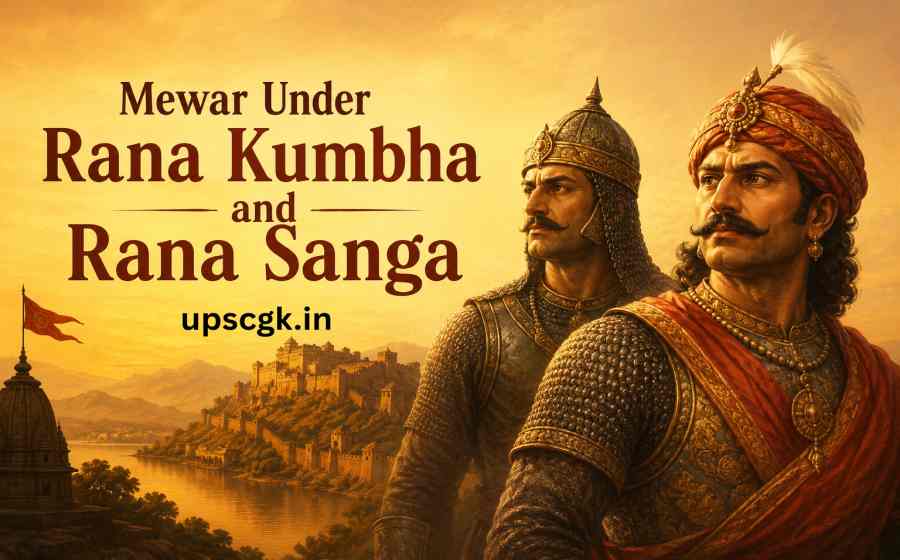
Explore Mewar under Rana Kumbha and Rana Sanga, their military achievements, cultural contributions and role in establishing Rajput supremacy in medieval India.
Mewar Under Rana Kumbha and Rana Sanga
The kingdom of Mewar emerged as one of the strongest and most respected Rajput states during medieval India. Situated in present-day Rajasthan, Mewar became a symbol of courage, independence, and resistance against foreign invasions. Two of its greatest rulers, Rana Kumbha (1433–1468 CE) and Rana Sanga (1508–1528 CE), transformed Mewar into a dominant political and military power in North India. Their reigns marked the golden age of the Sisodia dynasty and significantly influenced the political history of medieval India. While Rana Kumbha strengthened Mewar through military victories, architecture, and cultural development, Rana Sanga united several Rajput kingdoms and challenged the expansion of the Delhi Sultanate and the Mughals. Their leadership laid the foundation for Rajput pride and left a lasting legacy in Indian history.
Table of Contents
Mewar Before Rana Kumbha
The Sisodia dynasty had already established Mewar as an independent Rajput kingdom under rulers like Rana Hammir. Despite repeated invasions by the Delhi Sultanate, Mewar maintained its autonomy and gradually expanded its influence across Rajasthan.
By the time Rana Kumbha ascended the throne in 1433 CE, Mewar faced threats from neighboring Rajput states, the Malwa Sultanate, and the Gujarat Sultanate. Through capable leadership, he not only secured his kingdom but also expanded its territorial reach.
Rana Kumbha (1433-1468 CE): The Architect of Mewar’s Glory
Rana Kumbha is regarded as one of the greatest rulers of medieval Rajasthan. His reign witnessed political stability, military success, and remarkable cultural achievements.
Military Achievements
Rana Kumbha successfully defended Mewar against repeated invasions from neighboring Muslim kingdoms.
His major military accomplishments include:
- Defeated Sultan Mahmud Khalji of Malwa in several battles.
- Successfully resisted attacks from the Gujarat Sultanate.
- Expanded Mewar’s influence over parts of Rajasthan and central India.
- Strengthened border forts to protect the kingdom.
One of his greatest victories came against Mahmud Khalji at the Battle of Sarangpur. This victory established Mewar as the strongest Rajput kingdom of its time.
Construction of Vijay Stambha
To commemorate his victory over Mahmud Khalji, Rana Kumbha built the magnificent Vijay Stambha (Tower of Victory) at Chittorgarh.
The nine-storeyed tower remains one of India’s finest examples of Rajput architecture. Intricate carvings depicting Hindu gods, royal genealogies, and historical inscriptions make it an architectural masterpiece.
Today, Vijay Stambha stands as a symbol of Rajput bravery and cultural heritage.
Builder of Forts
Rana Kumbha is credited with constructing or renovating nearly 32 forts out of the 84 forts traditionally associated with Mewar.
Among the most important were:
- Kumbhalgarh Fort
- Achalgarh Fort
- Renovation of Chittorgarh Fort
Kumbhalgarh Fort possesses one of the world’s longest continuous defensive walls after the Great Wall of China and served as an important military stronghold.
Patron of Art and Literature
Apart from being a warrior, Rana Kumbha was also a scholar and patron of learning.
His contributions include:
- Encouraging Sanskrit and regional literature.
- Patronizing poets, scholars, and musicians.
- Writing scholarly works on music, including Sangeet Raj.
- Supporting temple construction and preservation.
His reign is often described as the cultural renaissance of medieval Mewar.
Administration Under Rana Kumbha
Rana Kumbha maintained a well-organized administration.
Important features included:
- Efficient revenue collection.
- Strong fort administration.
- Appointment of capable military commanders.
- Promotion of agriculture and trade.
- Protection of temples and religious institutions.
His balanced governance ensured prosperity while maintaining military preparedness.
Rana Sanga (1508-1528 CE): The Greatest Rajput Warrior
After Rana Kumbha’s death, internal conflicts weakened Mewar temporarily. Stability returned under Rana Sangram Singh, popularly known as Rana Sanga.
He is remembered as one of the most courageous Rajput rulers in Indian history.
Expansion of Rajput Influence
Rana Sanga united many Rajput chiefs under his leadership, creating one of the largest Rajput confederacies in medieval India.
His influence extended over:
- Rajasthan
- Parts of Gujarat
- Malwa
- Eastern Rajasthan
- Northern Madhya Pradesh
His growing power made him the leading Hindu ruler of North India during the early sixteenth century.
Victories Against the Delhi Sultanate
Rana Sanga defeated the Lodi rulers on multiple occasions.
His notable victories include battles against:
- Ibrahim Lodi
- Mahmud Khalji II of Malwa
He also intervened successfully in the politics of Malwa, increasing Mewar’s prestige across North India.
These victories convinced many Rajput rulers to accept his leadership.
Formation of the Rajput Confederacy
One of Rana Sanga’s greatest achievements was bringing together numerous Rajput kingdoms.
The confederacy included rulers from:
- Marwar
- Amber
- Gwalior
- Ajmer
- Harauti
This alliance aimed to counter the growing influence of Afghan and Central Asian rulers in northern India.
Battle of Khanwa (1527 CE)
The most significant event of Rana Sanga’s reign was the Battle of Khanwa, fought in 1527 between Rana Sanga and the Mughal emperor Babur.
Causes
After defeating Ibrahim Lodi in the First Battle of Panipat (1526), Babur sought to establish permanent Mughal rule in India.
Rana Sanga viewed Babur as another foreign invader and decided to challenge Mughal expansion.
Course of the Battle
The Rajput confederacy assembled a massive army to confront Babur near Khanwa in present-day Rajasthan.
Despite the bravery of Rajput soldiers, Babur employed:
- Field artillery
- Matchlock firearms
- Defensive wagon formations (Tulughma and Araba tactics)
These modern military techniques gave the Mughal army a decisive advantage.
Outcome
Rana Sanga suffered defeat and was seriously wounded.
The Battle of Khanwa became a turning point because:
- Mughal authority in North India became firmly established.
- Rajput political unity weakened.
- Babur consolidated his empire.
- Mewar remained independent but lost its dominant position.
Although defeated, Rana Sanga’s courage earned him immense respect among both contemporaries and later historians.
Character and Leadership of Rana Sanga
Historical accounts describe Rana Sanga as a fearless warrior.
According to tradition:
- He bore numerous battle scars.
- Lost one eye during combat.
- Lost an arm and suffered severe injuries in several battles.
- Continued leading armies despite physical disabilities.
These stories made him a legendary figure in Rajput folklore.
Legacy of Rana Kumbha and Rana Sanga
The combined contributions of Rana Kumbha and Rana Sanga elevated Mewar to unprecedented heights.
Their legacy includes:
- Strengthening Rajput identity.
- Preserving Hindu cultural traditions.
- Building magnificent forts and monuments.
- Promoting literature, music, and architecture.
- Inspiring later rulers like Maharana Pratap to continue resisting foreign domination.
The military traditions established during their reigns continued to shape Rajput resistance in subsequent centuries.
Historical Significance
The reigns of Rana Kumbha and Rana Sanga represent the peak of Rajput political and military power before the consolidation of the Mughal Empire.
Rana Kumbha demonstrated that a well-administered kingdom could successfully defend itself while fostering cultural excellence. Rana Sanga, through his efforts to unite the Rajputs, came closest to establishing a powerful indigenous political force capable of challenging foreign rulers in North India.
Their achievements remain central to the study of medieval Indian history and continue to symbolize bravery, leadership, and cultural pride. Even today, the forts, monuments, and traditions associated with Mewar stand as enduring reminders of the remarkable contributions of Rana Kumbha and Rana Sanga to India’s rich historical heritage.
Summary
Mewar reached the height of its political, military, and cultural influence under the leadership of Rana Kumbha and Rana Sanga. Rana Kumbha strengthened the kingdom through decisive military victories, efficient administration, and remarkable contributions to architecture, literature, and music, including the construction of the iconic Vijay Stambha and Kumbhalgarh Fort. Rana Sanga further enhanced Mewar’s prestige by uniting the Rajput states into a powerful confederacy and challenging both the Delhi Sultanate and the early Mughal Empire. Although defeated by Babur at the Battle of Khanwa in 1527, his courage and determination became legendary. Together, these rulers transformed Mewar into the foremost Rajput power of medieval India and left a lasting legacy of valor, cultural excellence, and resistance that inspired future generations, including Maharana Pratap.
Also Check: History