Explore Firoz Shah Tughlaq’s administration and public works, including irrigation, taxation and architectural achievements that shaped medieval India.
Firoz Shah Tughlaq
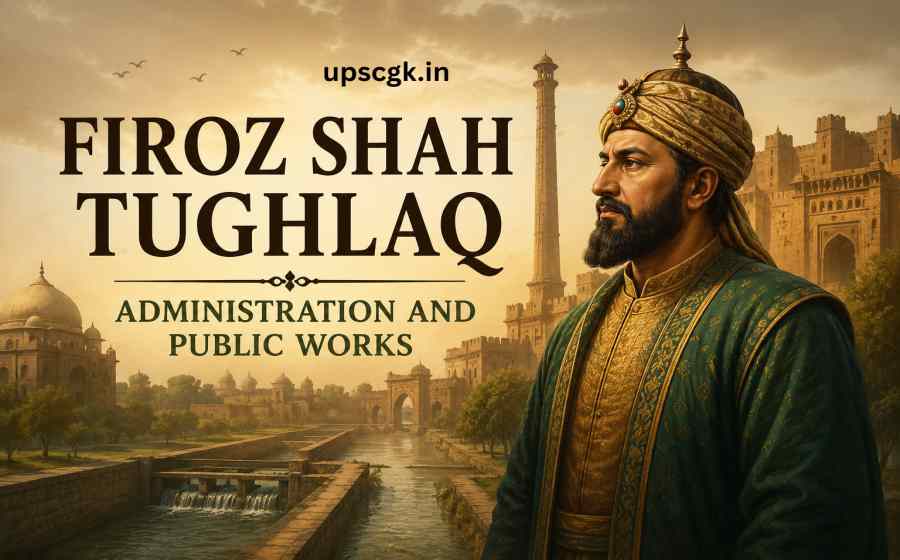
Firoz Shah Tughlaq (reigned 1351–1388 CE) was one of the most prominent rulers of the Tughlaq Dynasty of the Delhi Sultanate. He succeeded his cousin, Muhammad Bin Tughlaq, at a time when the empire was politically unstable and financially weakened due to previous administrative failures. Unlike his predecessor, who was known for ambitious but unsuccessful experiments, Firoz Shah adopted a more practical and welfare-oriented approach. His reign is remembered for administrative reforms, public welfare measures, irrigation projects, and architectural achievements.
Although he was not a great military conqueror, Firoz Shah Tughlaq focused on strengthening governance, improving agriculture, reducing the burden on the people, and constructing public infrastructure. His policies contributed to temporary stability and prosperity, making his reign one of the most peaceful periods of the Delhi Sultanate.
Table of Contents
Administrative Reforms
Firoz Shah Tughlaq introduced several administrative reforms aimed at restoring public confidence and ensuring efficient governance.
1. Welfare-Oriented Administration
Unlike Muhammad Bin Tughlaq, Firoz Shah prioritized the welfare of his subjects. He believed that a ruler’s success depended on the happiness and prosperity of the people. Consequently, he reduced harsh punishments, promoted justice, and encouraged agricultural development.
He regularly consulted nobles, religious scholars, and administrators before making important decisions. This collaborative style of governance helped maintain political stability during most of his reign.
Taxation Policy
One of the major achievements of Firoz Shah was the simplification of the taxation system.
Reduction of Taxes
He abolished several taxes that were considered unjust or not sanctioned under Islamic law. He retained only the major taxes recognized by Islamic principles, such as:
- Kharaj (Land Revenue) – Tax on agricultural land.
- Jizya – Tax imposed on non-Muslims.
- Zakat – Religious tax on Muslims.
- Khums – One-fifth share of war booty reserved for the state.
The reduction of unnecessary taxes provided relief to farmers and traders, encouraging agricultural production and commercial activities.
Promotion of Agriculture
Agriculture formed the backbone of the Delhi Sultanate’s economy, and Firoz Shah took several steps to improve it.
Expansion of Cultivable Land
Large areas of barren land were brought under cultivation through irrigation facilities and financial assistance to farmers.
Loans to Farmers
The state provided financial aid to cultivators affected by floods, droughts, or crop failures. These measures helped increase agricultural productivity and improved rural livelihoods.
Development of Irrigation
One of the greatest achievements of Firoz Shah Tughlaq was the construction of an extensive irrigation network.
Construction of Canals
He ordered the construction of several important canals, including:
- A canal from the Yamuna River to Hansi.
- A canal connecting the Sutlej River to the Ghaggar region.
- Additional canals supplying water to agricultural lands in Haryana and nearby areas.
These irrigation projects significantly increased agricultural output and reduced dependence on monsoon rains.
Wells and Reservoirs
Apart from canals, numerous wells, tanks, and reservoirs were constructed to ensure a reliable water supply for farming and daily use.
Public Welfare Measures
Firoz Shah introduced several schemes aimed at improving the lives of ordinary people.
Diwan-i-Khairat
He established the Diwan-i-Khairat, a charitable department responsible for assisting widows, orphans, poor families, and unemployed individuals. Financial assistance was also provided for the marriage of poor Muslim women.
Hospitals
State-funded hospitals offered free medical treatment and medicines to the needy. Qualified physicians were appointed to provide healthcare services.
Support for Education
Firoz Shah encouraged education by establishing schools and madrasas. Teachers and scholars received state patronage, and libraries were developed to preserve knowledge.
Employment and Social Welfare
To reduce unemployment, the government created opportunities in construction, irrigation projects, administration, and public institutions. Skilled artisans and craftsmen also received encouragement through royal patronage.
Judicial Administration
Firoz Shah emphasized justice based on Islamic law.
Application of Sharia
The judicial system followed Islamic legal principles more strictly than during previous reigns. Religious scholars and judges played an important role in administering justice.
Reduction in Harsh Punishments
Compared to earlier rulers, he reduced the use of cruel punishments and attempted to make the legal system more humane.
Military Administration
Although military expansion was limited, Firoz Shah reorganized the army.
Hereditary Military Service
He allowed military positions to become hereditary, enabling soldiers’ sons to inherit their fathers’ posts. While this policy ensured loyalty in the short term, it gradually weakened military efficiency because appointments were based on inheritance rather than merit.
Public Works and Architecture
Firoz Shah Tughlaq’s reign is especially remembered for large-scale public works and construction activities.
Construction of New Cities
He founded several cities, including:
- Firozabad (near present-day Delhi)
- Hisar-i-Firoza (Hisar)
- Fatehabad
- Jaunpur (developed during his reign)
These cities became important administrative and commercial centers.
Buildings and Monuments
Numerous public buildings were constructed, including:
- Mosques
- Palaces
- Caravanserais (rest houses)
- Bridges
- Gardens
- Hunting lodges
His architectural projects reflected simplicity, functionality, and durability.
Firoz Shah Kotla
One of his most famous constructions is Firoz Shah Kotla, a fortified palace complex in Delhi. It served as an important administrative center and remains a significant historical monument today.
Preservation of Ancient Heritage
An unusual feature of Firoz Shah’s reign was his interest in preserving ancient monuments.
He transported and re-erected two Ashokan pillars, one from Topra (Haryana) and another from Meerut, placing them in Delhi. Although the inscriptions could not be deciphered at that time, his efforts helped preserve these valuable historical artifacts.
Economic Development
The combination of irrigation, lower taxes, public construction, and agricultural support led to increased production and improved state revenues.
Trade also benefited from better roads, bridges, and market infrastructure, allowing merchants to transport goods more efficiently across the Sultanate.
Limitations of His Administration
Despite many achievements, Firoz Shah’s administration had several weaknesses.
- Excessive dependence on hereditary appointments reduced administrative efficiency.
- Greater influence of nobles weakened the authority of the central government.
- Strong emphasis on orthodox Islamic policies created dissatisfaction among some sections of the population.
- Military strength declined due to the absence of regular reforms and reduced emphasis on merit.
These weaknesses became more evident after his death, contributing to the gradual decline of the Tughlaq Dynasty.
Historical Significance
Historians generally regard Firoz Shah Tughlaq as one of the most welfare-oriented rulers of the Delhi Sultanate. His focus on public works, irrigation, agriculture, education, and charitable institutions distinguished his reign from many of his predecessors. Although his policies could not prevent the eventual decline of the Tughlaq Empire, they brought stability and prosperity during his lifetime.
His canals, cities, monuments, and administrative measures demonstrate a ruler who prioritized development over conquest. Even today, structures like Firoz Shah Kotla and the Ashokan pillars stand as reminders of his contributions to India’s medieval history.
Summary
Firoz Shah Tughlaq’s reign marked a significant phase in the history of the Delhi Sultanate. Through administrative reforms, tax relief, irrigation projects, charitable institutions, and impressive public works, he sought to improve the lives of his subjects and strengthen the state. While certain policies, such as hereditary appointments, weakened the empire in the long run, his achievements in governance and infrastructure remain noteworthy. His legacy continues to be remembered for promoting public welfare, agricultural development, and architectural excellence in medieval India.
Also Check: History