
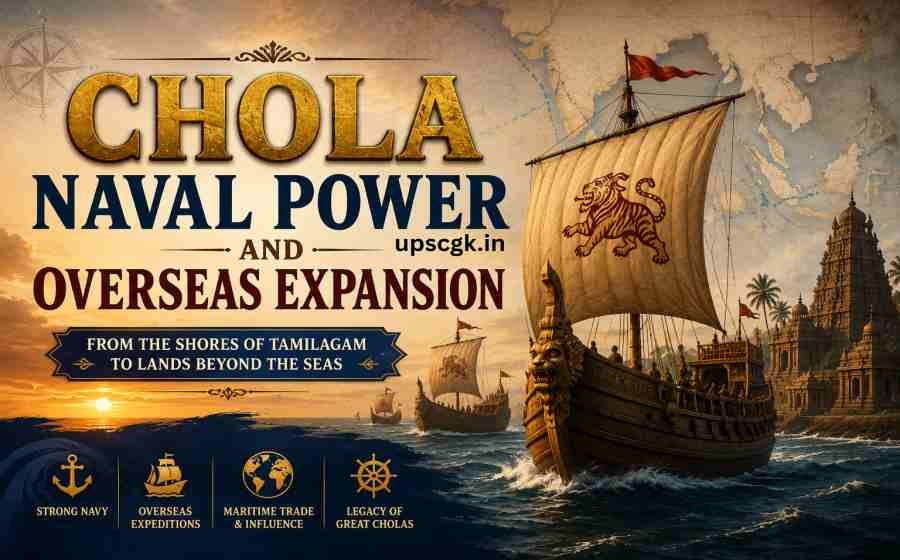
Discover the rise of Chola naval power and overseas expansion. Learn how the Chola Empire dominated Indian Ocean trade and its influence across Southeast Asia.
Chola Naval Power and Overseas Expansion
The Chola Empire, one of the most powerful dynasties in South Indian history, reached the height of its glory between the 9th and 13th centuries CE. While the Cholas are widely celebrated for their efficient administration, magnificent temples, and cultural achievements, their remarkable naval strength remains one of the defining features of their rule. Unlike many contemporary Indian kingdoms that focused mainly on land warfare, the Cholas recognized the strategic and economic importance of controlling the seas.
The Chola navy was not merely a defensive force but a powerful instrument of expansion, trade, and diplomacy. Through their naval expeditions, they established dominance over vital maritime routes, expanded their influence into Southeast Asia, and transformed the Bay of Bengal into what historians often describe as a “Chola Lake.” Their maritime achievements stand as one of the earliest examples of India’s overseas military and commercial power.
Table of Contents
Rise of the Chola Navy
The emergence of the Chola navy was closely linked to the geographical location of the kingdom. The fertile Kaveri Delta provided access to the eastern coast, while major ports connected the empire to international trade networks. As commerce flourished, the need to protect merchant ships and secure maritime trade became increasingly important.
Under rulers such as Rajaraja I (985–1014 CE) and Rajendra I (1014–1044 CE), the Cholas invested heavily in developing a formidable naval force. Ships were built using high-quality timber and were capable of transporting soldiers, horses, supplies, and commercial goods over long distances.
The Chola rulers understood that maritime supremacy would not only enhance their military capabilities but also increase economic prosperity by ensuring uninterrupted trade.
Organization of the Chola Navy
Although limited records survive regarding the exact structure of the Chola navy, inscriptions and historical accounts indicate that it was a well-organized military institution.
The navy likely consisted of:
- Large warships capable of carrying troops.
- Fast-moving vessels for patrol and reconnaissance.
- Transport ships for military expeditions.
- Merchant vessels protected by naval escorts.
Ports such as Nagapattinam, Kaveripattinam (Puhar), and Arikamedu served as important naval bases and commercial centers. Skilled sailors, shipbuilders, navigators, and military officers played significant roles in maintaining naval efficiency.
The Cholas also developed expertise in navigation by using monsoon winds, ocean currents, and astronomical observations, allowing them to undertake long-distance voyages successfully.
Importance of Maritime Trade
The prosperity of the Chola Empire depended heavily on overseas commerce. Indian merchants traded extensively with Sri Lanka, the Maldives, China, Southeast Asia, and the Arab world.
Major exports included:
- Cotton textiles
- Silk fabrics
- Spices
- Precious stones
- Ivory
- Metal products
- Fine handicrafts
Imports included:
- Horses from Arabia
- Luxury goods
- Camphor
- Gold
- Aromatic woods
- Chinese ceramics
Merchant guilds such as the Ayyavole 500 (Ainnurruvar), Manigramam, and Nanadesi played an essential role in expanding Indian trade abroad. The Chola navy protected these merchants from piracy and ensured safe passage through important sea routes.
Rajaraja I and the Expansion of Naval Power
Rajaraja I laid the foundation of Chola maritime supremacy. After consolidating his authority over South India, he turned his attention toward neighboring islands and coastal regions.
One of his most significant achievements was the conquest of northern Sri Lanka around 993 CE. Control over Sri Lanka provided strategic ports and strengthened Chola influence over Indian Ocean trade.
He also captured the Maldives, thereby securing important maritime routes used by Indian and foreign merchants. These victories demonstrated the effectiveness of the Chola navy and established the empire as a dominant regional power.
Rajendra I’s Overseas Expedition
The greatest demonstration of Chola naval strength came during the reign of Rajendra I.
Around 1025 CE, Rajendra launched a massive naval expedition against the Srivijaya Empire, which controlled important trading centers in present-day Indonesia, Malaysia, and parts of Thailand. The campaign targeted strategic ports including Kadaram (modern Kedah in Malaysia), Sumatra, and several other coastal settlements.
The reasons for the expedition included:
- Protecting Indian merchant interests.
- Securing maritime trade routes.
- Challenging Srivijaya’s dominance over the Strait of Malacca.
- Expanding Chola political influence.
The campaign was highly successful. Although the Cholas did not permanently annex these territories, they weakened Srivijaya’s control and strengthened India’s commercial influence throughout Southeast Asia. This remains one of the most remarkable overseas military expeditions undertaken by any medieval Indian kingdom.
Chola Influence in Southeast Asia
The Chola impact on Southeast Asia extended beyond military victories. Cultural exchanges flourished through trade, diplomacy, and migration.
Indian influence became visible in several ways:
- Spread of Hinduism and Buddhism.
- Construction of temples inspired by South Indian architecture.
- Adoption of Sanskrit inscriptions.
- Growth of Tamil merchant settlements.
- Exchange of artistic styles and administrative practices.
Countries such as Indonesia, Malaysia, Thailand, Cambodia, and Myanmar witnessed significant Indian cultural influence during this period. The Cholas contributed to strengthening these long-standing connections through peaceful trade as well as strategic military intervention.
Economic Benefits of Naval Expansion
The Chola navy significantly boosted the empire’s economy.
Control over maritime routes allowed the Cholas to:
- Collect customs duties from ports.
- Encourage international trade.
- Protect merchant guilds.
- Increase royal revenues.
- Develop prosperous port cities.
Nagapattinam emerged as a thriving international port, welcoming traders from China, Southeast Asia, Sri Lanka, and the Arab world. The wealth generated through maritime trade financed temple construction, irrigation projects, public works, and military expansion.
Naval Power as a Tool of Diplomacy
The Cholas effectively combined military strength with diplomacy. Friendly relations with foreign kingdoms encouraged trade while showcasing the empire’s prestige.
The Chinese Song Dynasty maintained diplomatic contacts with the Cholas, and several embassies were exchanged. Chinese records describe South India as an important commercial partner, highlighting the global reputation of the Chola Empire. The presence of Tamil merchant communities across Southeast Asia further strengthened diplomatic and economic ties.
Decline of Chola Maritime Dominance
After the reign of Rajendra I, the Chola Empire gradually faced challenges from rival powers such as the Pandyas, Hoysalas, and emerging regional kingdoms. Internal conflicts and shifting trade patterns also weakened their naval supremacy.
As the empire declined during the 13th century, its influence over overseas trade diminished. However, the legacy of Chola maritime achievements continued to inspire later generations and remains an important chapter in India’s naval history.
Legacy of Chola Naval Power
The Chola navy represents one of the finest examples of maritime organization in medieval Asia. Their ability to project military power across the Indian Ocean was unmatched by most contemporary Indian kingdoms.
The Cholas demonstrated that naval strength could serve multiple purposes, protecting commerce, expanding political influence, promoting cultural exchange, and strengthening diplomacy. Their overseas expeditions connected India with Southeast Asia and reinforced the country’s position in global trade networks.
Today, historians regard the Chola naval expeditions as evidence of India’s long maritime tradition. Their achievements highlight the importance of naval power in shaping economic prosperity, international relations, and cultural exchange during the medieval period.
Summary
The Chola Empire’s naval power was the foundation of its overseas expansion and international prestige. Through visionary rulers like Rajaraja I and Rajendra I, the Cholas transformed the Bay of Bengal into a thriving center of trade, diplomacy, and military activity. Their successful expeditions to Sri Lanka, the Maldives, and Southeast Asia showcased exceptional naval planning and strategic foresight.
Beyond military victories, the Cholas fostered commercial growth and cultural interaction across the Indian Ocean world. Their maritime legacy remains one of the greatest achievements of ancient and medieval India, demonstrating how a powerful navy can shape the destiny of an empire and leave a lasting impact on world history.
Also Check: History