Discover the history of Harsha and the Pushyabhuti Dynasty, Harshavardhana’s rise, administration, cultural achievements and lasting legacy in Indian history.
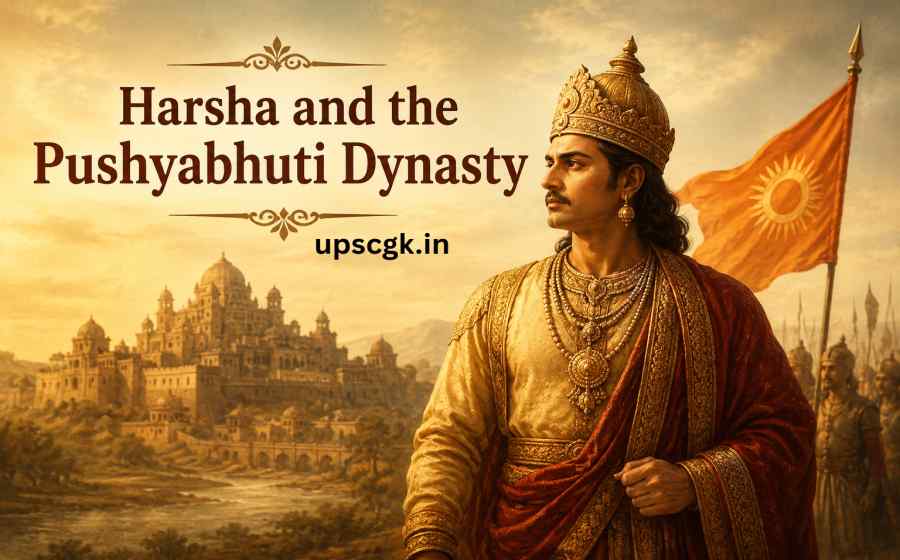
Harsha and the Pushyabhuti Dynasty
The Pushyabhuti Dynasty, also known as the Vardhana Dynasty, played a significant role in shaping early medieval Indian history. Its most celebrated ruler, Harshavardhana (Harsha), unified much of northern India after the decline of the Gupta Empire and established a prosperous kingdom known for efficient administration, religious tolerance, and remarkable contributions to literature and culture. His reign, from 606 CE to 647 CE, is often regarded as one of the brightest periods in post-Gupta India.
Harsha’s rule marked a revival of political stability in northern India after years of regional conflicts. Although his empire did not cover the entire Indian subcontinent, his influence extended across vast territories, making him one of the greatest monarchs of ancient India.
Table of Contents
Origin of the Pushyabhuti Dynasty
The Pushyabhuti Dynasty originated in Thanesar (modern Haryana) during the late sixth century CE. The dynasty emerged as a regional power following the decline of the Gupta Empire, when several kingdoms competed for dominance in northern India.
The founder of the dynasty is believed to have been Pushyabhuti, though historical records about him remain limited. The dynasty gradually expanded under successive rulers, particularly Prabhakaravardhana, Harsha’s father, who strengthened the kingdom and defended it against foreign invasions, including attacks from the Hunas.
Thanesar served as the early capital before Harsha later shifted the political center to Kannauj, which became one of the most prominent cities in northern India.
Rise of Harshavardhana
Harsha ascended the throne in 606 CE under tragic circumstances. His elder brother, Rajyavardhana, was killed while attempting to avenge the death of their brother-in-law, the ruler of Kannauj. At just sixteen years of age, Harsha inherited the throne during a period of political instability.
His first objective was to rescue his sister Rajyashri, who had been imprisoned after the defeat of her husband. Harsha successfully rescued her and strengthened his authority by assuming control over Kannauj.
Through military campaigns and diplomatic alliances, Harsha gradually united much of northern India under his rule. His empire extended from Punjab in the northwest to Bengal in the east, while the Narmada River marked the southern boundary of his kingdom.
Expansion of the Empire
Harsha spent much of his early reign consolidating power and expanding his territories. Several regional rulers accepted his supremacy either through conquest or alliances.
However, Harsha’s ambitions to expand into southern India faced a significant setback. He was defeated by the powerful Chalukya king Pulakeshin II near the Narmada River. This victory prevented Harsha from extending his empire into the Deccan region.
Despite this defeat, Harsha remained the dominant ruler of northern India and maintained peace and stability throughout most of his reign.
Administration Under Harsha
Harsha established an efficient administrative system that combined centralized authority with local governance.
Central Administration
The king remained the supreme authority in matters of governance, justice, military affairs, and foreign policy. Ministers assisted him in administration, while provincial governors supervised different regions.
Provincial Administration
The empire was divided into provinces, districts, and villages. Local officials collected taxes, maintained law and order, and managed public works.
Revenue System
Agriculture formed the backbone of the economy. Land revenue constituted the principal source of state income, while additional revenues came from trade, customs duties, and fines. Harsha is known to have maintained moderate taxation, allowing agriculture and commerce to flourish.
Military Organization
Harsha possessed a powerful army comprising infantry, cavalry, war elephants, and chariots. His military strength helped preserve internal stability and deter external threats.
Society and Economy
During Harsha’s reign, agriculture remained the primary occupation of the people. Farmers cultivated crops such as rice, wheat, barley, sugarcane, and pulses.
Trade flourished due to improved political stability. Major trade routes connected northern India with Central Asia and Southeast Asia. Markets prospered, and merchants played an important role in economic development. Urban centers like Kannauj, Prayaga, and Thanesar became important commercial and cultural hubs.
Religious Policy
Harsha is remembered for his remarkable policy of religious tolerance. Although he initially followed Shaivism, he later became a devoted supporter of Mahayana Buddhism under the influence of Buddhist scholars.
Despite his personal beliefs, Harsha generously supported Hinduism, Buddhism, and Jainism alike. He constructed monasteries, temples, and educational institutions while donating wealth to religious organizations.
Every five years, Harsha organized a grand religious assembly at Prayaga, where he distributed enormous quantities of wealth among monks, scholars, and the poor. These assemblies reflected both his generosity and commitment to social welfare.
Patronage of Education and Literature
Harsha’s reign witnessed a remarkable revival of learning and literature. The famous Chinese Buddhist traveler Xuanzang (Hiuen Tsang) visited India during Harsha’s reign and stayed at his court. His detailed travel accounts provide valuable information about India’s political administration, society, education, and religion during the seventh century.
Harsha himself was an accomplished scholar and playwright. He authored three celebrated Sanskrit plays:
- Ratnavali
- Priyadarshika
- Nagananda
These works highlight his literary talent and demonstrate the flourishing of Sanskrit literature during his reign.
Harsha also patronized renowned scholars such as Banabhatta, who wrote the famous biographies Harshacharita and Kadambari. These literary works remain important historical sources for understanding early medieval India.
Art and Culture
The Pushyabhuti period encouraged the growth of art, architecture, and education. Buddhist monasteries and Hindu temples received royal patronage. Centers of learning, especially Nalanda University, flourished under Harsha’s support and attracted students from different parts of Asia.
Music, painting, sculpture, and classical Sanskrit literature also developed significantly during his reign, reflecting a vibrant cultural environment.
Foreign Relations
Harsha maintained friendly diplomatic relations with neighboring kingdoms and foreign powers. His correspondence with the Tang Dynasty of China strengthened political and cultural ties between India and China. Diplomatic missions were exchanged, promoting trade, religious exchanges, and scholarly interaction. The visit of Xuanzang further enhanced India’s international reputation as a center of learning and spirituality.
Decline of the Pushyabhuti Dynasty
Harsha died in 647 CE without leaving a direct heir. His death led to political instability, and the vast empire gradually fragmented into several independent kingdoms.
Unlike the Mauryas or Guptas, the Pushyabhuti Dynasty lacked strong successors capable of maintaining centralized control. As regional powers asserted independence, the dynasty eventually disappeared from the political landscape.
The decline of Harsha’s empire marked the beginning of a new phase in Indian history characterized by the rise of numerous regional kingdoms.
Legacy of Harsha
Harshavardhana remains one of India’s most respected rulers due to his balanced administration, military leadership, cultural patronage, and religious tolerance. His reign restored stability after the Gupta period and promoted education, literature, diplomacy, and economic prosperity.
Historical works such as Harshacharita by Banabhatta and the travel accounts of Xuanzang continue to provide valuable insights into his administration and society.
Although his empire did not survive long after his death, Harsha’s contributions left a lasting impact on Indian civilization. His reign represents an important bridge between ancient and early medieval India, demonstrating how effective leadership, cultural patronage, and religious harmony can strengthen a nation.
Summary
The Pushyabhuti Dynasty reached its peak under Harshavardhana, whose visionary leadership transformed northern India into a politically stable and culturally vibrant empire. Through efficient governance, support for education, promotion of literature, and respect for diverse religions, Harsha earned a distinguished place among India’s greatest rulers. His achievements continue to be studied as a significant chapter in Indian history, reflecting an era of unity, prosperity, and intellectual excellence.
Also Check: History