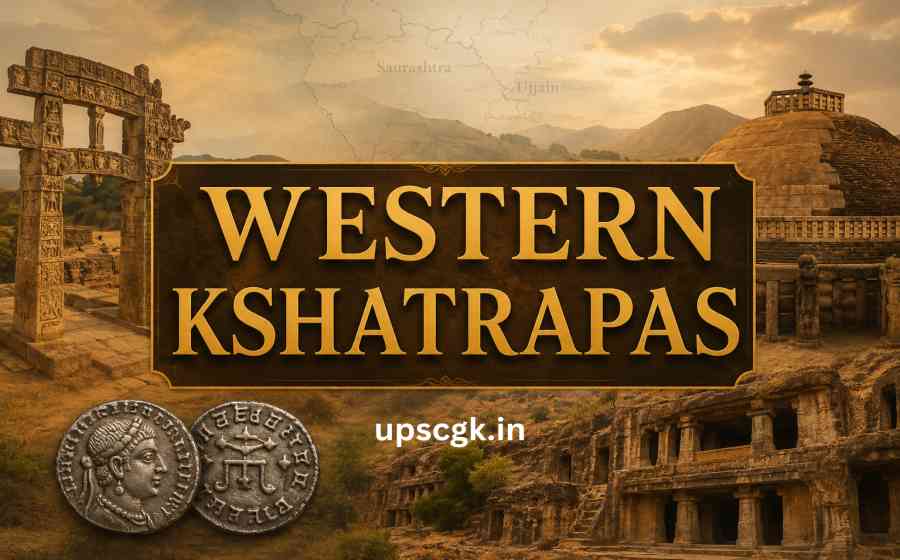
Discover the political achievements, administration, economy, art and cultural contributions of the Western Kshatrapas in ancient India.
Western Kshatrapas
The Western Kshatrapas, also known as the Western Satraps, were one of the most influential ruling dynasties in western India during the early centuries of the Common Era. Originating from the Saka (Scythian) tribes of Central Asia, they established their authority over regions such as Gujarat, Malwa, Kathiawar, Rajasthan, and parts of Maharashtra. Their rule lasted from approximately 35 CE to 405 CE, making them one of the longest-lasting foreign-origin dynasties in ancient India.
Although they initially entered India as foreign conquerors, the Western Kshatrapas gradually adopted Indian traditions, supported trade, patronized religion, and contributed significantly to the political, economic, and cultural development of western India. Their interactions with the Satavahanas and later the Gupta Empire played an important role in shaping the history of ancient India.
Table of Contents
Origin of the Western Kshatrapas
The Western Kshatrapas belonged to the Saka people, who migrated into northwestern India following the movements of Central Asian tribes. Initially serving under larger Saka rulers, they later established an independent kingdom in western India.
The dynasty is generally divided into two important families:
- Kshaharata Dynasty
- Kardamaka Dynasty
The earliest notable ruler was Nahapana of the Kshaharata line, while the Kardamaka dynasty reached its greatest glory under Rudradaman I.
Political Expansion and Administration
The Western Kshatrapas developed a well-organized administrative system inspired by both Persian satrapal traditions and Indian governance.
Provincial Administration
The term “Kshatrapa” means governor or satrap. Important provinces were administered by local governors who collected revenue, maintained law and order, and supervised military activities.
Many rulers also assumed the higher title “Mahakshatrapa”, indicating supreme authority over subordinate governors.
Military Strength
Their military enabled them to:
- Defend trade routes.
- Expand territory into western and central India.
- Resist invasions by neighbouring kingdoms.
- Wage prolonged wars with the Satavahanas.
Strategic forts and well-equipped cavalry units strengthened their rule.
Major Rulers of the Western Kshatrapas
Nahapana (c. 119–124 CE)
Nahapana greatly expanded the kingdom across western India. His reign is known from numerous inscriptions and coins discovered in Maharashtra and Gujarat.
He controlled important trade centres and ports, increasing the dynasty’s wealth through commerce with the Roman Empire.
However, he was eventually defeated by the Satavahana ruler Gautamiputra Satakarni, who temporarily recovered many lost territories.
Rudradaman I (c. 130–150 CE)
Rudradaman I was undoubtedly the greatest ruler of the Western Kshatrapas.
His achievements include:
- Restoration of lost territories.
- Successful campaigns against neighbouring kingdoms.
- Strengthening administration.
- Promotion of literature and Sanskrit.
- Public welfare projects.
His reign marked the political and cultural peak of the dynasty.
Junagadh Inscription: A Landmark Achievement
One of the most remarkable contributions of the Western Kshatrapas is the Junagadh Rock Inscription of Rudradaman I.
Its historical significance includes:
- First extensive inscription written in classical Sanskrit rather than Prakrit.
- Records the repair of the famous Sudarshana Lake.
- Demonstrates concern for irrigation and public welfare.
- Provides valuable information on administration and military campaigns.
The inscription marks an important turning point in the rise of Sanskrit as the preferred language of royal inscriptions.
Economic Contributions
The prosperity of the Western Kshatrapas rested largely on trade and agriculture.
Maritime Trade
Western India possessed several flourishing ports connected to international trade routes.
Trade flourished with:
- Roman Empire
- Egypt
- Arabia
- Persian Gulf regions
Exports included:
- Cotton textiles
- Spices
- Semi-precious stones
- Ivory
- Pearls
- Metal goods
Imports included:
- Gold coins
- Wine
- Glassware
- Luxury goods
This trade significantly enriched the kingdom.
Agricultural Development
Agriculture remained the backbone of the economy.
The rulers invested in:
- Irrigation tanks
- Reservoirs
- Canal maintenance
- Water conservation
The restoration of the Sudarshana Lake under Rudradaman greatly benefited farmers in Gujarat.
Coinage and Monetary System
The Western Kshatrapas issued one of the finest coinage systems in ancient India.
Their silver coins featured:
- Portraits of rulers.
- Greek-style artistic influence.
- Brahmi and Kharosthi legends.
- Symbols representing royal authority.
These coins served multiple purposes:
- Facilitated trade.
- Strengthened taxation.
- Helped historians reconstruct chronology.
- Reflected cultural interaction between Indian and foreign traditions.
Many later Indian rulers adopted similar coin designs.
Cultural Contributions
Although foreign in origin, the Western Kshatrapas became deeply Indianized over time.
Promotion of Sanskrit
Perhaps their greatest cultural contribution was encouraging the use of Sanskrit in royal administration.
Rudradaman’s Junagadh inscription established Sanskrit as an important language of governance.
Later dynasties, including the Guptas, widely adopted this practice.
Religious Tolerance
The Western Kshatrapas followed a policy of religious tolerance.
They extended patronage to:
- Brahmanism
- Buddhism
- Jainism
Religious institutions received donations, land grants, and financial support, helping these traditions flourish simultaneously.
Art and Architecture
Their period witnessed continued development of:
- Rock-cut caves
- Buddhist monasteries
- Temples
- Sculptural traditions
Several monuments in western India display artistic influences from both Indian and foreign traditions.
Trade prosperity also financed religious and public architecture.
Relations with the Satavahanas
The Western Kshatrapas frequently clashed with the Satavahana Empire over control of western India’s prosperous trade routes.
Major developments included:
- Nahapana’s territorial expansion.
- Defeat of Nahapana by Gautamiputra Satakarni.
- Recovery of territories under Rudradaman I.
- Continued rivalry lasting several generations.
These conflicts significantly influenced the political balance of peninsular India.
Decline of the Western Kshatrapas
After the reign of Rudradaman I, the dynasty gradually weakened.
Major reasons included:
- Internal succession disputes.
- Constant wars with neighbouring kingdoms.
- Declining trade revenues.
- Rise of powerful regional states.
Around 405 CE, the Gupta emperor Chandragupta II (Vikramaditya) defeated the last Western Kshatrapa ruler, ending nearly four centuries of Saka rule in western India.
Historical Importance
The Western Kshatrapas occupy a significant place in Indian history because they successfully blended foreign political traditions with Indian culture.
Their lasting contributions include:
- Establishment of stable governance in western India.
- Promotion of long-distance trade.
- Development of an efficient coinage system.
- Expansion of irrigation and public works.
- Introduction of Sanskrit in royal inscriptions.
- Patronage of multiple religions.
- Cultural integration between Central Asian and Indian traditions.
Their rule also acted as a bridge between the Satavahana and Gupta periods, ensuring continuity in administration, commerce, and cultural development.
Summary
The Western Kshatrapas were much more than foreign rulers who settled in India. Over nearly four centuries, they transformed into important patrons of Indian culture, trade, literature, and public welfare. Under rulers such as Nahapana and especially Rudradaman I, the dynasty reached remarkable political and cultural heights. Their achievements in administration, irrigation, coinage, Sanskrit literature, and international commerce left a lasting imprint on ancient Indian civilization. Even after their decline, many of their administrative practices, artistic traditions, and cultural innovations continued to influence subsequent Indian kingdoms, making the Western Kshatrapas an essential chapter in the history of ancient India.
Also Check: History